Thursday, January 16, 2020

Low Voltage


This is my entry in the Carole Lombard Blogathon hosted by Good Old Days of Classic Hollywood


Carole Lombard made her "talkie" debut in 1929.  Starring with William Boyd and character actor Billy Bevan she was part of a group of people stranded in a snowstorm in an abandoned church.


High Voltage (1929):


Somewhere in the Sierras a group of four passengers and their bus driver are attempting to navigate the roads during a blizzard.  On the bus are Hendrickson (Phillips Smalley) "the Banker", a young girl only credited as "The Kid" (Diane Ellis). Dan (Owen Moore) "The Detective" and his prisoner, Billie (Carol [minus the "e"] Lombard) "The Girl".  The driver, Gus (Billy Bevan) "The Driver" claims that the snow is nothing and he will get the group to Chicago.

Of course, Gus is an blowhard who thinks nothing can stop him from performing his duties.  (Neither rain nor snow...etc.)   But the snow has a different idea.  They get stranded and end up having to trek across the snow on foot.  Fortunately there is a nearby church (although how they knew which way to go is  mystery.  Its not evident that it is that nearby.)


The five get shelter inside the church, but discover they are not alone.  There is also a hobo, Bill (William Boyd).  Bill has some small stash of food so the six won't starve to death, but Bill takes charge of sorts.  At least as far as the rationing of supplies is concerned.  As Bill states, they may be there for 10 days.  It comes to light that Bill is on the run from the law himself, which causes some clashing between Bill and Dan.

Thus begins the rather odd stay in the church.  While Billie is initially standoffish with Bill, a mutual friendship occurs which actually blossoms into love. 


And at one point the two decide to make a break for it on he road leaving the others behind.  But the sighting of a rescue plane causes them to turn back.

There are certain aspects of this film that are distracting.  For one, there seems to be too many times when coherent dialogue is secondary to the actual need to have someone speaking.  I attribute this to the nascent novelty of talking pictures.  Every time Dan and Bill confront each other they have a  conversation it basically deteriorates into a kid's playground confrontation, with all the menace implied: "Oh yeah?"  "Yeah"  For instance, early in the picture, when Dan determines that Bill may be not all on the up-and-up:


Dan: I'd not be surprised if I haven't seen YOU some place before.

Bill: Well, maybe you have.  Who can tell.

Dan: Maybe one of these days I'll be taking YOU on to the pen.

Bill: Maybe you will.

Dan:  Maybe I will.

Bill:  Maybe

Dan:  Maybe


Truth be told, this little item is not much to really hold interest, unless you are a history buff who wants to see Boyd or Lombard in early talkie roles.  Billy Bevan is more of a treat than the two stars, if you ask me.  But far be it from me to turn you away from a potential hour of entertainment.  Just don't expect too much "voltage".  The love between Bill and Billie that develops is pretty tame.  And the confrontations aren't very exciting either.

A sad note:  This movie was the penultimate appearance of Diane Ellis ("The Kid").  She married her husband in October of 1930 and died on their honeymoon two months later in India.  

Quiggy

Friday, January 10, 2020

The Beyond Star Trek Blogathon Arrives.


The Beyond Star Trek Blogathon, a blogathon inspired by the efforts of various actors and actresses to break free from the tractor beam of the Star Trek Universe begins today.  Our illustrious bloggers have been tasked with covering some film or TV work done by people who have made a name for themselves in the Star Trek Universe, but decided not to limit themselves to that role.  Each of the actors and actresses following played significant roles in a Star Trek series or movie, but shined in other efforts as well.

Keep coming back over the weekend as these will be updated on a regular basis as new entries come  in.  You can also check out my co-host's website, Hamlette's Soliloquy.  Thanks Rachel for joining me on this treasure hunt.


The Roster:

 My first entry, Zombies of the Stratosphere, features Leonard Nimoy in an earlier alien role.


Hamlette's Soliloquy presents William Shatner in an episode of The Big Valley.


Caftan Woman looks at a few westerns featuring Deforest Kelly, Zane Grey Theater.


Angelman's Place gives us a creepy Leonard Nimoy in  Invasion of the Body Snatchers


Wide Screen World gets a little kinky with Eating Raoul (with Robert Beltran)


I Am Charles Baker Harris fondly remembers LeVar Burton and Reading Rainbow


Along the Brandywine delves into William Shatner's role in Little Women


Movies Meet Their Match  gives us yet another Shatner performance in Miss Congeniality


Coffee, Classics & Craziness discusses Leonard Nimoy on the TV show Mission: Impossible


Taking Up Room examines Patrick Stewart's turn as Xavier in X-Men


Diary of a Movie Maniac investigates Gene Roddenberry's film Pretty Maids All in a Row


More to come 


Quiggy

Thursday, January 9, 2020

Never Trust a Martian


This is my first entry in the Beyond Star Trek blogathon hosted by Hamlette's Soliloquy and Me


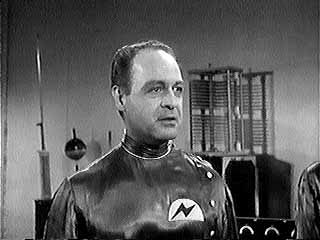
So is it kismet that one of Leonard Nimoy's first appearances on the screen was as an alien?  No, not as Spock.  15 years before that iconic role Nimoy played a Martian (zombie) in the 12 part serial Zombies of the Stratosphere.

Nimoy had a rocky start to his career before Star Trek.  He got the title role in Kid Monk Baroni, but that film failed at the box office, so Nimoy made a decision to just take whatever he could get, which usually resulted in his being an "also-ran" in the credits.  Of course, when Star Trek went into production he was in the title credits, albeit behind William Shatner, but before that you would have been hard pressed to notice his name in the credits.

In particular with Zombies, Nimoy's name only appears third in the list of the secondary characters, behind the 5 primary stars that appear in the first on screen credits.  And Nimoy (as Narab) is basically just a gofer in the film.  For most of the 12 part serial his sole line is usually just "Yes, sir" to the orders of Marex, the leader of the Martian entourage.  But even with that secondary status you can't miss Nimoy's face, and voice.


"Zombies" by the way, is a misnomer.  There are no real zombies, not ones you would think of anyway.  Even the 50's version of zombies.  In fact, you never even hear the Martians referred to as "zombies" until the final reel. But then, as we will see, the Martians are a sci-fi substitute for a much closer "alien" force which many in the West probably considered "zombies" in the 50's.


Zombies of the Stratosphere (1952):

As a group of government agents (Inter-Planetary Patrol) watch, an alien spaceship enters Earth's atmosphere.


Since they don't have any idea of it's intentions Larry Martin ( Judd Holdren) is dispatched to check it out.  Why Larry?  Because he has a spacesuit with rockets attached to his back.  (Note:  Although he is never called Commander Cody in this film, the outfit is almost an exact replica of the one used by that character in other films.  In fact, this was supposed to be a sequel to Radar Men from the Moon, but apparently some snafu involving a projected TV series starring Commander Cody caused the people in charge to have to change the name).


Before Larry can get to the ship though, Marex (Lane  Bradford) and his assistant Narab (Leonard Nimoy) have unloaded some supplies and take off with a couple of nefarious goons who met them at the landing site.  Marex and Narab go to a local (mad) scientist's lab/house where Dr.Harding (Stanley Waxman) is the go-to contact.


The Martians have a plan.  You see, the climate on Mars is pretty shabby.  So the Martians want to build an H-bomb which, when strategically planted, will blow the Earth out of it's orbit, thus allowing Mars to take its place in the Earth's orbit.  (And if you have trouble with the logic of that, you are probably in the wrong theater...)  They want Dr. Harding to help them in their construction of the H-bomb.

So why do they think Harding will be a willing participant?  Well, Harding has been selling state secrets to a competing power (Russia?) and the Martians threaten to reveal his shenanigans if he doesn't cooperate.  (See, even on Mars they understand the concept of "blackmail"...)

The Martians and their Earthling cohorts proceed to try various attempts at hijacking shipments of uranium.  One gets the idea that uranium wasn't all that much of a high priority item as these shipments didn't have hordes of armed forces personnel assigned to guard them.  (But then if they did, Larry Martin and his jet suit would have been pretty much an after thought, if not an unwanted presence. )

Over the course of the 12 part serial we get the typical "cliffhanger", scenes where Larry or one of his associates is trapped and apparently rides off to their death, only to have the next episode reveal some incredible luck to have them survive to fight anther day.


The only real question throughout the entire serial is why only two guys and one girl are involved in the desperate struggle to keep the Martians from fulfilling their nefarious plans.  Are we dependent only on one guy in a jet pack and a few pistols to save the Earth?  (And there is another question.  If the Martians are so advanced, why don't they have ray guns?  Even the Martians resort to primitive pistols.  And none of them are good shots.... I think only one person in the entire serial takes a bullet, but there must have been close to a hundred fired over the course of the serial.)

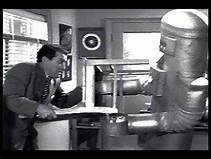
Probably the funniest part of the serial (though it probably wasn't INTENDED to be funny) is the appearance of a robot.  The robot has some laser powered arms, but on several occasions it just fights with its fists like the rest of the cast.


Although the villain in the film are Martians, this film could have easily subsituted Russians for the Martians and not suffered too much.  To be sure, the plot to switch the orbit of Mars with Earth might have had to be altered somewhat, but then again, the underlying plot was not much more  ridiculous than some of the plots to any James Bond film.  So maybe SMERSH (a frequent James Bond nemesis) could have planned it and was going to colonize Mars with its "New Order".

One must take into consideration when watching this or virtually any other serial that the potential audience for them was mostly kids.  You didn't really need a coherent plot, just losts of fist fights and gun play and an eventual triumph by the heroes.

Personally I'm an advocate for the return of the serial.  I think it would be an improvement on the theater experience.

Well, folks time to fire up the jet packs.  Drive safely, folks.

Quiggy

Tuesday, December 31, 2019

In Search Of The Perfect Show For The Warped Mind


When I was a kid/ young man in the late 70's I was into the concepts of anything that bordered on the bizarre.  I read with avid interest anything I could get my hands on on UFOs, Bigfoot, the Loch Ness Monster, Aliens Among Us etc.  (Think Weekly World News, except most of it was written in pseudo-scientific jargon and treated as if it were real.  Whether or not such things actually do or did exist notwithstanding.)


In 1977 a new TV series captured my interest.  It was hosted by Mr. Spock (really by Leonard Nimoy, the actor who played Spock on Star Trek) and delved into such subjects as UFOs, The Bermuda Triangle, The Bimini Wall, Atlantis and other such topics.  The series treated these subjects as potentially real, although, as the voice over said at the beginning of each episode:

"This series presents information based in part on theory and conjecture.  The producer's p[urpose is to suggest some possible explanations, but not necessarily the only ones, to the mysteries we will examine."

I religiously made a habit to be around a TV each week to watch the newest episode.  It ran from 1977-82, lasting 5 seasons, but it never really gained a following except among outcasts like myself and the Trekkies who never stopped believing that a Star Trek revival could be just around the next corner.  (At least that subset of the population eventually got their wish).

A month ago I happened to spot the entire original series on the shelf at the local used bookstore.  I treated myself to an early Christmas present (since I was the only one who would actually buy it for me...)  It was like nostalgia, immersing myself in a series that brought back memories of Saturday afternoon in front of the TV.  (That was when I vaguely remember watching episodes, although wikipedia gives some fairly inconsistent air dates.  It wasn't part of a weekly night time schedule, at least that I can remember.)

Some of the best episodes were the ones that dealt with real bona fide mysteries.  Such as a look at potential possibilities for the identity of Jack the Ripper.  Or mysterious disappearances such as what may have happened to Amelia Earhart. Or Glenn Miller.  Or Michael Rockefeller.   Or D. B. Cooper (and if you don't know who D. B. Cooper was, you are way too young...)

But also included, as hinted above, were investigations into sightings of various cryptids, not only Bigfoot and his brother, The Abominable Snowman, and the Loch Ness Monster, but also lesser known ones such as the Swamp Monster of rural Louisiana fame,  and the Ogopopo Monster, Canada's answer to Nessie.

Tomorrow, New Year's Day, I am planning on a marathon viewing of several episodes.  The marathon is entirely up to whim and I have no schedule as yet as to which episodes I will watch.  But I can guarantee you I won't be bored.  Maybe I'll even have time to review one or two before the weekend.


Quiggy

Friday, December 27, 2019

Attention Deficit Disorder on Steroids


John Landis, Joe Dante and several other directors teamed up in 1987 to deliver a paean to late night TV watching that ranks in the top 20 of my favorite comedies.  The format of the movie features a low budget sci-fi movie called "Amazon Women on the Moon" which a Tv station keeps trying unsuccessfully to broadcast "without commercial interruptions" but is consistently having to deal with the film breaking and thus having to put the viewing audience on standby.


Amazon Women on the Moon (1987):

An unseen TV watcher is thus channel surfing trying to find something to watch, occasionally going back to the station broadcasting the film.  Thus we are treated to a couple dozen vignettes that represent the programming on other TV stations.  The highlight for me is a segment in which a man and his wife (Lou Jacobi and Erica Yohn) are checking out his new TV which supposedly has excellent reception, but a glitch in the electronics zaps the guy and he wanders through some of the TV segments begging his wife to get him out of the situation.


In the meantime our unseen TV viewer who keeps changing the channels stops on several stations, and watches a few commercials and TV shows.  This is the glue, such as it is, that holds the film together.

Among the segments is a pretty cool parody of the 70's Leonard Nimoy hosted TV show "In Search Of..." and of "Ripley's Believe it or Not".  The show, hosted by Henry Silva, is titled "Bull**** or Not?" and this particular episode discusses whether Jack the Ripper may have actually been The Loch Ness Monster.


In another segment an infomercial tells how balding men can live a life of glamor with "real" hair by having segments of floor carpeting stapled to their bald pate.


"Critic's Corner" involves two smarmy movie critics, kinda like Siskel & Ebert, (played by radio show team of Barkley and Lohman.  I never heard of them either, but apparently they were a huge hit on LA radio for a number of years.).  The two introduce a new segment of their show in which they critique the life of an average Joe, Harvey Pitnik (Archie Hahn), who coincidentally happens to be watching the critics on TV and is exasperated by their comments on his less than spectacular life.


David Alan Grier appears in two segments as singer Don Simmons, one of which is a segment touting his greatest hits and another in which B. B. King enlists support for a charity for "Blacks Without Soul".  (Don "No Soul" Simmons is basically an African-American version of Pat Boone...)


In one scene a young man (Matt Adler) tries to surreptitiously buy a package of condoms only to find himself as the center of attention for being the 1,000,000 customer to buy that particular brand.


Throughout the film our unseen viewer keeps going back to the station showing the classic low budget sci fi movie of the title,  which feature Steve Forrest as the commander of a spaceship trying to engage in a battle of wits with the leader (Sybil Danning) of an all-women race of inhabitants on the Moon.    If you've seen enough of these low budget types of sci-fi movies from the 50's you will appreciate the zingers the film gets off at this genre.


This is only a handful of the segments within the film.  There are a whole host of cameos in this film, some familiar and some maybe not so familiar to you.  The cast reads like a who's who of late 80's character actors, including Rosanna Arquette, Paul Bartel, Ed Begley, Jr., Ralph Bellamy, Andrew Dice Clay, Griffin Dunne, Carrie Fisher, Steve Guttenberg, Arsenio Hall, Phil Hartman, Peter Horton, Mike Mazurki, Marc McClure and Michelle Pfeiffer.  It also includes in one rather gauche but still funny segment, involving a roast at a funeral, appearances by well-known comedians Steve Allen, Charlie Callas, Rip Taylor, Slappy White and Henny Youngman.

Be warned.  There are a couple of scenes of nudity in the film.  After all, two of the cameos are by Playboy and Penthouse models.  And there is a reason that the top of the movie poster above includes the word "Shameless".   It is not a movie for the prude, in other words.

Well folks, time to fire up the retro-rockets and go back to the planet I came from (wherever that is).  Drive safely, folks.

Quiggy


Wednesday, December 18, 2019

Mr. Monk and the Writer: Lee Goldberg's Monk Episodes


My favorite TV series is, without a shadow of a doubt, the early 2000's TV series Monk.

If you've never seen an episode imagine Sherlock Holmes with more quirks and emotional deficiencies than you could shake a stick at.  Adrian Monk (Tony Shalhoub) is a former police officer who has gone downhill since the murder of his wife.  He was already a little quirky even before, but after her death he became almost catatonic.


With the series premiere, Monk is gradually working his way back to some semblance of normal.  At least as normal as an OCD compulsive, phobia-laden man can be.  With the help of his personal assistant (and nurse), Sharona Fleming (Bitty Schram), Monk becomes an essential go-to guy when the San Francisco police department is stumped (which happens just about as often as it did when Sherlock Holmes was brought in as a consultant for Scotland Yard).


He also is the favorite of many bigwigs in the city and state government.  In fact, even though initially Capt. Leland Stottlemeyer (Ted Levine) and his assistant L. Randy Disher (Jason Gray-Stanford) are resentful and reluctant to allow Monk to help in cases, both gradually develop a respect for him over the span of the series.


A few years after I became a devoted fan of the series I happened across a book "Mr. Monk Goes to the Firehouse" by Lee Goldberg.


This was the first in a series of books that Goldberg wrote with the "defective detective" as its star.   Goldberg went on to write a total of 15, both within the span of the history of the TV series and after the TV series ended.


My initial reaction when I first read "Mr. Monk Goes to the Firehouse" was that Goldberg had just taken the script (which he was co-author of, BTW, with William Rabkin) of an episode of the TV series and just novelized it, albeit with a few changes.  When I stated as much on my (now retired) book review blog ...and then, I read... as such, however, the author himself kindly informed me that the book came first and the script for the TV show was adapted from it.  [And I really appreciated him taking the time to correct me.  Made me feel good that anyone famous would even acknowledge I existed.  :-) ]

Anyway, I read all those books, even though I never got around to reviewing all of them on that blog.  (I didn't lose interest in reading, just lost interest in keeping up with multiple blogs.  This blog, The Midnite Drive-in was the winner in the blog derby.)  Unfortunately, a few years back Goldberg stepped away from the Monk novels and the reins were taken up by another author Hy Conrad.  I understand the need to not be bogged down with a series like that, but I definitely liked Goldberg's novels better.

Anyway, aside from those novels, Goldberg also wrote three of the TV screenplays for the series, along with co-author Rabkin.    The first to be aired was "Mr. Monk Goes to Mexico", the second episode of season 2.  The second to be aired was the fifth episode of season 3, "Mr. Monk Meets the Godfather".  And the last episode that Goldberg was involved with writing was the episode which was referred to above: "Mr. Monk Can't See a Thing", airing as the 4th episode of season 5.

Mr. Monk Goes to Mexico (original air date: June 27, 2003):


 Adrian Monk absolutely hates leaving San Francisco.  This can be seen throughout the series.  Occasionally he is called on to visit locations that remove him from his staid environs, and to a number he is always so far out of his element that he can be very hard to deal with, by either Sharona, his nurse (in the first seasons), or Natalie, his assistant (in later seasons).

But at least for the most part he hasn't had to leave the state of California.  But the mysterious death of the son of a bigwig in San Francisco (and, by chance, a good friend of the mayor) draws him to Mexico.  The son died when his parachute failed to open during a parachute jump, but the doctor in the morgue, Dr. Alameda (Jorge Cervera, Jr.) who is doing the autopsy, insists that he drowned... in mid-air, no less, since he was talking with others just before he jumped.  Thus the local constabulary in Mexico, Capt. Alameda (Tony Plana) and Lt. Plato (David Norona) are confused.  Enter Monk who, although reluctant, is able to make the trip because he has 18 suitcases full of stuff that he can't live without (including three or four with just bottled water, the only brand of water he drinks.)

But someone wants him off the case.  Or rather someone wants him dead.  First his entire suitcase collection is stolen (including his cherished water).  Then on several occasions someone tries to run him down while walking on the street.  With severe dehydration setting in (since he won't drink the water, and not just the local water, but any water than is not the brand he drinks, which seems to be unavailable.)

Monk does his usual investigations including talking with an obnoxious spring breaker, T.J. (Shiloh Strong) who challenges him to a drinking contest before he will hand over any information he has.  Of course, Monk doesn't drink, but Sharona does and whips the whippersnapper up one side and down the other of the pitcher of beer.  She later suffers from a hangover and the mysterious appearance of a bunch of fiesta beads.  (Even if you've never been to a Mardi Gras celebration you probably know how she got those beads, but she doesn't initially know.)

As he tries to solve this case, despite being hampered by his aversion to drinking the local water, Monk observes several things that lead him to discover the true culprit.  Which may leave you kicking yourself when you realize how well you have been fooled by the red herrings that Goldberg throws at you.  Should have been obvious from the start, I think, but I admit I didn't see it coming.


Mr. Monk Meets the Godfather (original air date: July 23, 2004):


In a barbershop that is actually a front for a Mafia numbers gambling racket several gangsters are shot and killed.

"Fat Tony" Lucarelli (Lochlyn Munro) and his "associate" (read: bodyguard) Vince (Oleg Zatsepin) approach Monk and Sharona in an effort to get them to discuss solving who committed the crime with Tony's uncle.  Tony's uncle is Salvatore Lucarelli (Philip Baker Hall), the local "godfather" of the SF Mafia.  He suspects the culprit is one of two rival gangs and wants Monk to find out.  Seeing the potential for causing gang warfare, however, Monk refuses.

But the FBI stick their fingers in the pie in the person of Agent Colmes (Rick Hoffman) who convinces Monk that if he works on the case the FBI will help to get him reinstated as a police officer (his dream).  Despite Stottlemeyers's objections, Monk agrees, because after all, the carrot that the FBI guy waves in front of his face is just what he wants.

There was  witness of sorts to the crime.  A government mint employee across the way from the barbershop.  Supposedly he saw the guy who went into the barbershop, and the culprit was wearing a jacket worn by the local Chinese tong (the Asian Mafia).

But when Monk goes to visit the tong leader he determines that they are innocent.  When a Molotov cocktail is thrown in to the building while he is there, however, it is apparent that someone else is not so convinced.

The true culprit behind everything, in true Monk fashion, has nothing whatsoever to do with who we think is involved.  Although this episode is the least of my favorites of the three episodes Goldberg wrote I have to admit I really liked the character of Fat Tony who is admittedly (by himself, at least) to be "very persuasive".  (Or maybe it's really Vince who is the persuasive one... You only have to see Vince to know he could convince you to do whatever Fat Tony wants...)

Mr. Monk Can't See a Thing (original air date:July 28, 2006):


The third and final episode in which Goldberg was credited is the one which was based on the aforementioned novel "Mr. Monk Goes to the Firehouse".

Monk and his assistant Natalie goe to the firehouse because Monk wants to be sure that the plethora of smoke alarms he has in his house are in working order.  Unfortunately while Monk is there a fire alarm goes off and all but he elderly Rusty (Art Evans) go off on a call.

While Rusty checks out the alarms (by puffing on a cigar and exhaling on them) a guy walks in like he owns the place.  When Rusty confronts him the guy hits him with a shovel, killing him.  When Monk tries to stop him, the guy throws solvent in his face, blinding him.

Monk of course is distraught at the loss of his eyesight, and receives no encouragement from the eye doctor who says he doesn't know if Monk's eyesight will return.  In order to get Monk focused on  things other than his potential perpetual blindness, Stottlemeyer forces Monk to focus on helping solve the crime of who killed Rusty and what the culprit was after.

Monk's acute powers of observation help him when he realizes that one of the fireman's jackets and helmets that were there when he came in the first time are now missing.  But finding the jacket and helmet later are of no real help because the homeless man who has them just found them abandoned.  Which causes Monk to wonder why someone would kill a man to steal the equipment and then later abandon it.

By far the most complex and thus most entertaining of the triplet of episodes, the story has many twists and turns.  And just when you think its about time for Monk to utter his iconic phrase "Here's what happened".... Bam! Another twist.

Goldberg has written dozens of scripts and story lines for TV shows and has written probably at least 100 novels (I'm too lazy to actually count, but he has written a lot.)  Aside from the series he wrote involving Monk he also has written several involving the TV series "Diagnosis: Murder",  "The Dead Man" series written with his co-author of the Monk episodes, William Rabkin, and one that just caught my eye and I intend to seek out,  a non-fiction book titled Unsold TV Pilots.  (I'm intrigued by just what doesn't sell on TV considering what actually makes it.  I once wrote a couple of blog entries years ago that I called "Spinoff Hell" in which I discussed some of the more obscure spinoffs that successful TV shows inspired.)

Here's hoping Goldberg sticks around (which may be for some time, because although I can't actually find his birth date online, he looks to be a fairly young chap)  I really like the stuff he writes.

Quiggy