Showing posts with label John Wayne. Show all posts

Sunday, June 21, 2026

Semiquincentennial Movie Project #25: True Grit


The Semiquincentennial  Movie Project is an ongoing celebration of the 250th anniversary of the founding of the United States. During the course of this project your humble blogger is choosing a movie a week to represent each of the 50 states in the Union, as well as a movie scheduled for 4th of July weekend that will represent the nation's capitol, Washington D.C. The order of the weekly entries will coincide with the order of each state's entry into the fold (although, not necessarily coinciding with the date of their entry into said fold).


Week #26: Arkansas -


The state of Arkansas was established on June 15, 1836

Details about Arkansas:

State bird: mockingbird

State flower: pine

State tree: apple blossom

Additional historical trivia:

It's against the law to mispronounce "Arkansas" in the state. (Talk about anal!!!)

The Arkansas School for the Deaf sports team is called the Leopards, and their mascot's name is "Deaf Leopard". 

A famous stand to prevent African-American students from entering a previously all-white high school happened in Little Rock.

The first woman to be elected to a U.S. Senate seat, Hattie Caraway, came from Arkansas (although she was originally born in Tennessee). 

A Little Rock newspaper once offered a free plow with a subscription to the newspaper. 

Famous people born in Arkansas: U.S. President Bill Clinton,  Billy Bob Thornton, Johnny Cash, Glen Campbell, John Grisham, Alan Ladd, Paul "Bear" Bryant, Douglas MacArthur and Sam Walton (who founded a business you might (possibly) have heard of... Wal-Mart),  


True Grit (1969):

Note: I originally had scheduled this entry to be The Legend of Boggy Creek because I thought I had already covered True Grit at an earlier date. but a check of my archives proved I was mistaken. Because I recently did an entry for a tribute to Robert Duvall (where once again, I would have probably opted for True Grit instead of the one I did choose, The Seven-Per-Cent Solution, if I had known), I decided to change my selection for this. Someday down the road I may get back to that horror flick, don't give up hope....

The story starts out on a farm in  Yell County, Arkansas. A man, Frank Ross (John Pickard), prepares to leave on a trip to Fort Smith to purchase some horses for breeding. He is going to be accompanied by Tom Chaney (Jeff Corey), a hired hand. Frank's daughter, Mattie (Kim Darby), a girl with both feet firmly planted on the ground, admonishes him to take care in his dealings for the horses.


In town, after having secured the horses, Tom gets drunk and loses heavily in a card game. He insists he was cheated, but in a scuffle as Frank tries to get him to leave, Tom shoots and kills Frank and then runs off. 


Mattie arrives in town to take care of the transport of her father's body back to the family farm and find someone to hunt down Tom and bring him to justice. She also has a confrontation with the guy who sold Frank the horses, Col. Stonehill (Strother Martin), since not only does she determine that the horses are unacceptable, but also that Stonehill should pay for the loss of her father's horse and gear, since he was supposed to be taking care of them and Tom had stolen them while they were under his care. 


Can I just interject something here? I absolutely love it when Strother Martin makes an appearance in a film. In my opinion, a film gets about ½ a star higher rating just because he is in it in a scene or two. I kept expecting him to say to Mattie "What we've got here is...failure to communicate!" (and if you need a movie reference here for that quote, you need to watch more movies). The next time one of my fellow bloggers puts up a "character actor" blogathon, I have my entry ready.

Mattie determines that her best bet for tracking down Chaney is by employing a U.S. Marshall, Rooster Cogburn (John Wayne), who has a reputation for being the most reliable, as well as the most determined to complete his mission, when tracking down criminals. (He also has a reputation for taking too much interest in drinking, of which Mattie disapproves, but she is apparently willing to overlook that if she can get her father's killer brought in for justice).


Gumming up the plans is the appearance of a Texas Ranger, La Boeuf (Glen Campbell). La Boeuf is also looking for Chaney, but he wants to take Chaney back to Texas to stand trial for another murder. The relationship between Mattie and La Boeuf gets off to a rocky start even before she finds out about his quest. They had met in the boarding house where Mattie was staying, and he comes off as a rather offensive type, at least to her way of thinking. (Really, it's a matter of your own opinion who is more offensive. Personally I don't really like the Mattie character. She is a bit too headstrong and opinionated for my tastes. But the Kim Darby portrayal is exactly like she was written in the original source novel.)


Mattie is incensed that Cogburn has gone behind her back and let this interloper Texas Ranger in on the manhunt. In the original novel she even debates with herself about finding another partner, but realizes that that would take more time and effort than just sticking with her original arrangement. But her insistence of accompanying the pair on the manhunt is also met with resistance from the two. They both insist that it would be a burden to have to babysit Mattie along the way. But they both underestimate how headstrong and determined the girl is.


The story plods along for a brief period as each character tries to come to terms with the quirks that one or the other of the two fellow companions has that grates on them. The film doesn't really start to get interesting again until the trio happen upon a cabin that they are planning to use, only to find out that two desperadoes have claimed it for themselves. And, as luck would have it, they are cohorts of Lucky Ned Pepper (Robert Duvall), an outlaw that Chaney has been rumored to have hooked up with after his escape from Fort Smith.


Moon (Dennis Hopper) and Quincy (Jeremy Slate) are, it turns out, waiting for Ned to show up for fresh horses. After dispatching the pair, and after Cogburn learns of Ned's imminent arrival, the law officers set up and ambush. They manage to take out a couple of the hoodlums, but Ned escapes. 


A little while later things come to a head when Mattie is out fetching water and happens to come across Chaney. Although she manages to injure him by shooting him, the ruckus causes Ned to come by and she is captured. Ned tries to use her as a hostage to get Rooster and La Boeuf  to leave them alone. 


But, you just know that's not going to happen... 


One of the results that came from this film is that FINALLY the Academy Awards committee granted Wayne his due, and he won an Oscar for Best Actor. Wayne, in his acceptance speech, famously said: “If I’d have known that would have got me this, I’d have put that patch on 35 years ago!” Despite a career spanning over 40 years at the time, Wayne had only been nominated 3 times; One other time for Best Actor in Sands of Iwo Jima (which he lost to Broderick Crawford in All the King's Men) and once for Best Picture for The Alamo (which lost to The Apartment). 

Many people think he SHOULD have been nominated for Best Actor for The Searchers, Red River and The Quiet Man. As well, his final performance in The Shootist, but I personally think that would have been considered a sentimental nomination at best, since Wayne was dying at that point in his life. There are a few others that I might have included in the list: She Wore a Yellow Ribbon and, even though I prefer El Dorado, his role in Rio Bravo was great.

Kim Darby was over 20 years old when she took the part of the 14 year old Mattie. I have no idea whether there were any relatively competent actresses of a more appropriate age to fill the role at the time. I do know that Mia Farrow was originally cast, and she was 2 years older than Darby. Other actresses who were offered the role included Michelle Carey (who was 27), Sondra Locke (who was 25), Tuesday Weld (who was 26) and even Olivia Hussey (who was at least closer, being 17 at the time). Wayne wanted his own daughter Aissa, who at least would have been the same age as the Mattie character, whether or not she was a qualified actress. (Her IMDb credits only number 4 films, all of them before she even turned 8. And all of them, BTW, with Daddy). By comparison Hailee Steinfeld, the actress who got the role in the 2010 remake, actually was 14.

Glen Campbell had virtually no acting experience when he landed the role of La Boeuf. Personally I think he falls into that category of "singers who should NEVER have tried acting". To be sure, he was probably miles ahead of Neil Diamond, who tried to transition to acting with The Jazz Singer, but my opinion is he barely covered the role. There was almost no scene in the film that he exuded anything even remotely convincing that he was a Texas Ranger. More, he just looked like a guy play acting at being a Ranger. Even the title song he sang for the film was not on par with much greater songs he did as a singer; Southern Nights, Wichita Lineman, Country Boy and the one most people know him for, Rhinestone Cowboy. Side note: The part could have gone to Elvis, but that was nipped in the bud when Elvis' agent demanded he get top billing... even over Wayne...

Rounding out the headliners in the film is Robert Duvall as Ned Pepper. While he doesn't even come close to the quality he would exhibit later in his career, he does a pretty decent job in his brief appearances on screen here. 

By the way, don't miss a brief scene where John Fielder shows up as the oft mentioned "my lawyer, J. Noble Daggett", who up until his appearance I pretty much thought might just be bluff and bravado on the part of Mattie... He certainly doesn't look like the essence of tough street smart solicitor that Mattie pumps him up to be...


True Grit came in as #8 in terms of ticket sales for 1969, being beat out by the likes of Butch Cassidy and the Sundance Kid (OK. I can see that) The Love Bug, Easy Rider and Hello, Dolly. But...Paint Your Wagon??? Come on...! Rotten Tomatoes puts the film at 88% Fresh, which I think is fair. Roger Ebert said  "...it is the Western you should see if you only see one Western every three years (an act of denial I cannot quite comprehend in any case)." Other reviews were equally kind. Would it have been as great without Wayne heading the cast? I'm not so sure. I point out that even James Brolin, in my opinion, had to basically channel Wayne to pull it off in the remake. 

I myself rank the film in the top 15 of all Wayne movies I have watched. The character he plays here has some good qualities that I like in my movie heroes, not the least of which is that ever present resistance to being pigeon holed into a "just go with the flow" mentality that outsiders want to establish in the public eye. (One of the reasons I like :Dirty Harry" Callahan, too...)

I'll wrap up here. Drive safely folks. And come see a cantankerous (but not fat) old man sometime.

Quiggy


Wednesday, June 4, 2025

Wayne Got His .44 Magnum After All


John Wayne had a career that spanned decades. He began with bit parts in the late 20's, until his first real meaty part in The Big Trail (1930). Then he wallowed in "poverty row" westerns (cheap B movies cranked out by such studios as Monogram and Liberty, with budgets lower than even the quality) until John Ford rescued him and gave him what is referred to commonly as his breakthrough role as "The Ringo Kid" in Stagecoach (1939). Over the next 40 years, Wayne's name became a drawing factor in dozens of movies.

Admittedly, he was involved in some clunkers over that span. Not too many would disagree that probably his worst was when he tried to play Genghis Khan in The Conqueror (1956).(Wayne as a Mongol warrior? See the link to see what I thought of that decision). A lot of those poverty row westerns rank pretty low on a list of Wayne movies, too, and admittedly, to me at least, most of them could be confused with each other, because they all basically had the same story.

Personally, I think Wayne was at his best when he stayed with the westerns genre.  My personal favorites in this category are El Dorado, The Horse Soldiers, The Shootist, The Sons of Katie Elder, Stagecoach, The Train Robbers, The Undefeated and The War Wagon, all of which I have reviewed elsewhere on this blog. You can also add a few that I haven't gotten around to reviewing (yet): Chisum, Fort Apache, The Man who Shot Liberty Valance, Red River, The Searchers and True Grit. I also like Rio Bravo, but not nearly as much as I like the remake, El Dorado.

When Wayne tried to branch out from his western hero mold, at times he came across as a western cowboy in a role that was decidedly not a western, but many times did a good job at it anyway. As jingoistic as they come across, both Sands of Iwo Jima and The Green Berets are still standout Wayne performances. But both of those are war movies, and cowboys and soldiers are not all that far apart, at least in the Hollywood tradition. You could have transplanted both of those in the realm of the Civil War and made him a Union officer leading troops and they still would have been mostly the same.

In my opinion, however, when Wayne tried to play modern day characters outside of the war and western pictures, his films were not all that great.  Circus World, Jet Pilot and even Hellfighters are probably some of the worst films my admitted movie hero ever made.

Two movies Wayne made just prior to his last, and one of his greatest, films, The Shootist, rank among those that many Wayne fans are not overly fond of.  Both, I think, were made in response to Dirty Harry (1971) and involved him playing modern day detective/cop characters. In McQ (1974) and Brannigan (1975) Wayne played the rogue cop role already made famous by Clint Eastwood, and followed by such TV shows like Baretta. Of course, in McQ Wayne's character quits the force and takes on the role of private investigator to complete his goal, but he starts out as a sort of Harry Callahan character at the start.

It's not that Wayne is absolutely horrible in these two. The fact is, being an avowed Wayne western aficionado, I myself just had a hard time with accepting him playing the gritty modern cop character. Now it must be said, Wayne had been approached to play Harry but turned it down, and admitted later that he thought he had made a mistake. So his taking on these two roles probably had a lot to do with that decision. 

Contrary to the title of this blog entry, Wayne's gun(s) in these films is not a .44 Magnum as Eastwood uses in Dirty Harry. In Brannigan his preferred weapon is a Colt Diamondback, and in McQ, it is a SW Model 10, but I couldn't resist the title, given that these two films were basically knockoffs of the Eastwood film.

Both films have something to keep the interest of people. There is a little bit of film noir running through each, what with a lot of surprise double crosses, and a few "didn't see that coming" twists, but in my opinion, Wayne was the fly in the ointment here. Clint Eastwood was 40 when he made the first Dirty Harry, and as such somewhat believable as the rogue cop with some vigor still in his body. Wayne, on the other hand, was in his mid-60's when he made these two, and even taking the cancer that was starting to take toll on his body by this time, just didn't have the oomph to look like he could still hang with the big guys. 


Brannigan (1975):

Jim Brannigan (John Wayne) likes doing things his way, regardless of what objections the bosses might have. He is hot on the trail of a mobster named Larkin, and he'll stop at nothing to get him.  But Larkin is no longer in America.  He is currently in London, where the Brits have offered to extradite him to the Americans, and the powers that be send Brannigan to collect him. But basically Larkin is walking around free until at such a time. That's because the Brits have some "by the rules" laws, which includes the fact that he could go on bail.  Not to worry, however, Jimbo, they have him "under surveillance". Jolly good, eh, what? 


Larkin has a hit out on Brannigan, and has hired a hit man to eliminate him, this despite the fact that even if he succeeds the Americans will just send another man.  But Larkin doesn't like Brannigan very much, so he has his sights set on just the immediate future. 


And he has one of the best hit men in the world on the pay roll, Gorman (Daniel Pilon). He also has no intention of taking the advice of his "lawyer" , Fields (Mel Ferrer), to skip town through a bit of subterfuge because Larkin really likes London and wants to hang around.


Brannigan is met at the airport by a police officer, a woman (bit of a change from his last stint in London during the war.) Det. Sgt. Jennifer Thatcher (Judy Geeson) escorts Brannigan to meet with the head honcho in Scotland Yard, Sir Charles Swann (Richard Attenborough), who assures him they can pick up Larkin any time Brannigan is ready to do so.  But there is a fly in the ointment.  While Larkin was at a men's club getting a massage, he is kidnapped, and now even the Yard has no idea of his whereabouts.


Brannigan gets off to a bit of a bad start with Swann over his insistence to wear his firearm, which, although regulatory by American standards is against British law.  "When in London, do as the Londoners do" is not a part of Brannigan's repertoire, however. Despite many demands put on him by Swann to turn over his weapon, he refuses to do so.  Which decision comes in handy quite often over the course of the film.

 What keeps this movie from becoming an unintentional farce like the Conqueror is the fact that the action gets gritty enough to hold your interest.  And the chase scenes through the London streets are exceptionally well paced.  I am especially grateful for the fact that when, in the inevitable scene in which Wayne is forced to take the wheel in one car chase, the film didn't sink into the "fish out of water" driving I half expected: that of Wayne, being American, driving the wrong side of the road or some such ridiculousness.  At least they kept that joke out of the picture.

There is some very interesting twists going on, and Brannigan seems to think that maybe, just maybe, that kidnapping of Larkin isn't as on the up-and-up that it would seem to be.  Although you might think it was given the fact that one scene involves the "kidnappers" sending the police one of Larkin's fingers as proof they mean business. Which just goes to show how committed some people can be in hoodwinking others.

Over the course of the film there is always that hit man working his way into the objective, and in one scene, the female detective almost buys it just because the hit man mistakes her for Brannigan.  Fortunately she is saved, because that would have been a very serious letdown if she had died.  I liked the girl playing her.

The final shootout with the bad guys goes pretty much as you would expect.  But wait! Remember the hit man?  He is still determined to finish his assignment. OK, so this movie (and as you will see, the other one) are not really horrible. And with a younger guy than Wayne, these movies both might have been good moneymakers, whether or not a star name was in the title role. 


McQ (1974):


The beginning has a guy driving around the city where he kills two uniformed police officers.  One is a guy on early morning patrol checking locks when he sees the car and investigates.  The driver shoots him and speeds away.  But not very far because he shoots another a few blocks away.  Then he goes to a diner where he stashes the gun in a satchel.  And we find out that he is a police officer himself... He takes the satchel outside and throws it in a car that pulls up, but as he is walking away, the driver of that car shoots him. It turns out that the original shooter was a Det. Sgt. Boyle, who was a partner and friend of Lt. Lon "McQ" McHugh (John Wayne). 


It's a bad morning for McQ. Not only does he learn that his partner and friend has been shot, but when he goes outside, he finds some guy trying to hijack his car.  He yells at the would-be thief  who runs away, but someone has been lying in wait for him and tries to shoot McQ.  He dodges the bullets and ends killing his would be assassin instead.  Already, barely three minutes into the picture, we have 4 dead bodies.

In the tradition of film noir, it gets even more complicated as it goes along.  McQ's boss, Capt. Kosterman (Eddie Albert) thinks the whole thing is a plot by radicals. (This being the 70's, liberal anti-war student radicals were often the bad guys.) 


But McQ is convinced it is the work of a local drug lord, Santiago (Al Lettieri).  He tries to do his own work in solving the murders (Boyle has in the meantime died), and ends up beating the crap out of Santiago to try to get a confession.


That doesn't work so well.  McQ ends up in hot water with his bosses and is told to take a desk job pending investigation.  But McQ is in no mood to give up so easily.  He quits the force and then goes to a private detective friend to get hired on as a private investigator. This is just a cover, since McQ's "client" is himself, thus giving him some freedom to operate on the case in another capacity. He still retains a compadre on the inside of the force, however, to help him wangle the necessary information he might need; J.C. (Jim Watkins)

In the process of investigating he finds out from a former snitch, Rosey (Roger E. Mosely), that there is a planned heist, and from another snitch, Myra (Colleen Dewhurst) that the planned heist is going to be from the police department itself.  


It turns out that about $2 million worth of drugs is about to be burned, but hoods posing as laundry men, take the drugs.  McQ gives chase but loses them in a confusion during the chase. Capt. Kosterman is none too pleased and threatens McQ with removal of his private license. But McQ is still on the case, with or without his legal license to carry. Ultimately he breaks into Santiago's offices where he finds, conveniently, a desk littered with bags of the "drugs".  But he is caught by Santiago and his henchmen, and finds out that even crooks can be taken for a ride.  What Santiago actually ended up with in his drug heist are bags of sugar. 

You get it now?  There are some police men on the inside who are dirty, taking the drugs for their own profit and basically leaving the real drug dealers high and dry.  McQ suspects that the Mr. Big on the inside must be Kosterman, who, after all, has been doing everything he can to get McQ off this case.  But don't be too sure about that...

Of course, it turns out, as anyone watching must have cottoned to, that Boyle was involved in some dirty dealings, but he had to have a partner in the ring, one who knew all about his dirty dealings, and one who was higher up in the echelon on the inside.  But maybe there were a couple of other partners that were in on it that no one else knew about. And possibly, just possibly, friends that McQ has may not entirely be the friends he thinks he has.

At this point I would normally tell you how it all panned out.  But despite  the fact that I thought Wayne was out of his element in this role, I still liked the double cross the film makers put on the viewing public as to the real solution.  Maybe you will see it coming a mile away, but I was thrown for a loop. Which is why I think this movie is worth watching, at least plot wise. Wayne may not be believable as an obviously aged cop trying to pull off stuff that someone 20 years younger ought to be doing, but the story makes it worth a watch.

One of the important reasons why this film works is that it had a guy behind the camera who knew how to make the action interesting.  John Sturges, the same man who gave us such classic action oriented movies as The Great Escape, The Magnificent Seven (and there's a movie long overdo for an appearance at the Drive-In...), Ice Station Zebra and his last film, The Eagle Has Landed knew how to hold the viewers interest. Many of you could name others, I'm sure, but those are the ones that come immediately to mind for me.  

Well, folks, as opposed to most of my Wayne movies, this time I won't have to try to saddle up a horse, although the Plymouth is no match for the kinds of cars Wayne gets to go home in...

(And, in case you missed it a few years ago, for those who might be wondering, I present the Plymouth...)


Drive safely, folks.

Quiggy


Saturday, October 17, 2020

Romance in the Ranchos


This is my entry in the Jean Arthur Blogathon hosted by  The Wonderful World of Cinema


 A Lady Takes a Chance (1943):

So the movie begins with a rather fairy-tale-ish opening crawl:


Once upon a time.

It was so long ago that people drove sixty miles an hour {horrors!} And skidded their tires {I imagine so...} And ate big gobs of butter {no wonder they drove so fast and skidded tires!} And drank three cups of coffee all at once {ditto} And there were more fellows around than there were girls {yeesh!}  And everybody was having a good time without knowing it {well, maybe the girls...} That's when our story happened.  Away back then in 1938. And here's hoping that "once upon a time" goes on again some quick tomorrow {that last was an added reference to the then ongoing WWII.  This being a 1943 movie}

 First a comment.  The movie starts out with our heroine Molly (Jean Arthur) beginning a vacation on a 14 day trip across the United States on a tour bus.  I don't know if you've ever had the "pleasure" of riding a bus cross country but at least in the late '80's it was no "tour".  I once rode from south Texas to Washington D.C.  It was the worst time of my life (even though the destination was pleasurable).  It took 64 hours, including the interminable exchanges and I bet I got all of 2 hours sleep.  And here she is taking a 14 day round trip.  And apparently they were expected to sleep on the bus!


Anyway, apparently Molly is a popular girl.  She has three, count 'em three beaus show up to see her off.  All of them are anxious to have her return and maybe break down and finally be a wife.  Malcolm (Grady Sutton), Bob (Grant Withers) and Gregg (Hans Conreid) all try to one-up the other with going away presents and goodbye kisses, much to the astonishment of her ailse mate Flossie (Mary Field) who wonders why she is going away in the first place with such exhibits of manliness waiting.


The first few days are filled with the excitement of picture taking as well as the obviously uncomfortable rigors of trying to find comfortable sleeping positions on a bus.  But when she gets to the west all things go the way these romantic comedies go.  While at a rodeo she has rodeo star Duke (John Wayne) fall head over heels for her (literally, he flies off his bucking horse and lands on top of her).  With such mild first encounters blossoms love.  At least it does for Molly.  Duke, on the other hand, is just being courteous by showing her a good time, unaware of the effect he is having on her.


Eventually Duke makes the wrong move on Molly and she becomes disgusted with him.  Especially after she finds out his watch is broken and she has missed catching up with her tour bus.  Stranded she has to stay the night, but when Duke tries to take a few liberties she is offended and dismisses him.  Unfortunately she also dismisses her opportunity to tag along to the next rodeo where the tour bus will be making a stop after it starts on its return journey to New York.


Molly's on and off again infatuation with Duke causes several problems along the way, including her causing poor Duke's prized horse to become sick.  Of course it all works out in the end for the horse (it is a romantic comedy, after all) but will things work out between Molly and Duke?  Ah, there's the real question.


I have to admit this is not one of the better John Wayne movies.  He;s a bumbling fool, nothing like the he-man idol that attracted me to his movies.  I have never seen Jean Arthur before (at least not that I can recall).  But she comports herself well in the role of the lovesick female.  I guess it all depends on what your opinion of this type of movie is.  Myself I've never really been a fan of romantic comedies.


But all in all, I guess its not really all that bad.  The comedy relief supplied by Charles Winninger as Duke's sidekick Waco, as well as a brief appearance by Phil Silvers as a tour bus emcee are pretty good.  And other than the bad memories sparked by those scenes on the tour bus, I enjoyed myself.


Well folks I'm headed back to the old homestead (fortunately in my car..)  Drive safely.


Quiggy


Tuesday, March 10, 2020

Flight to Destiny


This is my entry in the Claire Trevor Blogathon hosted by The Wonderful World of Cinema and In  the Good Old Days of Classic Hollywood


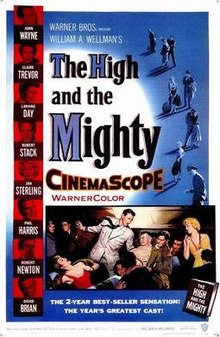
So where did disaster movies get their start?  If you are thinking Irwin Allen, I suggest you are off by a few years.  The High and the Mighty predates any of his films by 20 years.  In fact the classic Airport (which wasn't directed by Allen, and in fact predates even Allen's disaster movies by a couple of years) was still 16 years away.  I would consider The High and the Mighty to be the father of all disaster movies.

It has all of the elements of those classics that you remember, such as Airport, The Poseidon Adventure, The Towering Inferno, and others.  It has an all-star cast all pitted in a classic nail-biting event where unfortunate events may or may not mean death and destruction to the people caught up in those events.

Starring John Wayne, Robert Stack, Claire Trevor, Phil Harris, Robert Newton and a host of others, the plot is a plane ride from Honolulu to San Francisco in which it appears that the plane just might not make it to its final destination.  All of the characters are either running from their respective pasts or running from their futures.  Its Melodrama with a capital "M".

The movie garnered 6 Oscar noms including one for both Clair Trevor and Jan Sterling for Best Supporting Actress (both of which lost to Eva Marie Saint for her role in On the Waterfront).  I note that both of of those were pretty good in the film, but their screen time is shared by so many others that they sometimes seem lost in the shuffle.


The High and the Mighty(1954):

Dan Roman (John Wayne) prepares to help pilot a transatlantic flight from Honolulu to San Francisco.  Roman is rather old to be a co-pilot, but he has a past that has inhibited him.  It seems that a few years earlier he had been a pilot on a plane that crashed, and among the dead were his wife and young son.  So he has not had an entirely great life in the interim.

The passengers include a variety of characters.  May Holst (Claire Trevor) is an actress who hasn't had much luck in recent years.  Sally McKee is a former beauty queen who is on her way to meet a future husband, except the potential mate, she thinks, is attracted to her because he thinks she is the young beauty queen he saw in a picture that is several years old.  Lydia Rice (Laraine Day) is an heiress whose husband, Howard (John Howard), has rashly invested in a gold mine and she doesn't want to be with him anymore because of it.  Donald Flaherty ( Paul Kelly) is a professor who has been helping the government with some project (probably a bomb, but it is never really established) and has left the project in disgust to go back to his university.  ED Joseph (Phil Harris) and his wife (Ann Doran) are returning from a less than spectacular vacation on the islands.  Throw in a few more people, each of which is trying to deal with their own personal problems (John Smith and Karen Sharpe play a young married couple returning from their honeymoon with worries about the future) and you have an assortment of people that only a Hollywood movie could pit together.

On the flight things are going smoothly until one of he four engines catches fire.  The fire is put out forthwith, but damage has caused some of the fuel needed for the flight to leak out.  This creates the drama that drives the film.  The navigator, Lenny (Wally Brown), insists they could make the coast if the winds will just play along, but it turns out that he has made a miscalculation.  The pilot, John Sullivan (Robert Stack) thinks the best course is to ditch the plane in the Atlantic and wait for a rescue from the Coast Guard, which is on its way to intercept them.  But Dan is convinced by Lenny that they could actually reach the coast.

AS the flight goes on, the passengers and crew deal with their personal problems, as well as face the uncertain future that they may not actually survive to face it.  The tension mounts, as it must do, and there are some twists along the way.  Don't miss the scene where one unstable passenger confronts another with the accusation that the other has been tempting his wife into infidelity.  This being 1954 and not 2020, you will see some things that nobody could get away with in these post 9/11 days.  Not including the fact that in those days you could actually smoke on a plane.

Whether the plane arrives in San Francisco or not, some or all of these people will experience their own individual rebirth into life.  As must needs be in classic Hollywood style.

THat all for this trip.  Drive safely folks.

Quiggy


Saturday, July 6, 2019

The Wild Blue


This is my entry in the Janet Leigh Blogathon hosted by Love Letters to Old Hollywood


How many major motion pictures can you name where a branch of the Armed Services gets top billing?  By that, I mean one that is not a documentary?

Jet Pilot does just that.  Check out the movie poster below.  The opening credits of the movie bear it out, too.  After the Universal logo we get scenes of jets spinning in the air with the words "Starring John Wayne... Janet Leigh... and the United States Air Force".

And to be honest, that's the best part of the movie, the Air Force.  Although Jet Pilot is not near as bad as The Conqueror, coupled with the latter it ought to have proved to Wayne and everyone else that Howard Hughes was not the ideal boss to work for.  But then I guess Wayne could be forgiven on some level because part of the reasons for making the two films was that he was sucking up for funds to finance the film of his dreams, The Alamo.

With up around 200 appearances in film and television over the span of his 50 year career in Hollywood, there are bound to be a few duds of course.  (Personally, although I am a huge fan, most of the westerns he made in his early days before [and just after] Stagecoach are pretty much interchangeable.)  But Wayne's experience with Howard Hughes seems to be the low point of his oeuvre.


The story is what hampers the movie more than anything else.  For one thing, the movie was actually filmed in 1950, when jet planes were hot stuff, but by the time Hughes had quit screwing around with the film in 1957, jets were becoming passe.  That and the plot line becomes rather lame.  Even Wayne himself admitted that it was a silly movie.  Which just goes to show what happens when you want to make a political statement but don't bother to get the right people behind you.  Howard Hughes was a brilliant businessman, to be sure.  He just should have stayed in the office and let the people who knew what they were doing run the film industry side of it.

Janet Leigh and John Wayne do have a little chemistry which makes it a better than the pairing of Wayne with Hayward in the aforementioned  The Conqueror.  Can't say I actually believe Leigh as a pilot, or for that matter as a Russian (the producers didn't even bother to have any of the actors and actresses playing Russians use a fake accent... James Bond it's not, but still if you aren't paying attention you may not know which country the characters are supposed to be in).  I did have a hard time accepting Wayne falling in love with a communist soldier (not Wayne's character, Wayne himself.  If it had been any less virulent Red-baiter of an actor I might have fell for it more.)

Watch this movie for the very good scenes of aerial photography and as a window into the early age of jet engine technology.  As I stated in my review of The Conqueror, you could probably just as easily turn off the sound and make up your own dialogue.

BTW, Chuck Yeager supposedly is one of the Air Force pilots you see flying those jets.


Jet Pilot (1957):

In the Alaskan frontier, an Air Force base detects the invasion into American air space of a Soviet jet plane.  After forcing it to land, they discover that the pilot is a woman, Anna Marladovna (Janet Leigh).  Col. Jim Shannon (John Wayne) is assigned to scope her out and figure out just what she is up to.


Eventually over the course of  a few days (or weeks or months; it all depends on how believable you think it is for a man to fall in love with a woman he just barely met...), Shannon does fall for Anna.  Although he acts like a typical shy gallant hero (no hanky panky before marriage, no sir!  At one point when her orders he to take off some of her outer gear, he is flabbergasted when she is on the verge of stripping naked in front of him...).


The brass has the ultimate say in what is going to happen to Anna.  Ultimately, it turns out, Anna is a spy.  She has been sent over by the Soviets to see what she can divulge from the Americans, without giving away any secrets the Soviets might have to which she'd be privileged.  When her subterfuge is uncovered, Shannon determines that the only way to save her from being deported is to marry her.  (Yeah, right...)


But the brass still wants its pound of flesh and determines that they will jail her instead, since they can get away with that.  She is an American citizen now.  But Shannon still has an ace up his sleeve.  On the pretext of taking Anna to authorities south and east of Alaska he instead heads north and west.  Into Siberia.  Yes, that's right, the notorious Communist-hating Wayne defected.  All because of the love of a woman.  (OK, maybe I can see that...)


Of course, now that he's in Russian territory its "the shoe is on the other foot" and Russian authorities are trying to get Shannon to reveal secrets of the Americans.  Well, he may be thinking with his genitalia, but that doesn't mean he's stupid.  There is no point in trying to avoid the spoiler alert, but then if you know John Wayne the actor and his politics you ALREADY know how the movie HAS to end anyway.  Or at least you know the spoiler alert... Shannon doesn't stay in Russia.  But I will leave you with something to watch to see how he manages to get away from the crack superior Russian Air Force.


Time to head home.  Drive safely, folks.


Quiggy

Saturday, April 13, 2019

Love Over Gold


This is my entry in the Stewart Granger Blogathon hosted by Maddy Loves Her Classic Films.


The song North to Alaska by Johnny Horton was the theme to the movie.  The song came out before the movie was filmed by several months and turned out to be Johnny Horton's last big hit.  He died in an automobile accident shortly before the movie was released.

The story of the gold rush of Alaska may be overshadowed by the previous gold rush in California in 1849, but it still has some cache of interest to those of us interested in history.  The movie North to Alaska covers some of the feel.

It should be noted that the movie was filmed in California, which explains why the terrain doesn't exactly seem right.  But if you don't let that bother you, it has a great feel for the time of the movie.  (Whether or not the Nome of 1901 had such muddy streets or not...)


North to Alaska (1960):

Sam McCord (John Wayne) and George Pratt (Stewart Granger) and his brother Billy (Fabian) have been working a gold mine near Nome, in Alaska.  And they have been very successful at it.


Sam is on his way to Seattle to get some more mining supplies, and as an added bonus he is tagged to bring back with him Jenny, the love of George.  Jenny and George have been corresponding over the past three years and George is infatuated and plans to marry her.  He has even built a honeymoon cabin just off the way from the main cabin the three men share.


Sam arrives in Seattle, not knowing what to expect, but he finds more than he bargained for.  Jenny is a maid in a rich man's house.  Not only that, but she gave up on George some time before and is now married to the head butler of same rich man's house.  Sam, who doesn't have a high opinion on women in the first place, is disgusted.  As a result, he decides to get drunk over it.


While in Seattle, he goes to the Hen House, a local bordello.  There he meets "Angel" (Capucine), whose real name is Michelle Bonet, and is French.  It seems to Sam she would be the perfect substitute for George, since Jenny was also French. (They all look alike...?)  He convinces her to go with him to Alaska.  But Michelle gets the wrong impression.  She thinks she is going to be with Sam.


To make matters worse, during the trip, Sam is such a gallant gentleman, it causes Michelle to fall in love with Sam.  When the truth is revealed, Michelle is of course distraught, but by that time she is already in Nome.  She originally plans to return to Seattle, but changes her mind.

Back at the base camp, George of course is angry about the situation.  He wants Jenny and thinks Sam either got drunk and forgot her, or some equally malevolent act.  And Billy has a puppy dog love for Michelle, whom she rejects because, after all, she is in love with Sam.  Eventually, George, who realizes that Michelle is in love with Sam decides to try to manipulate Sam into admitting he loves Michelle in return.


Meanwhile, in Nome, Frankie Canon (Ernie Kovacs), a small-time hustler who has managed to finagle himself into being a bigwig has designs on Michelle, too.  It turns out they were an item way back when he was a gambler and she was a prostitute in New Orleans.  And he thinks she's back in town to be with him.  Plus he has lots of money, all acquired illegally, including managing to file false claims on several gold mines in the area.  One of which is Sam and George's.


A rare comedy from the Wayne oeuvre, this one has plenty of misunderstandings and double talk standards of the genre which, while maybe not as hilarious as, say, Arsenic and Old Lace  or Blazing Saddles in the sense of laugh out loud comedy, is still pretty funny.  Check it out.


Time to saddle up and ride home.  Drive safely, folks.

Quiggy