Showing posts with label John Carpenter. Show all posts

Saturday, January 10, 2026

Claustrophobic Terror


This is my second entry in the Film. Release. Repeat. Blogathon hosted by Hamlette's Soliloquy and yours truly.


I make no bones about it. My favorite director is John Carpenter and five of his films are in my top ten favorite movies of all time. I missed out on Halloween when it first hit the theater, so my first John Carpenter movie was actually Escape from New York. Not long after I saw that, which highly impressed me, I went back and saw the aforementioned Halloween, as well as The Fog. And I also began to anticipate each new film that came out in subsequent years.  The five that occupy space in my top ten (in no certain order) are Big Trouble in Little China, They LiveThe ThingEscape from New York and Christine

My review of The Thing has been a long time coming as a feature film at The Midnite Drive-In. I feel certain if I hadn't gone through a lethargic period of writing during Covid that it would have long been reviewed. Same goes for Christine (and that will soon be remedied too.) Carpenter made four films with Kurt Russell back in the day, including a TV movie on Elvis, Escape from New York and it's sequel Escape from L.A.Big Trouble in Little China and The Thing


The Thing (1982):

Note: In the interest of not turning off some of the more skittish readers, I have refrained from using any pics in this review depicting the creature in it's changing process. If you really want to see them you can google images of The Thing 1982...


The film starts out with a dog. The dog is being chased by some guys in a helicopter. The occupants seem intent on killing the dog. When they arrive at the U.S. based camp they are still intent on killing the dog, but this is seen as an attack on the scientists and they kill the interlopers. Of course, if one or the other groups had been fluent in the other's language the US group might have been forewarned, but the interlopers only speak Norwegian and the US guys only understand English.


The base helicopter pilot, MacReady (Kurt Russell) and the base doctor, Copper (Richard Dysart) decide to go up to the Norwegian base and see what might have happened. They find the base in shambles, and an odd malformed body which they take back to the US base camp. The camp biologist, Blair (Wilford Brimley) is given the task of performing an autopsy on this weird body. What Blair finds inside are normal human organs, heart, liver and the like.

The crew decides to go try to find out what the Norwegians had been doing just prior to the havoc that happened at their camp. The end up finding a spaceship that appears to have been hidden under the ice for some 100,000 years. They also find the leftover remains of what may have been a body the Norwegians uncovered in the spaceship. 


The dog is put in the kennel with the base camps' dogs, because, after all, as far as they know, its just another dog. But this "dog", of course, is NOT a dog. Which is why those Norwegians were trying to kill it. The camp kills the odd thing as it is in the process of changing, and the day is saved. Roll credits.


Not so fast. The creature is able to replicate itself and disappears into the attic above the dog compound. Blair autopsies the dog thing the group killed and comes to the conclusion that the creature could assimilate any living organism, and through computer simulation estimates that if it got loose it could assimilate every living thing on the planet within a few years. As a result Blair becomes just a wee bit paranoid, since virtually any one of them could now be the thing, posing as one of them.

Blair, in his paranoia, wreaks havoc on the compound, virtually destroying any avenue that the thing could use to escape the compound: demolishing all radios, computers, sleds, etc. The crew manages to subdue Blair and lock him in the tool shed. Dr. Copper suggests that they take blood samples from each of them and compare them to blood samples held in storage in the compound, but of course, the thing has anticipated this and contaminated the samples.


No one knows exactly who to trust. Each of the crew immediately begins to look with suspicion upon his co-workers, and since they are isolated at the bottom of the world now, without any lines of communication with the outside world, it gradually becomes a matter of finger-pointing. Of course, everyone insists that he himself is the same as when he first came into the camp and thus not the alien creature. The one that is the creature also claims this, of course, but then why would it admit it was an alien?

In the end, virtually everyone in the crew has been killed, either because it was actually a part of the thing's assimilation process, or through misadventure. The remaining three crew members determine that the alien plans to go into hibernation again. MacReady and his remaining cohorts decide to demolish what is left of the base camp, although, since the creature can apparently survive in hibernation indefinitely, I am not sure what this would accomplish. As MacReady and Childs await the inevitable freezing to death that is coming now, they decide to share a bottle of Scotch.


The Thing  was a remake of a classic sci-fi film from the 50's, The Thing (from Another World). The original novella, Who Goes There? by John W. Campbell, Jr., has much more in common with the 1982 remake than it does with the 1951 original film. Basically the creature in the 1951 film, joking referred to these days as "an intelligent carrot" was just an alien form of a vampire. It killed, but it didn't kill to propagate it's species, it only killed to find sustenance off of the humans. (The "intelligent carrot" remark refers to the fact that, although it was filmed in black and white, the alien itself was orange, and had characteristics of a vegetable life form.)

What made this version of The Thing so compelling is that, like predecessors in such films as Invasion of the Body Snatchers, this creature had the ability after it consumed its victims, to take over their characteristics. (Much the same way the creature in the original novella did.) Carpenter had some good help in the special effects department on this film. He brought on board Rob Bottin, with whom he had worked on The Fog, to create the special effects of the creature transformation.

BTW, if the effects in the first Alien movie had you running for the porta-potty, let me just say "You ain't seen nothing yet". The special effects are one of the reasons that the movie got such initially bad reviews from critics. Initially Carpenter was not going to direct, because at the time he preferred directing movies in which he was actively involved in the original story, and filming a previously published story was not in his interest. As such Tobe Hooper (of Texas Chainsaw Massacre and Poltergeist fame) was approached, but producers became disenchanted with the way Hooper was doing it. Eventually they were able to convince Carpenter to do it.

As far as Kurt Russell as the star was concerned, he wa the last of the film's characters to be cast. Not that Carpenter was reluctant to work with him but he just wanted to keep his options open. Some of the actors considered were Christopher Walken, Brian Dennehy, Scott Glenn, Jeff Bridges and Nick Nolte. The most intriguing of those, in my opinion, would have been Jeff Bridges. I think Walken would have taken the character in an entirely different and not altogether sympathetic direction.

When the movie was initially released it was not well received, but in retrospect it has garnered some praise. Personally I think that it is an excellent remake. The creature in the original just never gave me the willies like the Carpenter/Bottin creation. And the atmosphere created by the film made it all that much more attractive. The claustrophobic situation, what with all the action taking place in an isolated are like Antarctica and the fact that no one can trust anyone else to be whom they seem to be has a profound effect on the terror the situation creates.  

The film barely made its original investment back and was NOT the hit that Carpenter hoped would boost his credibility. Coming in on the heels of Steven Spielberg's E,T.: The Extraterrestrial, which was a much more upbeat movie, to the say the least, of aliens, the dark and somewhat nihilistic The Thing was viewed as probably coming in at the wrong time for the political landscape. The country was in the middle of a recession, and hope for a better future was not prevalent in the film. In retrospect, however the film has been gradually gaining some more appreciative audiences. 

Watching this film in conjunction with the Philip Kaufman 1978 version of Invasion of the Body Snatchers might cause the most susceptible paranoiacs to run for the hills. Still, all in all, one of the reasons why  I consider this movie to be a good remake, not withstanding Carpenter's hand in it, is the fact that it entertains, even despite some of it's flaws.

Well, folks, time to crank this old Plymouth up and head home. There is snow predicted tonight, so my isolation may be a little discomforting...

Quiggy


Saturday, May 27, 2017

Black Magic in Chinatown


This is my entry in the Favorite Director Blogathon hosted by yours truly and Phyllis Loves Classic Movies


My first introduction to John Carpenter was with Escape from New York.  I instantly became a Carpenter fan.  Over the ensuing years, I made a point to go see each new movie that Carpenter put out.  It is curious then that this one escaped my notice when it was in the theater.  I didn't actually get to see it until it was out on video.  Perhaps that is part of the reason why it ranks as my favorite Carpenter movie.  (Not the ONLY reason, to be sure.  The plot and the presence of Kurt Russell has a lot to do with it too...)

The script started out in life as a Western, if you can believe it.  The script was given an extensive re-write by W. D. Richter, a great scriptwriter in his own right who, among other scripts, worked on the scripts for the 1970's remakes of both Invasion of the Body Snatchers and Dracula.  He also directed (but not wrote) one of my other favorite movies, The Adventures of Buckaroo Banzai.

The movie was made at the same time as the Eddie Murphy flick The Golden Child.  In fact, there was a concerted effort to get this movie in the theater before the Eddie Murphy movie because it was thought that it would flounder in competition with a movie that had the superstar.  As it turned out, it didn't matter anyway.  The movie bombed at the box office.  But it has something going for it in it's after life.  It is more fondly admired than the turkey Eddie Murphy put out.  It has a HUGE cult fan base (of which I am one).


Carpenter with Hong in his Lo Pan makeup


Carpenter's output has been largely in the horror genre.  His output includes the original introduction to slasher extraordinaire Michael Myers, Halloween, The Fog, the remake of The Thing, the film adaptation of Stephen King's Christine, as well as the previously reviewed They Live.   He has also delved in the sci-fi world, as evidenced by Starman and two features, previously reviewed, with the anti-hero Snake Plissken, Escape from New York and Escape from L.A.

Early Carpenter work includes a TV movie about Elvis (featuring today's movie's star, Kurt Russell), and an excellent nail-biting remake of sorts of the classic John Wayne flick, Rio Bravo, set in modern day, Assault on Precinct 13.  Not all of Carpenter's works have been gems, however.  (Take my advice and avoid Memoirs of an Invisible Man at all costs...)  But Carpenter has made more hits that are genuinely revered by people, like me, who like his kind of movies, and you can guarantee this won't be the last time I review one of his movies.  Just waiting for the right moment (or the right blogathon...) 


Big Trouble in Little China (1986)

Jack Burton (Russell) is an independent truck driver owner/operator of "The Pork Chop Express".  At the beginning of the movie he is driving a load of cargo into San Francisco, specifically Chinatown.  After dropping his load, he spends an evening indulging in some of the delights of Chinatown, including food and gambling with dock workers.  At the end of the evening (actually early morning, by this time) he makes a bet with his friend Wang Chi (Dennis Dun) which he wins.


But Wang hasn't got the money, so Burton accompanies him to get it.  But before this can happen Wang has to go to the airport to pick up his fiancee, Miao Yin (Suzee Pai), freshly coming in from China.  While there, members of a Chinese street gang, The Lords of Death, try to kidnap another Chinese girl, Tara (Min Luong), a friend of Gracie Law (Kim Cattrall).


Burton foils the kidnapping, but in the process, Miao Yin is kidnapped instead.  Burton and Wang give chase and end up back on the streets of Chinatown.  There they encounter a funeral procession for a member of the Wing Kong (the good tong).  Members of Chang Sing (the bad tong) interrupt the funeral procession and a mini-war breaks out.


But this battle is interrupted by the three "Storms", three brothers with phenomenal powers; Thunder (Carter Wong), Lightning (Peter Kwong) and Rain (James Pax).


 These three make short work of the two gangs, but the  two heroes don't stick around.  They drive off, but run over, seemingly, a wizard, David Lo Pan.


Lo Pan is the villain of the piece, so you just know he is not killed.  Jack and Wang go to Wang's father's restaurant where the plot becomes even more complicated.  First it turns out that everybody but Jack knows Gracie.  Then we find out that the reason that Miao was kidnapped is she has green eyes (apparently a rarity among Chinese people).  She is being held in a brothel in Chinatown.

The heroes enlist the help of Egg Chen (Victor Wong) to rescue Miao, but the plan falls through because the three storms show up and kidnap her from the brothel.  Now we find out that Lo Pan is older than Methuselah.  He is cursed by an ancient emperor and the only way he can remove the curse is to marry a Chinese girl with green eyes.  But the only problem with that is that he must sacrifice her after he marries her.  Which makes it a little easier, so he thinks, when he captures Gracie, who also has green eyes.  He plans to marry them both, sacrificing Gracie to the Emperor and living out his life in joy with Miao.


The film is replete with Chinese black magic.  To counteract it, Egg Chen comes along with his own brand of white magic.  You can see it for yourself even in the beginning of the movie. A beginning, BTW, that was demanded by Barry Diller and the executives at 20th Century Fox because they didn't understand the movie and were afraid that Jack Burton's character did not come off heroic enough.  That's Barry Diller conducting the interview with Egg in that scene.  It was a last minute addition after all the rest of the movie had been wrapped up.  The original movie was intended to start with Burton driving into Chinatown (the part where the opening credits roll).

The white magic that Egg uses includes potions to help the heroes be brave in the face of the monsters and traps that lo Pan has set up, and also to do battle with his guards.  Not that Burton really needs it.  He's a gung ho, devil-may-care type with an over inflated sense of his own bravado, but it gives us some great moments in the movie.  And the movie is funny as all get out, if you can appreciate the humor.  One of my favorite lines in the movie is when Jack and Wang come up along a door with Chinese writing on it.

Jack: "What does that say?
Wang: "Hell of Burning Oil".
Jack: "You're kidding?"
Wang: "Yeah.  I am.  It just says Keep Out."

All of this leads up to the final confrontation between our good guys and Lo Pan and the Three Storms. And of course the saving of the damsels in distress.  Big Trouble in Little China is a great place to start with Carpenter, especially if you are a little squeamish about blood and gore and don't want to experience Halloween or The Thing.


Keep in mind there are a whole raft of other great directors in this blogathon.  Be sure to check them out.

Quiggy


Tuesday, October 25, 2016

Illegal Aliens

Dislaimer:  The Midnite Drive-In is not responsible for nightmares, insomnia or fear of going to sleep as a result of reading this post.  Read at your own risk.


Entry #2 in a 3-part series of "My Favorite Horror Movies".

Aliens, and alien invasions are usually considered the exclusive dominion of the science-fiction genre.  In point of  fact, aliens, good or bad, are, by necessity, "creature features", and thus should be considered also as horror movies.   Still, the usual alien feature films are looked at and reviewed as science fiction simply because, although no concrete proof exists of the presence of aliens (Von Däniken's "Chariots" notwithstanding), they are considered scientifically feasible or, according to some renowned scientists like Carl Sagan, probable., compared to ghosts, vampires, werewolves and other creatures of legend which are the usual monsters of horror movies, and which no rational scientist would even hint might be real or possible.

Some might balk at classifying The Day the Earth Stood StillClose Encounters of the Third Kind or E.T. as horror films, and I would whole-heartedly agree.  On the other hand, you would almost HAVE to agree with me that any of the Alien series, The Thing from Another World, The Blob, and Predator, all have elements of horror running through them, despite the fact that they are essentially about alien life forms.  More so than any of these is any of the multiple versions of Jack Finney's book The Body Snatchers.  Each of the directors of the four (so far) versions has had their own slant on the story, but it is essentially at its core a horror story.  John Carpenter's They Live! also plays out as a pure horror movie (but no surprise there since Carpenter's main milieu is the horror genre:  Christine, Halloween, The Fog, his remake of The Thing, etc.)


Invasion of the Body Snatchers (1978)


Unlike the original 1956 version, which I reviewed in September for the Keep Watching the Skies blogathon (see here), which involves the aliens taking over a small town, the 1978 Phillip Kaufman directed film takes place in San Francisco.  Whether or not the first one outdoes the second one in terror, or vice versa, is a matter of how you personally feel about society in general.  Both have their pluses and minuses.

The 1978 version benefits greatly from the phenomenal musical score, by a guy named Denny Zeitlin, a jazz musician and a pioneer in electronic music.  The music Zeitlin created heightens the terror and suspense of the movie, and it seems a shame, but he never scored another movie.  He has had several offers over the years, but he claims it was too taxing and far too much work, so this film remains his only endeavor into movie soundtracks.

Opening sequences show the pods on another planet, lifting themselves off the planet and floating in space to land on Earth.  (Pay close attention to the opening sequences, because an interesting note is that all of that was done for about $50.  The "planet " is just a 2x4 stick of wood, and the "pods" are just a jar of art department gelatin.  This movie was made for about  $3½ million, and a lot of the special effects were far cheaper than they appear to be on screen).

Opening sequences on Earth have brief glimpses of the pod people already in progress of taking over the Earth.  In one scene a priest (played by Robert Duvall) is swinging  on a swing set in a playground.  You can see the blank stare in his face and you just know there is something odd about him (although it doesn't really click until you have seen others that have been assimilated.)


Matthew (Donald Sutherland) is a health inspector.  He is friends with a fellow health department employee, Elizabeth (Brooke Adams).  When Elizabeth confides to Matthew that her boyfriend, Geoffrey (Art Hindle), has begun acting strangely, and intimates that she thinks it's not really Geoffrey, Matthew suggests that she talk with a friend of his, Dr. Kibner (Leonard Nimoy), who is a pop culture psychologist.  (Remember this is the late 70's.  A time of self help books like Thomas Harris' I'm OK, You're OK, and the me generation.  This whole movie brims with the 70's feel, including some of the most humorous, in retrospect, clothing: polyester suits, sweaters instead of vests on suits, open (wide) collars without ties.   Also, some of the language is so 70's you may be tempted to snicker...)


While at a Kibner book signing, Elizabeth and Matthew encounter a woman who claims her husband is not her husband.  (Earlier, Matthew had had words with his drycleaner who claimed his wife is not his wife).  Kibner does his best to resolve that situation and then tries to calm Elizabeth's fears.  At the book signing is also a struggling writer friend of Matthew's, Jack Bellicec (Jeff Goldblum).  Jack despises Kibner, mostly because Kibner is a success ful author and he, Jack, is not, but he claims that Kibner's psychology is just so much crap.


Jack and his wife, Nancy (Veronica Cartright), operate a mud baths health spa (there's that overwhelming 70's feel again).  Nancy discovers a half-formed body in one of the stalls and freaks out.  Jack calls Matthew, and together they come to a half-formed conclusion that it is a duplicate of Jack.  Matthew tells Jack to call Kibner, then goes to Elizabeth's house, where he finds her asleep, and another half-formed body that is beginning to look like her.


He carries Elizabeth out, avoiding Geoffrey, who is one of the pod people. When he gets back to Jack's place Kibner is there.  Kibner convinces (or tries to) them it was all just their imagination
 But when Kibner leaves, he gets in a car where Geoffrey and another pod person is, and we are let on to the fact that Kibner has been converted.

Gradually it becomes evident that the flowers which have recently cropped up and which Elizabeth has been trying to identify are the source of pods, which take over the memories and substance of the original human bodies.  Two things distinguish this version from the original.  First, in the original, it is never really revealed what happens to the original human bodies.  In this one, a series of dramatic scenes reveal that the bodies dry up and decay.  Also the bodies of the pod creatures as they are forming are much more solid and disgusting looking.

Special effects do play a bigger part in this version.  Once again, however, there is no alien spaceship landing on the White house lawn, or futuristic death ray guns shot by bug-eyed monsters.  But Kaufman and company did take advantage of a better budget to create some pretty decent special effects.

  I won't reveal how this one ends. You have to see it for yourself.


They Live (1988)

John Carpenter, as I have intimated before on this blog, is my absolute favorite director.  My favorite Carpenter movie of all time is Big Trouble in Little China,which I will get around to reviewing, just waiting for the right blogathon or at least the right time to do so.  I'm also a big fan of his other Kurt Russell collaborations (see Waiting for the Snake for a review of the two Snake Plissken features).  But Carpenter's main ouevre is primarily in the horror genre.

One that really gets me as a lot of fun is one he made during the late Reagan Presidency.  Note: this one may piss you off if you admire Reagan and his economic policies, which had an after-effect of causing the rise of homeless shanty-towns in some of the bigger metropolitan areas.  It is also a sort of condemnation of the commercialization of America.  It could be and probably should be viewed on a secondary level as a political diatribe.


"Rowdy" Roddy Piper plays a character called John Nada.  (Nada is Spanish for nothing, which basically makes Piper's character  a fictional "nobody").  John is a drifter, out of work but just looking for an honest day's pay, any job to pay the bills (what little bills he has...).  He gets a job on a construction site and is offered a place to stay in a shantytown by a fellow worker,  Frank (Keith David).


John helps out with some repairs needed in the shantytown and meets the leader of the group, Gilbert (Peter Jason, a familiar face if you watch a lot of these kinds of movies.  You may recognize Jason as the bartender in the cowboy bar from 48 Hours, or any one of some 200 roles he has played over the years).  John observes Gilbert suspiciously hanging around a church, and when he goes to investigate hears a choir practicing.  Meanwhile, back at the camp the regular TV program being watched by some of the residents is getting interference from some hijacked broadcast in which the broadcaster claims that some evil hidden force is "controlling us".


John continues to nose around and finds out that there is no choir in the church.  It is a recording to cover up some secret activity which involves Gilbert and some others from the shantytown.  John also discovers a box of sunglasses, curious about them, but halfway dismissively puts a pair in his pocket.  The next day, while walking outside he puts on the sunglasses he found and immediately the whole world goes black and white.  Signs which are advertisements without the glasses become one word commands like "OBEY" and "SLEEP".


John of course is confused, alternately taking off and putting on the sunglasses, but the real shock is when he sees an obviously rich person who, when he puts on the glasses is revealed to be a very ugly alien.  It becomes obvious that the sunglasses have some special power, but he is unsure what that power might be or what it might mean.  When he confronts an old woman who is in fact one of the aliens and tells her she's as ugly as sin, she speaks into her wristwatch "We have one that can see" and promptly disappears.


When he goes outside he is confronted by cops, which with the benefit of the glasses, he can now see are aliens.  He overpowers them and takes their guns, then goes on a shooting spree, but only killing the aliens.  At a bank he utters one of my favorite movie lines of all time:

"I have come here to kick ass and chew bubblegum....and I'm all out of bubblegum."

John tries to connect up with Frank and after a ridiculous looking wrestling match in which John tells Frank to put on he glasses and Frank refuses, he finally gets Frank to put them on and now Frank can see the alien influences, too.


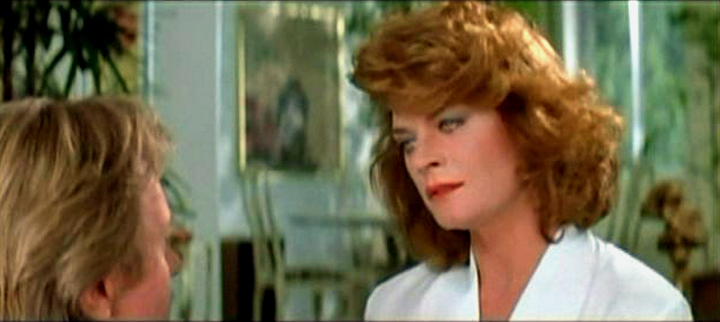
The last part of the movie has John kidnapping a pretty TV assistant director, Holly (Meg Foster, a woman who has the most mesmerizing eyes I have ever seen).  He tries to convince her of what's going on, but she of course, thinks he's nuts.


 It turns out that is a contingent of humans who do know about the alien invasion and are helping them (much like some of the Jews in the concentration camps helped the Nazis, to get better treatment.  If you can hang on until the end, you'll get a few good scenes that will make watching this one extremely well worth it, especially if you have a sardonic sense of humor like I do.

Well folks, looks like the aliens at the concession stand slipped me a mickey.  I'm getting tired.  Hope you guys can stay awake.

Quiggy


Sunday, May 22, 2016

Waiting for The Snake


John Carpenter is my favorite director, and by extension, I guess you could say Kurt Russell is my second favorite actor (John Wayne is still #1).  The reason I say Carpenter is my favorite director and Russell is #2 on the list of actors  is because on my top 10 list of favorite sci-fi/horror movies, Carpenter/Russell collaborations occupy four of the spaces, Big Trouble in Little China, The Thing, and the two objects of today's post, Escape from New York and Escape from L.A.

One-eyed ne'er do well S. D. "Snake"  Plissken is a World War III Special Forces war hero, garnering two Purple Hearts, and being the youngest soldier to be decorated by a U.S. President.  But he turned to a darker side after the war, committing various criminal acts.  He avoids capture quite a bit, but does eventually come under the control of the prison system at various times in his career (hence the ability to have not one, but two feature films of his exploits in the criminal justice system.  His only real nemesis is himself, although he is driven by an intense hatred for the justice system and the nation and its political system in general.  In other words he doesn't "give a F*** about your country or your President".


Escape from New York (1981)

The pre-history to this one involves a rise of crime to astonishing levels.  As a result, the government converts Manhattan Island into a ultra-high security prison, building a containment wall around it, mining all bridges and tunnels, and sending all criminals into the prison, with just one rule: Once you go in, you never come out.  The prison itself is then allowed to run it's own self within the confines of the walls.  Gangs and cutthroats run their own system within.

Into this mix, Air Force One, the President's plane, is hijacked by revolutionaries and crashed into the center of New York.  The President (Donald Pleasence) [a President with an English accent, What IS the world coming to?] is launched before the crash in an escape pod.

"Jolly good show, eh what?'  The President encourages his staff.


Police forces, with Police Commissioner Bob Hauk (Lee van Cleef) are dispatched to rescue the President, but before they get there the President is captured.   Hauk and his contingent are told to leave immediately or the president will be killed.


Meanwhile, Snake has finally been captured and is being processed for internment in the prison.  Because of his experience as a guerilla war soldier, he is given a chance to redeem himself by Hauk, with all past iniquities removed from his record.  All he has to do is infiltrate the prison, find the President, and get him and his secret info back to civilization in 24 hours.  This is the overriding suspense of the story because a) the President has to deliver the secret info he is carrying in less than 24 hours, and b) to insure that Snake cooperates with the authorities, he has been injected with microscopic nuclear bombs which will explode if he doesn't get back in time.  (Thus preventing him from just taking off and saying "Screw it.")

Upon landing (at the top of the World Trade Center) he immediately descends into the chaos that is the prison system in New York.  Using a locating device he finds himself in an old theater in which, watching the floor show, among others, is "Cabbie" (Ernest Borgnine).

Snake Plissken?  I heard you were dead...

As referenced in the above caption, a running theme throughout the movie is whenever Snake meets up with someone, the first comment from the is "I heard you were dead."  Obviously these people don't know Snake Plissken.  You can't kill a snake that easy.  Anyway Cabbie informs snake that the Duke (Isaac Hayes) has the President.   He takes Snake to meet with the Brain (Harry Dean Stanton) who is essentially the Duke's adviser, and who also has a map to where the mines are on the bridge.  Brain resides in the New York Public Library with Maggie, his main squeeze.

The Brain (with the Bosoms)  


It turns out that Snake and the Brain were partners in crime, but Brain (whose real name is Harold) ditched Snake, so Snake has trust issues with him.  But Snake convinces Brain (at gunpoint) to take him where the President is being held.  Things backfire when the Duke discovers what is going on and captures Snake.  He forces Snake to go one-on-one against the biggest, baddest mofo in the prison (Ox Baker).  While Snake battles it out, Brain and Maggie rescue the President.


Eventually the four team up again with Cabbie and begin a race down the bridge trying to dodge the mines, and being chased relentlessly by the Duke.  The Duke's car is a sight to behold,   It has chandeliers hijacked from some fancy hotel as headlights and looks exactly like you'd think a 70's era African-American gang leader would have.

The Duke's "Pimpmobile"

Not all of the heroes survive however.  But, of course, Snake does.  (Remember, it's hard to kill a snake.)  You'll have to watch the movie to see who else does.


Escape from L.A. (1996)

It's 16 years later from the time of Escape from New York, and, coincidentally, (or maybe not) the same amount of time since the first movie.  I don't know what the hell happened to the prison in New York.  For all I know it's still in existence.  But in the history since that time there has been a massive earthquake that completely separated the city of Los Angeles from the mainland.  The country is now being run by a radical right-winger (think Jerry Falwell on moral steroids), who, as President for Life (played with incredible intensity by Cliff Robertson), has declared L.A. to be a morally corrupt place.  It is here that all morally undesirable people are sent.

Right makes might


Not necessarily all within the confines are criminals by current standards of legality.  The "morally corrupt" inhabitants include those of non-conforming religions (Muslims and any non-Christian religions, as well as atheists), users of now illegal drugs such as tobacco and alcohol, fornicators, and anything else that the devout Christian President deems a "sin".  Of course, being in that atmosphere, most of the residents, at least the ones we encounter on screen, are morally corrupt even by today's standards, but they could be seen as victims.


The President's daughter, Utopia (A. J. Langer), confiscates a secret weapon from her father and escapes into L.A. where she ends up hooked up with the leader of a counter-revolutionary group inside the compound, Cuervo Jones (George Corraface).  The secret weapon, the MacGuffin of the story, is a device that can be used to control satellites orbiting the earth and with pinpoint accuracy effectively shut down an area, an entire country, or as stated in the movie the entire globe.  It does this by sending an electronic pulse that shuts down all electric powered paraphernalia within the focus of the satellites.

Radical revolutionary 


Snake, our hero, is sent in to recover the device.  The President gives him explicit instructions, however, to eliminate his renegade daughter.  Under the direction of Commander Malloy (Stacy Keach), Snake is outfitted with various weapons and gear reminiscent of the latest James Bond film (Q, is that you?).   Among this is a holographic projector which gives him an ability to make a holograph of himself for a  15 minute period.  The impetus to get Snake to do the job is he is given a cut on his hand by a passing person which injects him with the "Plutoxin 7" virus, which he is told will kill him in a very short time.  (Once again, Snake is forced to comply with the less than reputable legal forces to do their will)


Among the people that Snake encounters is an aging hippie surfer (played by Peter Fonda), a smarmy scam artist, Eddie (Steve Buscemi), and a former cohort from his adventure in Cleveland (prior to the movie), "Carjack", who has been transformed into a transsexual leader of a competing gang, Hershe (Pam Grier).  I really liked Hershe and despite the obvious accoutrements on her chest, I had to watch the end credits to see if he or she was played by a male or a female... Pam Grier pulls off an incredible performance for a movie of this caliber.
Map to the Stars Eddie

Pipeline

Hershe


Much of the movie, as in it's predecessor, involves Snake trying to overcome delays in his quest, including a great scene in which he has to score 10 points on a basketball court against a countdown timer which will mean his execution if he doesn't score the points in time.  And of courso, Cuervo Jones has to have his own stylish ride.  The film is a little too dark for me to see, but it appears that there is a disco ball on the trunk.  What purpose it serves, I have no idea...

Having a (disco) ball.  Wish you were here. 


Snake eventually nabs the device, and, against his explicit instructions, takes the daughter back to the mainland.  The President, showing his completely nasty side, has the daughter taken to the electric chair and demands the device from Snake.  As his timer runs out, it is shown that he was lied to about the virus.  It was just a very intense flu, not a lethal toxin.   Snake still has an ace up his sleeve (this is Snake Plissken, after all). Remember the holographic projector he was given?  Well, he finally gets a chance to use it.  Nuff said.  You have to watch the movie to see how it all comes out.


Well, the theater has just gone dark, so it's time to crank up the old Plymouth Fury and see if I can dodge the mines.  Drive safely kiddies.  BTW, are you curious about that Plymouth?  Here it is for you to enjoy.


Quiggy