Showing posts with label 1961. Show all posts

Wednesday, December 11, 2024

December 11, 1961: A Date That Will Live in...Something

I had intended to do this post to celebrate my 60th birthday way back in 2021.  But if you have been following this blog since it's beginning, you know that the circumstances of the onset of COVID caused me to lose interest for a period of time and 2021 passed by with only a couple of entries on the blog.  And this one wasn't one of them.

Yes, folks, I'm an old man.  This year I am turning 63. The idea for this blog entry was inspired by an idea.  What would I have watched on TV the night I was born? (Assuming, of course, that I could actually watch TV at only a few hours old...) Using a webpage that lists what was actually on the schedule that night:

December 11, 1961

I arbitrarily decided which shows I would have chosen for the night.  So let's go back to that time and watch a night of TV.

(Note: These times are listed by EST airings (and since I was actually born in Durham, North Carolina, those would be the actual times the shows aired for me.  Of course, the time of the show's airings would have been different depending on where you were at the time. For instance, I now live in Texas, so an 8:00PM airing on the East Coast would have aired at 7:00PM if we had been in Texas. And, BTW, Texas is where I was when my first birthday rolled around..)

A brief spoiler alert!  I tell the plot of the whole episode in the following encapsulations of each TV show. You can still watch the shows, they are all watchable, but if you want to go through the list and find the episodes and watch them first, I'll still be here when you get back.

 TV Night at the Quiggy House  (Dec 11. 1961):

TV Guide: Dec 9-15, 1961
 

Note: To begin, a brief apology: Unfortunately, my first show for the evening, (Pete and Gladys) had a very limited selection of available episodes online. The episode broadcast on Dec. 11, called "The Live-In Couple", was not available anywhere I looked. So by necessity, and for the sake of completion, I selected a later episode.  The actual air date for "Hero in the House" was actually three weeks later., on New Year's Day. (The rest of the slate of shows, however, were actually aired on the date in question)


As a bonus, in case you'd like to watch, I have included the episodes from youtube (always assuming someone hasn't taken them down...).

8:00PM: Pete and Gladys ("Hero in the House")


Background: Pete and Gladys was an early example of the classic "spinoff". On a TV show from the 50's December Bride, starring Spring Byington, Harry Morgan played a next-door neighbor, Pete who often showed up on the show. Pete would often grouse about his wife Gladys (who was never seen on that show).  Sometime after the cancellation of December Bride, a new show, Pete and Gladys appeared giving us some insights into a character already familiar to the fans of the previous show. The brief two season run of the show followed the usual sitcom format, with daily interactions between the stars and various other characters.

Interestingly enough, although it only lasted two seasons, it did garner some attention.  Cara Williams was up against a few others competing for the 1962 Emmy awards for Best Actress in a Leading Role in a Series (she lost to Shirley Booth for her role in the series Hazel, however). 

In addition to Morgan and Williams the shows brief run had a Who's Who cast of guest stars, many of which will be familiar to fans of 50's and 60's TV, as well as movies.   Among them: Donna Douglas, Nancy Kulp  and Raymond Bailey (from The Beverley Hillbillies), Morey Amsterdam and Richard Deacon (from The Dick van Dyke Show), Bea Benaderet and Frank Cady (from Petticoat Junction), Ronny Howard and Howard McNear (from The Andy Griffith Show) and a host of others.  (BTW, I don't really know, but I'm PRETTY sure they were not playing the characters from their other shows... but without the benefit of watching I can't say...)


Pete (Harry Morgan) and Gladys (Cara Williams) are having dinner with their friends, Ernie (Joe Mantell) and Peggy (Mina Kolb). They are going to go to a movie afterwards, which is going to be a French film.  Ernie says he doesn't like foreign films because of the effort to keep up with the subtitles and is promised that next week they'll go to an American film (Gee! A weekly trip to the movies??? Rich people...)

But then Gladys says next week will be out because Pete is going to a veteran's convention, which leads to Gladys pestering Pete to tell his war story, something along the lines of having taken on and captured  a whole platoon of enemies single-handedly.  Except it turns out that the story is not real.  He later tells Ernie that he just made it up to impress his wife, and to explain why he has a Japanese samurai sword.   But his wife thinks it's true, so...

At the movie theater, a rather big, stocky guy tries to make the moves on Gladys.  She gets angry and walks away from him and tells Pete about it.  Pete initially thinks a littler guy is the fresh guy, but when he finds out that it was the bigger guy he backs away from the encounter, and of course later becomes, as is wont to be among these kinds of characters, a little frustrated and guilty with himself for not having shown any backbone against said bigger guy.  And of course, not only is HE not going to get any sleep over it, he's not going to let Gladys get any sleep over it either...

So what's the solution to regain his sense of self-respect?  How about setting up an imaginary fight... (Yeah, that ALWAYS works out... unless you are living in a sitcom...) Ernie takes Pete to meet a friend of his, Charlie (Henry Kulky), who is a big guy. and one who occasionally does stunt work on film.  Charlie teaches Pete how to throw and take fake punches, and then arranges to show up at Pete's house and pose as a burglar, whom Pete will proceed to thrash in front of Gladys.  (You see this coming already, don't you...? I did anyway... or at least, I thought I did...)


Charlie shows up, and bangs a few pots around, but Pete has trouble waking Gladys, and when he finally does, she won't let him leave the bedroom to confront the "burglar".  So Charlie, who has to pick up his wife, leaves. Finally Gladys lets Pete go down to investigate, but Charlie is not there.  Who is there is Ernie. Ernie, who had been on hand to let Charlie in, ends up being dragged into an impromptu fight with Pete. (Pete has to justify his ruse somehow, doesn't he?)  After Gladys finds out it was Ernie that Pete was fighting, Pete breaks down and confesses the whole setup.

But Gladys, being the doting, loving wife she is, arranges a separate fight so that Pete can regain his self respect.  She sets up an event where a friend of hers has his cousin flirt with Gladys in public. When they go to the restaurant where the "fight" has been arranged, Gladys spies the guy she thinks is her friend's cousin.  But, it turns out, the man is NOT the friend's cousin, but a total stranger.  Yet Pete, acting like she had planned, stands up to the guy. And becomes her hero, especially after she learns the truth about the guy.

OK, so I (and you, too, maybe) thought the fight back at the apartment was going to turn out to be a real burglar, which is how the plot would have gone if this had been played out the usual way sitcom situations run. I liked the surprise ending of the situation.  But I can see that this sitcom was not along what were the expectations I associated with the tropes that normally occur.  If this was a standard throughout the run, it might have been a nice change.


8:30PM: The Rifleman: ("Long Gun from Tuscon")


Background: In the town of North Fork in New Mexico Territory in the early 1880's, Lucas McCain (Chuck Connors) raises his young son Mark (Johnny Crawford). Much of the series involves moral tales, one in which one character or another is faced with his (or sometimes her)  prejudices or preconceptions and must modify his attitude to be more accepting.  A frequent costar was Paul Fix as Micah, the town marshal (and this is one of those characters that is given a second chance at life, as Micah is a recovering alcoholic.)


Side note: The opening credits of The Rifleman always got to me on various levels.  For one, the rifle that Lucas uses apparently has more rounds in it than I would have believed possible. (By my count he gets off 12 shots before he has to reload.  It's explained during the course of the series that Lucas' gun has been modified, but I still can't believe he has the capacity in that gun to hold 12 shots. 


The second is that dirty go-to-hell look he gives the camera as the announcer intones "The Rifleman... starring Chuck Connors". I remember as a kid watching the show (in reruns)  I used to get up and slap the TV screen, telling him to wipe that nasty look off his face.

Anyway the episode opens with John Holliver (Peter Whitney) showing off the shooting advantages of his "long gun" to his associates.  In rides a fellow conspirator, Deecie (Brian G. Hutton) who informs Holliver that the whole town is basically deserted as most of the town has left to go to a neighboring town for a celebration.  Holliver says there's no rush; in fact it might be a nice gesture to let the man Holliver has come to North Fork to kill spend the night worrying about his impending death.

In the temporarily deserted town Lucas is acting as a temporary marshal while Micah is out of town.  But he was not around 5 years earlier.  That's when Holliver had gunned down a 19 year old boy, making it look like self defense.  Except the town didn't see it that way and ran him out of town.  Not just "ran him out of town" but apparently ran him out of town on a rail, which isn't just a euphemism. They actually tied him to a rail.  Which hurt Holliver's pride (not to mention probably his butt and back...)

Anyway, Holliver has returned to seek vengeance on the town.  But in the tradition of an old western trope, the town is full of a bunch of lily liver chickens who don't want to face him.  Leaving Lucas, as acting sheriff, to stand up to Holliver and his three men. At sunup. (of course, its sunup, when else would it be.)

Even though Mark wants to help, Luke tells him to stay put in his friend's house and not interfere, because he wants the boy to have time to "grow up", to be a boy while he can, and approach manhood at a normal pace.

At sunup, Holliver and his men enter the street.  Lucas comes out to meet them, but at the last minute he has three others join him, three men who had expressed a desire to not be involved, but apparently had a last minute change of heart.  And, of course, it's now four on four, and of course, the good guys win and the bad guys go down in short order.

BTW, if you are like me and have a fairly good memory for faces, Peter Whitney might look familiar.  He had a pretty decent career in the film field. ("Hey, I Know That Guy" has been a idea that had been percolating on my to do list for this blog, which I actually kicked off last month. The idea being that somebody in the supporting role on a TV show triggers a memory and I go do a review of the film I remember him or her from. But I had to go to my old standby of IMDb to figure out where I remembered Whitney.  And surprise, surprise... the memory was from the same movie that inspired me to that blog idea... he was Deputy Courtney in In the Heat of the Night). See the "Hey! I KNOW that Guy"s first entry here for more on that.


9:00 PM: The Danny Thomas Show: ("Toonoose's Plot)


Background: The Danny Thomas Show started out life as Make Room for Daddy, but due to some necessary changes (brought own by the death of Jean Hagen, the original star as Danny's wife, and a few other issues) was transformed into The Danny Thomas Show.  The basic premise remained in effect throughout, however.  A family oriented comedy which involved the daily interactions of Danny Williams who was a successful nightclub comedian and his family.  By 1961 the cast included Marjorie Lord as his wife and Rusty Hamer and Angela Cartwright as his kids.


Danny (Danny Thomas) and his wife, Kathy (Marjorie Lord) are frantically trying to get ready for a date night.  Or at least Danny is... As is typical in the 50's and 60's family scenes at least on TV, Kathy is delaying the start (because after all, women could never have the sense of urgency for a date night that men did...)

Both of the children are extremely friendly towards their dad, although each has an ulterior motive for their agreeable attention: Rusty (Rusty Hamer) wants Dad to sign his report card without even looking at his grades (which must not be very impressive), and Linda (Angela Cartwight) has apparently done something not that good with Dad's electric razor (Getting bubblegum out of it?  She was shaving bubblegum?)

To complicate matters, Danny's uncle, Toonoose (Hans Conreid) shows up, with the intention of moving in.  He has left his home in Toledo to come to New York, with the stated intention of never going back.  The reason?  The family bought a plot of land on a former golf course, with the intention of turning it into a burial ground for members of the family.

The prime spot on the land is a hill over looking it all, with a nice plum tree at the top.  Toonoose is of the opinion that it should be afforded to the most prominent member of the family... and who is the most prominent member?  Why, Toonoose, of course.  But cousin Habib has initiated a coup that will insure that he, Habib, gets that spot. So Toonoose has abandoned the Toledo family for good in disgust.  And intends to move in with his favorite nephew.

Hijinks ensue as Toonoose becomes an unwanted guest (in more ways than one).  He "educates" Linda in an American history that does not fit the accepted one.  He convinces Rusty that real he-men members of the family are strong warriors, causing Rusty to get a black eye after instigating a fight with the biggest kid in school.  He redecorates the apartment with some really ugly stuff that Kathy objects to.  He makes a mess of the kitchen, which doesn't set well with the maid, Louise (Amanda Randolph).  And the straw that breaks the camel's back is that Toonoose dumps Danny's golf clubs out of the golf bag so he has a place to store the rice he cooked while making a mess of Louise's kitchen.

So the diplomatic Danny takes things into his own hands and calls Habib to try to remedy the situation.  He tells Habib that really, the prime spot in the family plot would be the area of the sand trap which would cause family members to remember Habib as the most humble of all the family members.  Which convinces Habib to relent and let Toonoose have the hilltop plot.... Only, Toonoose, overhearing Danny's conversation with Habib, has now decided that HE wants to be the most humble member... (If you strive to be known as "humble" you failed already, but that is a lesson for another story.)


9:30PM: The Andy Griffith Show ("The Clubmen"):

The Clubmen

Background: The Andy Griffith Show revolved around the daily goings on in the small town of Mayberry in North Carolina.  Andy Taylor was the sheriff, a widowed man with a young son, Opie, his Aunt Bee and his best friend, Barney Fife, who also served duty as his deputy at the sheriff's office.  Various other characters made appearances now and then, townspeople which are doubtless familiar to just about anyone even if they have never watched the series: Floyd, the barber. Otis, the town drunk.  Gomer Pyle, the local service station operator and mechanic. And a few others that would crop up now and then, including Helen Crump and Thelma Lou, who were romantic interests for Andy and Barney respectively.

By the way, did you know that The Andy Griffith Show was a spinoff of the previous show in tonight's program, The Danny Thomas Show?  It's true.  Danny Williams had a run-in with Andy Taylor while traveling through Mayberry in an episode of said show which was the jumping off point to create this show a year or so earlier


Andy (Andy Griffith) is dropped off in front of the sheriff's office by a friend, George (George Neise), with whom he has been fishing.  George expresses a desire to go fishing again, bringing a few friends from the state capitol (Raleigh, in case you don't know your geography) and Andy tells him come by any time.  George invites Andy to come up to Raleigh for the next meeting of his men's social club, The Esquire Club.  Everybody knows that The Esquire Club is the be all and end all of all the clubs out there.  It is known as fairly elitist, acquiring only the best of the best of the best, so a membership means something.

Andy says the only way he could come if he could bring his deputy Barney (Don Knotts) and George, never having met Barney, assumes that any friend of Andy is good enough for him and his fellow members. Andy is fairly laid back about the opportunity.  But Barney just about hits the moon over the possibility.  And proceeds to let the rest of the town know about what is a sure thing in his mind, acceptance of membership.  But if you know anything about Barney you know that he is NOT exactly "laid back".

Barney insists that he and Andy (especially Andy) has to learn how to act with these bigwigs.  Andy, of course, just wants to be himself and let the cards land as they are dealt.  At the meeting, Barney of course, comes across as a little brash and not very well knowledgeable.  (For instance, he thinks that one member, who shots in the 80's in golf ought to be taking lessons from one who shoots in the 90's instead of the other way around...)

As expected, Barney is blissfully unaware of the faux pas he is committing.  And thinks that they are both a shoe-in for membership.  But when George and a friend show up at the sheriff's office later, they tell Andy that he is accepted, but the members decided that Barney was not club material.  Andy, ever diplomatic, tells the group that he appreciates the honor, but that he and Barney will not be joining.  When Barney comes in and Andy tells him that only one of them was admitted, Barney is absolutely incensed, sure that it was ANDY that was rejected.

The show ends with Andy telling Barney that another club has accepted both of them as members.  It is young Opie's (Ronny Howard) Tomahawk Club.


10:00PM: Thriller  ("The Return of Andrew Bentley")


Background: The basic premise of Thriller was the same as it's competitor The Twilight Zone,  an anthology series in which each week the host, Boris Karloff, would present a story. Although with an eerie, suspenseful plot, with sometimes horror elements added to it to differentiate it from the other more well-known show.


The time period for this episode, apparently is the late 1800's ( a deduction made by the fact that the style of clothes hints at it, as well as the fact that our two protagonists arrive in a horse drawn carriage).  A suitably Gothic scene for what will turn out to be a suitably Gothic story. 

Arriving at the home of his Uncle Amos (Terence de Marney), Ellis Corbett (John Newland) and his wife, Sheila (Antoinette Bower)  find the old man in an agitated state.  He tells Ellis that he is about to die and his leaving his estate to  Ellis,  because Ellis is his only living relative.  Even though, as he states he is not happy about it, but he has no choice.  

Why?  Because he has certain stipulations that accompany this bequeath of his estate. First he must promise to stay in the house 24/7 (that alone would leave me out.  I get antsy even after about 6 hours in the house.).  Second he must be on constant watch for evil spirits that might come to take the body, or worse, the soul, of Amos. Apparently he has plans to be entombed in the confines of his house for eternity. (That is not entirely bad, in my mind, even if it is a little weird). One of the other rules to get his inheritance is that Ellis must inspect the tomb every day for signs of tampering.

As Boris Karloff, the host warns the audience there are unknown things in the arts of black magic, but "everyone knows here is no such thing as magic".

Or is there?

It seems that Amos is worried about a previous event in his life.  Amos is a practitioner of black magic. He had a partner named Andrew Bentley (Huh? Amos and Andy?  Really?)  By the way, Andrew's spirit is played by Reggie Nalder.  For those of you unfamiliar with the name (or his repertoire), he was the uncanny faced villain in several movies, including the assassin who was such a threat to Jimmy Stewart in The Man Who Knew Too much, and notably, for me, as the vampire in the 1979 TV movie adaptation of 'Salem's Lot.

Well Ellis and Shiela eventually get the estate, but Shiela keeps trying to get Ellis to renege on the deal because the place gives her the willies. But it's not until Ellis actually sees the ghost of Bentley trying to break into the crypt that he starts to get edgy himself.  The ultimate facts come to light.  The only way to get rid of Bentley is to destroy his corpse.  But no one knows where it is.  Amos killed Andrew 3 years earlier,  but some one stole his corpse.  And now it is a threat.

Ellis enlists the help of the local Reverend (played by Oscar Beregi, whom you will recognize as having been a frequent actor in The Twilight Zone) Together they find the corpse and destroy it, thus saving the day and the resting place of Amos.  

This episode really gave me the creeps.  I'm glad I watched it in the afternoon, instead of around bedtime.  Which is a good thing, because in terms of the blog, this would be the wrap for the evening.

Well, folks, it's time to toddle off to bed.  And since I'm only a few hours old at this point, I bet I sleep like a baby.  (OK, save the groans and the raspberries... don't even THINK I didn't hear that.)

Quiggy


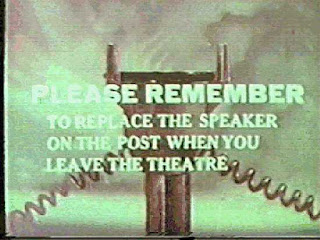
Final note: Above is a sign off from a TV station in Raleigh NC, which would have been one of the local TV stations (for me) at that time.  Sign offs were de rigueur in those days because TV stations went off the air after the news (or the late show).

Quiggy

Monday, January 3, 2022

The Creature (re)Generation


So, I was browsing old drive-in ads on Pinterest and found this in an archive.


And I thought, what better way to get a new year's start on trying to get back into this blog.  Both movies have been given the MST3K treatment, so I knew going in that both were pretty shoddy and potentially laughable.  


Both movies are a product of the  60's and brought to the US under the auspices of American International, the giant of the drive-in movie world.  Both movies are also originally produced in foreign markets.  The Green Slime came to us from Japan and Reptilicus came to us from Denmark proving that low-budget schlock is not strictly an American product.


As far as The Green Slime is concerned it's a co-production with AIP and Toei studios in Japan, but as near as I could tell there isn't one single Japanese actor or actress in the entire production. (Unless thos green slime creatures are really Japanese people in the costumes. At least the Danish produced Reptilicus is handled by an all-Danish cast (none of whom you will recognize (unless you are a devotee of Danish and West German cinema,


Both are definitely the kinds of movies that I originally started this blog to bring to light, low-budget drive-in fare that exemplifies some of the main tropes of 50's and 60's drive-in cinema; sub-par acting, ridiculous dialogue and cardboard characters that have no depth.  But both are entertaining in their own right if you like that sort of thing.


The Green Slime (1968):


"Is it something in your head?

Will you believe it when you're dead?

GREEN SLIME!" 

(lyrics from the theme to The Green Slime)


The opening song is an indication of what we are in for.  Sounding (to me) kind of like the psychedelic rock that was prominent at the time, it is pretty catchy, but the lyrics are just plain weird.  I was reminded of Iron Butterfly, myself.


This movie starts out with a theme similar to later big budget movies you are familiar with (Armageddon and Deep Impact, both from 1998).  Early on one of the characters on a space station, the Gamma 3, mutters somewhat reluctantly, that "Nothing ever happens around here."


Of course, you know from experience that that's when something exciting does happen. Because the next line is another character who says "I'm getting a lot of interference...".  Which of course is is when the $^:+ hits the fan.


The team on the space station has discovered an asteroid which as somehow veered of course of it's standard trajectory and his headed on a collision course with, you guessed it, Earth.  And it's going to cause a butt load of damage if it hits.


The commander of the space station, Commander Vince Elliott (Richard Jaeckel) relays the information back to Earth and his superior decides the situation warrants him calling out from retirement an officer, Commander Jack Rankin (Robert Horton) to go up and take over the reins on a mission to destroy the asteroid.


Vince

Jack  


Warning, Will Robinson! Danger! It seems that Rankin and Elliott are not the best of friends, and the problem mainly stems from the fact that Elliott stole Rankin's girl away from him.  And Dr. Lisa Benson (Luciana Paluzzi) just happens to be on the space station with Elliott.


Lisa

(BTW, if she looks familiar, her most famous role, for me anyway, was as one of the Bond girls in Thunderball.)


The egregious subplot of a love triangle is only one of the more ridiculous parts of this movie.  What happens when the crew lands on the asteroid to blow up the thing constitutes what makes up the bulk of this movie.  It seems there is some kind of green slime buried under the rock where they plant the explosives.  And one small loogie sized bit of it gets on one of the crewmen's clothes and is brought on board the space station.


The green slime stuff as the ability to regenerate itself at an alarming rate and eventually becomes a one-eyed tentacled creature that rampages over the space station.  And it's regenerative powers means that every time it is hit and a piece of it comes off, that piece regenerates into another creature.  (Which explains why the movie poster says "The Green Slime ARE coming" not is coming.)


GREEN SLIME!


The conflict between Rankin and Elliott escalates as each has ideas as to how the invader should be addressed.  And of course there is the ubiquitous scientist on board< Dr. Hans Halverson (Ted Gunther) who advocates keeping one alive so it can be studied.  Just think what it could mean to science and posterity to understand such a creature (that could multiply itself and cover the Earth in just a few days) ...how can we pass up that?


Eventually of course the slime creatures overwhelm the entire space station and the inevitable must happen.  "What's the inevitable?" you ask?


Why, of course, the conflict between Elliott and Rankin over whether the space station should just be destroyed so the creatures can't do any havoc on terra firma.  And he-man heroes that they are, only one can win that battle...


A final note: The Green Slime was a directorial effort by Kinji Fukasaku whose other efforts including being on of the directors of the Japanese sequences of Tora! Tora! Tora!, the classic American-Japanese extravaganza that depicted the Japanese bombing of Pearl Harbor.


Reptilicus (1961):

Danish miners are drilling in Lapland for copper and discover something unique on the drill bit when it is pulled from the Earth.  Skin and blood!  They also discover a piece of a prehistoric reptile, a tail, which they naturally take to the local scientific institute.


The scientists decide that the best possible solution for their new find is to keep it frozen.Which they manage to do up until someone fails to keep an observation on the controls and the freezing unit fails.  And you know that's not good.


The tail begins rapidly regenerating until gradually the monster has regenerated itself into a complete prehistoric behemoth which the scientists have dubbed reptilicus.  And because it is all powerful (and it is needed to keep the plot going) it escapes.  


But before the action goes into full swing we are treated to a travelogue of modern day Denmark for some reason.  And briefly a musical number with a song called "Tivoli Nights" none of which has anything to do with the plot.


A lot of the action seems to be culled from clips of maneuvers culled from the archives of the Danish army as the try to get a line on Reptilicus.  But they are making a BIG mistake.  They keep trying to blow it up.  Until one of the scientists (a woman, who is apparently smarter than all the men put together) points out that if they blow it up it will scatter parts of Reptilicus all over the countryside, each with the potential of regenerating into another Reptilicus.


The dialogue and the acting are on par with some of the worst American made low budget flicks of the era.  It makes one wonder how any of these actors ever had a career beyond this.  But they did, albeit, as stated before, entirely in the Danish and west German cinema.


The script was written by Ib Melchior, who not only wrote the story that inspired one of my favorite films Death Race 2000, but was also the director of The Angry Red Planet and The Time Travelers, two films previously reviewed on this blog.


Reptilicus is pretty laughable.  I've read that he resembles a marionette from Howdy Doody, but my opinion is he looks kind of like a reject from Jim Henson's Muppets.  He spits green vomit which is dubbed acid slime by the characters although we never see it hit anything, and the movie never even shows the aftermath of what damage it has done, so we can only take the characters words for it that it does any kind of acid damage.  But it does knock over a few buildings.


It has wings, but we never see it fly.  One wonders why it evolved wings in the first place.  Maybe the producers intended to include a few sequences in which the creature battled the Danish Air Force but the Air Force declined to get itself involved in this schlock...


One can only thank God that the Danes only made one foray into this giant monster genre.  They were probably better at sticking with dramas like Babette's Feast.


Well folks, time to fire up the old Plymouth (which is still working even after the Covid panic).  Drive safely


Quiggy.


Saturday, May 16, 2020

Why the 60s Was the Greatest Decade for War Films


This is my entry in the 6 from the 60's blogathon hosted by Classic Film and TV Cafe


"War is man's greatest adventure" - Ernest Hemingway

War movies have been around ever since the invention of movies.  It may not have been among the first subjects. After all, a decent war flick does involve a bit more than some slapdash makeup to create a Frankenstein monster, or even to create the illusion of traveling to the moon.  But take it as fact, once the concept of motion pictures took off, quite naturally the adventure of war became a target to transfer to the screen.

I can't actually tell you what the first war movie was.  I gave up trying to find a website that would tell me.  But as early as 1911, war was depicted on film.  The Fall of Troy, a 1911 short film from the silent era seems to be one of the first, however.

Over the years, war became increasingly a good draw at the box office.  Some of the classics would have to include (regardless of political messages they may have had):  Birth of a Nation (1915), Battleship Potemkin (1925), All Quiet on the Western Front (1930), Sergeant York (1941), From Here to Eternity (1953), Patton (1970), Platoon (1986), Gettysburg (1993), Black Hawk Down (2001) and Fury (2014).

(Author's Note:  For brevity, I only chose one movie from each decade.  This is not necessarily the best movie, just my choice as a representative of the decade. If a movie you favor was not chosen, it does not mean I think it's less than the one I actually chose. Your opinion may differ.)

You will notice, of course, that the 60's are missing from the above list.  That's because, in my opinion, the 60's were the best decade for war films.  The primary subject for war films during this time period, of course, was for the then fairly recent conflict of WWII.  The one we actually could hold our heads high and proudly state "We won!"

Of course, it didn't hurt that some of the biggest names in show business were associated with these films.  I mean look at the cast listing of the six movies I am using as a representative:  Stanley Baker, Ernest Borgnine, Charles Bronson, Jim Brown, John Cassavetes, James Coburn, Sean Connery, Vince Edwards, Henry Fonda, James Garner, William Holden, Trevor Howard, Lee Marvin, Steve McQueen, David Niven, Gregory Peck, Donald Pleasence, Anthony Quinn, Cliff Robertson, Frank Sinatra, Rod Steiger and John Wayne, just to name a few.  Plus you had such stalwart directors as Robert Aldrich, John Sturges and Daryl F. Zanuck behind the camera.

Of course, the following six are only a representative of the whole decade, not necessarily the unanimous best.  They are some of my favorites, of course, but as you will see, I also chose these six because I have already reviewed them in depth in other posts on this blog.  Some of the others not included, but well worth checking out from the 60's output of war films are:  The Alamo (1960), The Battle of Britain (1969), Battle of the Bulge (1965), The Green Berets (1968), Hell in the Pacific (1968), Lawrence of Arabia (1962), The Sand Pebbles (1966), Where Eagles Dare (1968), and Zulu (1964). (Still an incomplete list, but it will get you started.)


My favorite war movie of the 60's is not one that involves actual war action.  I consider The Great Escape  (1963) to be the best of the bunch, however.  It is actually based on a true story about the planning of and escape from a Nazi P.O.W. camp near the end of WWII (based on an account written by one of the P.O.W.s who witnessed the events, Paul Brickhill).  The all-star cast makes this an intriguing movie.  The ending is somewhat of a downer, I warn you in advance.  I won't spoil the ending more than that, but watching the likes of McQueen, Bronson, Garner, Coburn and the like as they plan the escape is rather riveting.  As a side note, I used to call my folks every week when they were still alive, and I would play this movie without the sound in the background as I talked with them. (It helped me focus on the conversations, believe it or not...)


Another great escape movie is Von Ryan's Express (1965).  In this film, Frank Sinatra plays a downed pilot named Ryan who becomes the ranking officer in an Italian P.O.W. camp during WWII.  As such, he makes a general nuisance of himself, earning himself the rather disparaging nickname of "Von Ryan" (insinuating that he has Nazi sympathies).  The ultimate goal at the end is the commandeering of a prisoner train that is transporting the Italian P.O.W.s to a German P.O.W. camp after the Italians have surrendered.


 The Dirty Dozen (1967) is a different animal altogether.  In this film Lee Marvin is an officer given the task of training a dozen malcontents into a crack force of soldiers destined to create havoc at a secret Nazi rest area for officers of the German army.  And the all-star cast of this one has people who have memorable scenes which will stick with you long after you watch it.  Don't miss the great performances of Charles Bronson, Telly Savalas, and Donald Sutherland just to name a few.


On the heels of that escapade comes another story about a cadre of men with a goal to disrupt the Nazi's and their nefarious deeds. The Guns of Navarone (1961) involves a group who must somehow disable a couple of devastating guns in a mountain stronghold that is creating havoc with troop movement of the Allies.  Gregory Peck and David Niven are among the stars of this great adventure.


In The Devil's Brigade (1968) William Holden is the leader of a cadre of American and Canadian soldiers with a task to capture yet another Nazi stronghold.  Like the Dirty Dozen, many of Holden's charges are malcontents who must be whipped into shape before proceeding on their mission.


Rounding out this sextet of great 60's war movies is another one that is actually based on fact.  John Wayne heads yet another cast of familiar names staging the historical D-Day invasion of France, then under Nazi control.  The Longest Day (1962) focuses on more than just Wayne, however.  Most of the big names are listed above, but you will recognize quite a few more of them, depending on your movie watching history.  And the fact that it's all pretty much true to the actual conflict is a history lesson that for once you might not mind enduring.

Looking back, the fact that all of these are representative of only one conflict, WWII in Nazi Germany, may seem a bit choosy.  But the fact is there is not a dud in the bunch.  And they were all made during one decade. For more in depth discussion on each entry, please click on the links to see my thoughts on each.  Or better yet, devote a weekend to just watching the movies.  I guarantee you won't be bored.

Drive home safely, folks.

Quiggy


Saturday, May 4, 2019

And the Child Will Lead


This is my entry in the Audrey Hepburn at 90 Blogathon hosted bu Sister Celluloid.


It's always been hard for me to understand society's hostile view of homosexuality in the period before Stonewall.  Although I grew up raised to view homosexuality from an evangelical Biblical view (in which it is cast as a sin against God), I was also raised to accept others as they were.  Which is something of an oddity when you consider that I have gone on the right side of that equation in my life.  I am heterosexual by nature (and/or upbringing), but I accept the idea of an alternative lifestyle as being equal to my own choice.

Anita Bryant made headline news in the 70's when she campaigned for the repeal of a law that prohibited schools from discrimination based on sexual orientation.  It was called "Save Our Children" and based on some concept that "being gay" was somehow contagious.  At least that's the impression I got.  I think she thought that gay teachers had some secret agenda to indoctrinate their charges with the decision to become gay.

From the early days of the Hays Code, homosexuality had been deemed verboten; you couldn't talk about it directly and any ostensibly gay characters in a film had to come to an untimely end if they were even presented in the first place.  When Lillian Hellman wrote her play that was produced on Broadway, The Children's Hour, which she based on a real 19th century event, it was optioned by Hollywood.  The original play contained the basic premise of one of the students at a girl's school accusing two of her teachers of being lesbians.

But when Hollywood came to call in 1936,  William Wyler , the director,  had to change the name of the movie to These Three, and the basic premise was changed from a lesbian relationship to one in which one of the two women had had a sexual encounter with the other's fiance.  By 1961, some of the strictures of the Hays Code had been relaxed, and Wyler was able to film the play in it's more original form.


The Children's Hour (1961):

Karen (Audrey Hepburn) and Martha (Shirley MacLaine) are old college chums who now run a girl's boarding school.  Martha's Aunt Lily (Miriam Hopkins) helps out.  Karen is engaged to Joe (James Garner), a doctor, but she is also an independent woman.  She has postponed any potential marriage to her beau because she wants the school to be a success first, and she is reluctant to ditch Martha with the school until it can survive on its own.

Going to the school is Mary (Karen Balkin), the granddaughter  of  Amelia Tilford (Fay Bainter).  (Amelia is also the aunt of Joe.)  Mary is a spoiled child, always in trouble at the school, and a selfish conniving little brat.  She constantly uses her manner to get her way, and when that doesn't happen, she isn't above pretending to have all kinds of illnesses to manouever people into feeling sorry for her.

Karen is not one to fall for this subterfuge, however.  When Mary is caught telling a lie, Karen reacts by refusing to allow her to attend a special event.  Mary reacts with typical brattiness, but that doesn't help her situation.  So she tells her Aunt Amelia that she knows a secret about Karen and Martha.  She claims she has seen them in intimate situations (in other words, that they are lesbians).

No one believes her until Mary blackmails a fellow student, Rosalie (a young Veronica Cartwright).  It seems that Mary knows Rosalie is the resident kleptomaniac on campus, and threatens to reveal the fact unless Rosalie corroborates her story.  The result is Amelia is convinced of Mary's story and uses the information to spread the story, and most of the girls are removed from the school by their parents.

Karen and Martha decide to file a lawsuit against Amelia and they plan to use Lily's testimony to help them win their case.  Except Lily doesn't show up for the court case and the two lose.  As the impending closing of the school becomes more and more possible, Karen and Martha commisserate with each other.  Martha then reveals that she thinks she does have those kinds of feelings for Karen and is ashamed of them.

But the fact remains that the two women were not lesbians, and when Amelia finds out that Mary lied she tries to make amends with them.  But Karen is adamant that she is not going to accept the apology.  Martha, for her part, is so ahamed of her feelings she takes drastic measures.  And Karen, who has determined that Joe was not entirely convinced the rumors were untrue, chooses to break off with him.

This movie is a hard one to watch for someone who has such libertarian attitudes towards the private lives of the individual.  I feel for both Karen and Martha in the destruction of their lives; it doesn't matter whether or not the rumors were true, they should have been left alone.

The Children's Hour received 5 Academy Award nominations, although it failed to win any.  Significantly neither Hepburn or MacLaine were nominated for Best Actress.  (Hepburn was nominated in the same year for Breakfast at Tiffany's).  The only actress to receive a nomination was Fay Bainter for her portrayal of the vindictive Aunt Amelia.

The movie is a good example of the intolerance of society towards those who don't fit in to what the society at large considers "normal".  And it still rings somewhat true, even today.

Time to head home.  Drive safely, folks.

Quiggy


Saturday, April 28, 2018

Spaced Out in 1961


This is my entry in the 1961 Blogathon hosted by Movie Movie Blog Blog.


1961 was a momentous year.  The year started with the first Roman Catholic candidate for President being inaugurated into office.  Later significant events included the first man to orbit the Earth in space (Yuri Gagarin) later to be followed by the first American in space (Alan Shepherd),  the President first advised the public about building fallout shelters, the "hijacking to Cuba" craze started with the first plane that was hijacked, and Adolph Eichmann, one of the major organizers of the Holocaust, went on trial (and was later found guilty of war crimes).  Also significant;  your not-so-humble blogger was born.

On the movie side, several significant and well received movies made their debut in 1961.  West Side Story was the Oscar darling of the year, but also significant movies such as The Hustler, The Guns of Navarone, Judgement at Nuremberg and Breakfast at Tiffany's, all of which took home Oscars were released.

On the slightly less significant, but just as interesting side of the entertainment industry were the first performance of a band that called themselves "The Beach Boys", two classic TV shows, "Mr. Ed" and "the Dick Van Dyke Show" premiered, and Roger Maris hit 61 home runs in a single season (a record that would stand for 37 years).


The Phantom Planet (1961):

There is nothing like a rogue planet to stir up consternation among the scientific community.   Especially when that rogue planet only shows up periodically to cause havoc with the space industry.

The Pegasus III encounters some problems while out from  Lunar Base 1, scoping things out.  The instruments go haywire and then suddenly an asteroid appears on the radar that wasn't there before.  Not only that but some tractor beam has caught the Pegasus III in it's grip and is drawing it into the asteroid.  (Can anyone say "Death Asteroid"?).  Also since Lunar Base 1 is unable to detect the asteroid out there in space, the only people that have encountered it were the crews of the two spaceships that have eventually crash-landed on it.


Yes, I said two.  Apparently this has happened before.  A previous spaceship, Pegasus II, also experienced the same phenomena.  And apparently there were no survivors of either crash.  This doesn't make the American space bigwigs back home very happy.  So they decide to send their best pilot, Capt Frank Chapman (Dean Fredericks) to check it out.  Chapman had been scheduled to be the first man to fly to Mars, but the brass decides to postpone that in an effort to get to the bottom of this situation.


Chapman goes out in Pegasus IV (you'd think there might be some superstition about sending out a third spaceship called Pegasus, but maybe that's just me...)  Chapman and his second-in-command, Lt. Ray Markonen (Richard Weber), don't initially find anything.  They conclude that the orbit of the mysterious planetoid must be very erratic.  Through some rather unfortunate events, Markonen is eventually killed.


Then Chapman finds the same planetoid that the others have found, and yes, his rocket is also captured by the mysterious tractor beam that the other  spaceships.  But our hero manages to get the ship to land safely.  He passes out into unconsciousness after exiting the spaceship.


He is found by a band of Lilliputians (really, little people just like the ones in Gulliver's Travels).  They open his helmet, and when he breathes in the air of the planetioid, he too becomes a little person.  He is taken hostage where he meets with the ruler of the place, Sessom (Francis X. Bushman).  Chapman finds himself on trial for the crime of being a foreigner (??!!)  His sentence;  he is made a citizen of Rhetan (???!!!), the name for the planetoid.


He immediately gets on the bad side of Herron (Anthony Dexter), the resident bully, because Herron sees him as a rival for the love of Liana (Colleen Gray), who happens to be the daughter of Sessom.  Of course, Chapman doesn't really want Liana, or for that matter, to even stay on Rhetan, but he is almost a prisoner, since he is forbidden to ever leave.  But if he is to remain, and is to actually marry and become a viable producing member of society, he actually has his designs on the mute Zetha (Delores Faith).

But Herron insists on a duel for Liana.  When Chapman gets the upper hand in the duel, but refuses to administer the death blow, Herron and Chapman become bosom buddies.  (only in the movies...)  Herron and Liana and Zetha eventually agree to help Chapman escape Rheton.  Fortunately for Chapman, if he does get back to Earth, he won't be six inches tall anymore, because, surprise, surprise, when he breathes his normal Earth oxygen, he will be reverted to his normal size.


In the interim, the Rhetons have to do battle with another race know as the Solarites.  These are pretty ugly creatures (actually we only get to see one, a thoroughly unrecognizable Richard Kiel, in his first feature film role as a captured Solarite being help prisoner on Rhetan).  It is Chapman's bravery that helps get him the help he needs to escape the phantom planet.


As ridiculous as this whole thing sounds, the movie is actually pretty good.


Assignment- Outer Space  aka Space-Men (1961):

The Italian movie Space-Men was made in 1960.  It appeared on the US shores with a re-dubbed English version of the script in 1961 as Assignment: Outer Space.


I am honestly not sure what the hell the plot of this movie is.  Initially, a reporter from Earth, Ray Peterson (Rik Van Nutter), also given the name of IZ41, is sent to a space station to write a story about "infra-radiation" (whatever the hell that is..).  He makes friends with the pilot who takes him out to the space station, Al (Archie Savage), also known as X15.  (Note:  It's never really clear why all these people have additional alphanumeric names, especially since most of the time they are addressed by their given names).


Once on the space station, Peterson gets sideways with the commander, George (David Montersor) (who is the only one who wasn't given an alphanumeric name, so I guess rank has its privileges).  Peterson, just by being there, annoys the commander.  But he also a supreme f**k-up.  He manages to cause a problem that makes the ship lose 500 gallons of fuel into space.  (Of course he was trying to save the life of Y15, a fellow astronaut, but that is besides the point, as far as George is concerned.)


Y15, as it turns out, is Lucy (Gabriella Fannon), the ship's navigator.  The ultimate surprise, (sexist as it may be, but this was the early sixties after all) , when Peterson finds out that his fellow astronaut is female is to exclaim "You're a girl!"  To her credit, she doesn't respond with "No sh*t, Sherlock!"  The bad news is, now Peterson is even more hot water with George because, guess what, Lucy is George's girlfriend.  (It's probably useless to ask why the authorities let a girlfriend/boyfriend situation be on the same space ship...)


Now here's why this plot is so confusing.  Apparently there is a rogue spaceship, pilot-less, that is heading towards Earth.  When it reaches Earth it will begin to orbit it.  And it's fitted with some kind of cosmic mumbo-jumbo that will burn up the planet if it is allowed to orbit it.  And it's also got some heavy-duty force field that makes it virtually impregnable to missiles.  (I can't help but wonder why the scientists built the damn thing in the first place..  Also this sounds a bit like the Death Star, again.  Wonder if George Lucas watched this double feature in real life as a young man..)


Several attempts are made to destroy the rogue spaceship, but eventually, and you had to know this was coming, our hero, despite being only a reporter and not having any space piloting experience, volunteers to drive a space cab through a tiny vulnerable spot in the force field and land on the space ship, in an effort to disable it.  Any guesses as to whether he succeeds?   Peterson of course is given a medal by Princess Leia (oops, I mean, he gets to be friends with his fellow spacemen, including George and Lucy).


I can save you a little bit of trouble on this one.  The acting is very sub-par.  The special effects are negligible.  (There is even a short three or four frame scene in one shot in which you can clearly see a car and a house, despite the fact that the scene takes place on Mars, which even in this movie is currently not habitable.)  Both of these movies were released on the same day, December 13, 1961  (just two days after yours truly was born).  They indeed were paired at the drive-in so it's looking more and more like Lucas might have seen them together.  Take my advice, though.  See the first one, but skip this one, unless you are a movie masochist like me.


Time to drive off into the dark recesses of space (or at least to the nearest Death Star).  Drive home safely folks

Quiggy


Wednesday, November 1, 2017

The Art of the Hustle

 The Also Rans (Post #1)

This post is part of an ongoing series that will cover movies that were nominated for Oscars in all five of what is affectionately known as the "Big Five" (Best Picture, Best Director, Best Actor, Best Actress and Best Screenplay), but failed to win any of those awards.


Years ago, there were thousands of pool halls across America.  These weren't the glitzy, yuppie-infused hangouts of today, where college students go to drink and pick up potential sexual liaisons, with pool being just a side attraction.   These were low-lit halls where working men went to play pool and relax.  As one of the proprietors says to Eddie Felson early in The Hustler, there's "no bar, no pinball machines, no bowling alley.  Just pool."

The aura of The Hustler is one that will either attract you or repulse you.  The grittiness of the movie and the seedier sections of the towns where these pool halls are located seems to have an effect on the viewer.  Personally, I would find such an atmosphere intimidating at first, but once I got adjusted to it, I think I would start to appreciate the lack of pretense.  It's too bad I was a little late coming into the world because I would dearly love to find such places.  You however, may feel like you want to go wash your hands after seeing this movie, and that's OK.

One of the things that makes this movie work so well was the decision to film it in black and white.  Of course, Robert Rossen, the director of the film, preferred to work in black and white anyway, but the darkness of the story works much better in this medium.  I refer you to the sequel, The Color of Money, which was made some 25 years later, and was filmed in color.   Although that movie, directed by Martin Scorcese, is very good, it just doesn't have the zing of the original.

Paul Newman was not the first choice of Rossen.  He wanted Frank Sinatra, whom he expected would have made an extension in portrayal jumping off from his character in The Man with the Golden Arm (a movie about a heroin addict).  But Sinatra was not available.  Other actors were sought after and auditioned, including Jack Lemmon and Cliff Robertson, but Newman got the nod for the role and history was made.

Piper Laurie was a relative newcomer when this movie was made.  She had been in a few movies, but nothing really substantial until The Hustler.  Her performance as an alcoholic and part-time college student was a bravura portrayal.  Unfortunately, nothing came her way after her Oscar nominated performance and she decided to marry and retire from acting.  Her next role didn't come for 15 years when she was again nominated for an Oscar for her role as the evil mom in Carrie.

Jackie Gleason and George C. Scott were also nominated for Oscars in the Best Supporting Actor category.  Gleason, in particular, stands out because he manages to essay the role of Minnesota Fats with a minimum of dialogue but a maximum of body language.  The cool pool wizard (Gleason was a prety good pool player in his own right, BTW) manages to be a presence in the movie just by being on camera.  Scott also puts forth a grand performance, as described by one writer I read, "a devil in sunglasses".

The fantastic part of this movie is it never drags, not even once.  The scenes in which the action primarily involves playing the game of pool are especially entrancing.  The Ultimate Book of Sports Movies by Ray Didinger and Glen Macnow rank this movie as #8, and the website digitaldreamdoor ranks it as #2.  While you may wonder how pool is considered a sport, ranked with football, basketball and baseball and the like, I remind you that quite often ESPN has broadcast pool tournaments, and I personally think pool is more exciting to watch than tennis.  I won't even discuss how uninteresting it is to watch people play poker.


The Hustler (1961)

"Fast Eddie" Felson (Paul Newman) and is partner Charlie (Myron McCormick) arrive in a town, claiming to be on their way to a convention.  Felson hustles some money from the locals and they continue on their way.  Eddie has plans to meet with the legendary Minnesota Fats (Jackie Gleason) and challenge him to play pool for big money. Eddie is the up and coming wizard and already has a legend following him.  But he is a victim of his own making because he is an alcoholic and sometimes lets his drinking get in the way of his playing.

When he finally meets up with Fats he manages to beat the pool legend for a total of  $18,000, but his ego and his drinking get in the way and he loses all but $200 of it right back to the fat man.  He is hampered by the fact that Bert Gordon (George C. Scott) has insulted his ego by calling him a "loser" and encouraging Fats to keep playing him.  A falling out occurs between Eddie and Charlie and Eddie leaves the hotel room in which he and Charlie are staying, leaving half of the $200 with him.

 At a bus terminal Eddie meets Sarah (Piper Laurie).  They chat for a while and Eddie tries to put the make on her, but she becomes nervous and dismisses him.  Eddie meets up again with Bert who again calls him a "born loser", saying that he has talent but that he lacks character.  Bert tells him he will stake Eddie to play Fats again, but he wants a 75-25 split of the winnings, with bert getting the lion's share.  Eddie scoffs at this prospect.

Eddie and Sarah meet up again, and the relationship begins to blossom.  He moves in with her.  He wonders where she gets her money, since she seems to have no job, and she is not very forthright in revealing her situation, but these are two people who know where they stand in society and he accepts her ruse.

Eddie hustles a local shark and in revenge the shark and his buddies break Eddie's thumbs.  Unable to play pool for the time being he becomes entirely dependent on Sarah.  After he heals from his injuries, Bert reappears with his offer and Eddie decides that "25% of something is better than 100% of nothing" and agrees to the deal.  Bert takes Eddie to Louisville here Bert has a prospect for Eddie, a rich man who loves to play and gamble.  But the game turns out to be carom billiards instead of pocket pool, which Eddie had never played, and he promptly loses.

Telling Bert that he knows he can win, he continues to play and manages to win a substantial amount which nets Eddie the $3000 stake he needs to play Fats again.  Bert  and Eddie have a falling out after Sarah commits suicide, a result of her humiliation from having a sexual encounter with the evil Bert. 

The final encounter, between Eddie and Fats is one to see.  Once again Eddie is on his game.  It plays out just as you would probably expect from a 60's movie, but it is well worth seeing.

As stated in the prologue, The Hustler was nominated for all five categories of the "Big Five".  In case you were wondering, here are the winners who actually got to go home with those statuettes:

Best Picture:  West Side Story
Best Director: Robert Wise for West Side Story
Best Actor: Maximillian  Schell for Judgement at Nuremberg
Best Actress: Sophia Loren for Two Women
Best Screenplay: Abby Mann for Judgement at Nuremberg

As an added note, The Hustler did take home two Oscars, on for Best Art Direction and one for Best Cinematography, both in the "Black and White category.

That's it for this first entry.  Hope you enjoyed it.

Quiggy