Wednesday, December 18, 2019

The Rise and Fall of a Big Man


This is my entry in the Al Pacino Blogathon hosted by Pale Writer


In the early 80's, somewhere around 1983, Showtime broadcast what was, at that time, the only two Godfather movies, edited so that it was historically in sequence.  It was my first ever experience with the Godfather saga.  For those of you who have never seen either, the first Godfather movie showed the transition of the Corleone family post WWII, as Michael Corleone (Al Pacino) arrives home from serving the country in WWII, and the family's dealings with pressure to expand it's operations from gambling and prostitution into the drug culture, among other things.  Vito Corleone (Marlon Brando) is an old-fashioned guy who resists the coming change, while his eldest son, Sonny (James Caan) looks at the potential from a money point of view.

Michael himself is resistant to get involved, wanting to distance himself from the family "business".  But when Sonny is killed in a gang hit, Michael eventually transfers from being a reluctant participant to an active leader, and after the death of his father takes over the family business.

In The Godfather Part II, Michael is now the capo di tutti capi, and is trying desperately to maintain his empire.  In contrast the film also shows the immigration and maturation of the original Godfather, Vito (played by Robert DeNiro), as he learns how to survive in the Italian ghetto of New York.

When Showtime originally aired its edited version (a 4+ hour extravaganza), it transitioned the Vito/DeNiro portion to the front of the movie series, thus making it more historically in sequence.  It wasn't until a few years later that I got to see both movies in their original form.  Needless to say, the effect was eye-opening.

You get the idea that Hollywood doesn't really understand some of it's potential.  Else why would they have allowed Ted Turner to "colorize" dozens of black and white films back in the 80's, most of which were not improved by the process and many of which lost its cache by the coloring?  And why would they allow the altering of director Coppola's vision by taking the flashback sequences out of context in this film?  It's fortunate that the historical sequencing of the Godfather films did not become big, because watching The Godfather Part II in its original form has something that would be entirely missed watching it in sequence.  The whole film acts as a parallel between the rise of Vito and the gradual decline of Michael.

The film was a big hit at the Oscars.  It was nominated for 11 awards and won six of them, including Best Picture and an award to DeNiro for Best Supporting Actor  Which I think was the first time for an actor in that category, whose character spoke virtually no English in the role.  He spoke Italian with the exception of one or two phrases.   (Sophia Loren, BTW, beat him out as the first overall foreign language Oscar recipient, when she won one a few years earlier for Two Women, in which her character spoke Italian.  And if you want to get technical, Jane Wyman actually won the first Oscar by playing a character who used sign language to communicate.)
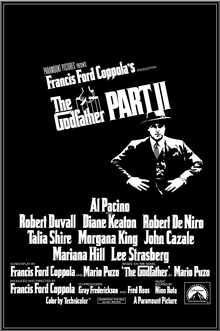


The Godfather Part II (1974):


1901:  While Michael (Al Pacino) contemplates his future...


We are first treated to a flashback to a young Vito Andolini (Oreste Baldini) as he accompanies his mother to beg the local Mafioso chieftain, Don Ciccio (Giuseppe Sillato) to spare the life of young Vito.  See, Vito's father insulted the don and the don had him killed.  It is probably already too late for Vito's older brother who has sworn vengeance for his father, but mother thinks she can convince the don that Vito is too shy and stupid to join in.  When shortly thereafter Vito's brother is indeed killed attempting to extract vengeance, mom helps Vito to escape and young Vito heads to America.


1958:  Michael is trying to gain control of several gambling casinos in Las Vegas, part of his attempt to legitimize the family business.  At his son's First Communion party, Michael meets with a corrupt senator (G. D. Spradlin) who tries to extort more money from the Corleones than is normally charged for the transfers.  Michael counters with another offer, one which the senator rejects.  (But he will live to regret it, as we shall see.  Don't **** with the family there, senator...)


Michael also meets with a mob sub-boss Frank Pentangeli (Michael V. Gazzo) who wants permission to dispense with a pair of brothers, the Rosatos, who are causing him some grief in his New York territory.


But Michael refuses to grant permission because the Rosatos are connected with Hyman Roth (Lee Strasberg), a business partner in Miami.  When later that night an assassination attempt is made on Michael, he suspects his business partner.


1917:  The now grown Vito Andolini (now called Vito Corleone, due to a discrepancy  during his initial immigration) is working in a grocery store and raising a new son.  Don Fanucci (Gastone Moschin), the local Mafioso boss forces Vito's boss to hire on his nephew, thus essentially forcing the man to have to fire Vito.  Vito meets Clemenza (Bruno Kirby) for the first time and unwittingly helps him in a robbery.


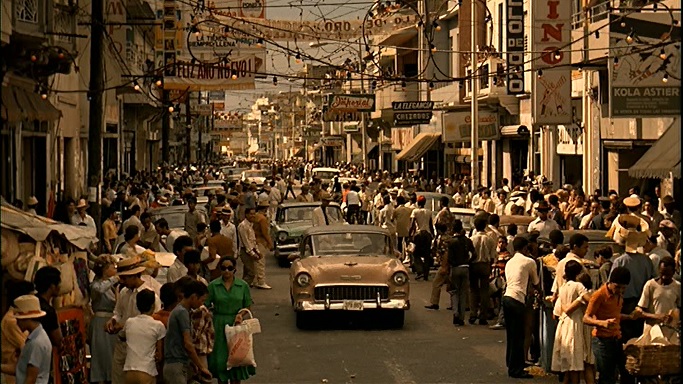
1958:  Michael meets with Roth, although he does not let on his suspicions that Roth was involved in the attempted assassination,  Instead he convinces Roth he suspects someone else.  Roth and Michael travel to Havana where they have an ongoing relationship with the current leader of the country, Batista.  Several things occur to sour things, including a failed attempt by Michael to have Roth killed and the revolution that brings Fidel Castro to power coming to fruition.


1920:  The situation with Don Fanucci is getting out of hand.  The don extorts money from everyone and even tries to muscle in on Vito and his friends' occasional robberies, demanding a cut in return for the don not ratting them out to the police.  Vito arranges for the don to take an early exit from life.


1958:  Michael has to deal with the Senate Subcommittee's investigation into the activities of the secret organization known as the Mafia.


He also has to deal with his older brother Fredo (John Cazale) who may or may not be ignorant of his involvement behind the attempted assassination of Michael.  But Michael resolves not to do anything while his mother is still alive.


And what's worse is his wife, Kay (Diane Keaton) insisting that she is leaving Micheal and taking the kids with her.  Not only that, but she tells him the miscarriage he assumed she had was actually an abortion.  (And that's the straw that breaks the camel's back, so to speak...)


1923:  Vito returns to his hometown of Corleone and exacts his revenge on Don Ciccio, now an old man and no threat to anyone, but revenge is revenge, especially in the society of which Vito has been a part.


The movie comes full circle as by the end we see Michael sitting alone and contemplating his future.  His friends are gone, his enemies are gone, his family is gone and he has only what he has built for himself, a life of crime and the loneliness it produces.


Watched by itself, The Godfather Part II may not completely satisfy since you are not really given much background on why Michael is where he is today.  But then how many movies have you seen recently as stand alone movies are there in which all the characters motivations are revealed in the context of the movie?  Personally I would watch all three Godfather movies in succession (there was a third one that came out in the 1990's which takes up the Corleone saga 20 years later from the end of Part II.)

Al Pacino is in top form in this outing.  At the Oscars that year,  he competed with the likes of Jack Nicholson (Chinatown), Dustin Hoffman (Lenny) and Albert Finney (Murder on the Orient Express), any one of which COULD have won, but  all lost to Art Carney (Harry and Tonto), and the less said about that injustice the better.


Time to fire up the old Plymouth.  Drive safely folks, and watch out for big long cadillacs packed with gunmen....

Quiggy

Saturday, December 7, 2019

Hamlette's Merry Christmas Tag

A movie tag created by my friend Rachel (Hamlette).  I'm just doing the movie part.  I won't tag anyone, too much risk of offsetting people.  But you are welcome to follow suit if you feel inclined.  You can check out her original post here.


1.  A Partridge in a Pear Tree - movies that involve agriculture.

Field of Dreams (1989):

First off the bat (no pun intended).  Nothing in the rules said I actually have to LIKE the movie I pick (which you will see my opinion if you read the link).  Although mostly about baseball, Costner's character is a farmer.


2.  Turtledoves - movies about a long-lasting relationship:

Longtime Companion (1989):

This is a beautiful story about the long term relationship between several gay couples during the onset and aftermath of the early years of AIDS.  I chose to use it here rather than in another category (#5).  It has some heartfelt and tender depictions that some straights overlook when thinking about the gay community.


3.  French Hens - movies that take place in France.

The Longest Day (1962):

A movie with too many stars and cameos to mention.  OK, just one... JOHN WAYNE.


4. Calling Birds - movies where people talk on the phone.

Bill and Ted Films (1989 & 1991):

OK, I'm stretching a point here.  There are a few scenes where people talk on the phone, but I couldn't resist using these movies because the time machine is a phone booth.


5. Golden Rings:  movies with multiple romances.

The Princess Bride (1987):

You've got Westley and Buttercup.  You've got the grandfather and the grandson.  You've got Inigo and Count Rugen (didn't say they had to be "loving" romances...)  And then you got the romance of Prince Humperdinck with himself.


6. Geese a-Laying - movies with a birth or that feature babies.

Alien (1979):

That scene where the alien pops out of the guys chest is a birth if I ever saw one...


I spared you the scene of the actual birth... you can thank me later.


7.  Swans a-Swimming - movies where someone goes swimming.

Forbidden Planet (1956):

Anne Francis goes skinny-dipping.  OK, not really.  She's wearing a body suit which you can see if you go through the scene in slo-mo.  (Of course I did...)


8. Maids a-Milking - movies featuring cows.

Urban Cowboy (1980):

OK, I took some liberties here.  There are some cows in the rodeo scene, but I picked this for the fact that Debra Winger is on a mechanical bull... and she makes that bull look GOOD.


9. Ladies Dancing -movies with a dance scene.

Xanadu (1980):

No matter what you think of the movie, there are some pretty good dance scenes in it.


10. Lords a-Leaping -movies about athletes.

Eight Men Out (1988):

There was really only one choice here.  My favorite sports movie (despite the fact that the events depicted are less than inspiring...)


11. Pipers Piping - movies with someone playing a musical instrument.

Howard the Duck (1986):

Howard comes to Earth and the best job he can get is playing guitar with an all-girl rock band?  But he does wail on that Stratocaster...


12. Drummers Drumming -movies with a character in the military.

Patton (1970):

I've covered so many movies about war and the military it was tough to pick just one.  But then, George C. Scott is one of my top 5 favorite actors.


So what do you think of my choices?  Feel free to dispute.

Quiggy


Thursday, December 5, 2019

Christmas in Space


This is my entry in the Happy Holidays blogathon hosted by Pure Entertainment Preservation Society


You have no idea to what lengths I will go to subject myself to the most arcane and outre stuff imaginable, just to entertain you.  OK, I admit, most of the time I enjoy it.  But like they used to say in the old Army enlistment commercials, "It's not just a job; it's an adventure".

Case in point is today's entry.  In 1978, with a true sequel to the original Star Wars film still a couple of years away, George Lucas red-lighted a TV special, mostly to keep the film still relevant.  (although in retrospect there wasn't all that much need.  It was and still is one of the highest watched movie franchises in Hollywood history, but this was still early on in it's history).

On Nov 17, 1978, the public at large was subjected to The Star Wars Holiday Special.  The special was a (sort-of) Christmas TV special, even though Christmas was replaced by the fictional Life Day, an event celebrated each year on Chewbacca's home planet. It was aired on CBS in a time slot normally occupied by Lynda Carter's Wonder Woman and the Bill Bixby/Lou Ferrigno show, The Incredible Hulk.

It had some interesting features.  For one it introduced the character of Boba Fett, a later character in the pantheon of films.  And James Earl Jones finally got credit for voicing Darth Vader for the first time.  But it was also a complete disaster.  In more ways than one.

It was so badly received that most of the people involved in it refuse to this day to acknowledge their part in it.   Many fans disown it, too.  There are probably a number of people out there who may have every movie, toy, book and other assorted tie-ins to the Star Wars franchise, but you can be sure this is not part of their collection, unless they have a bootleg copy that was recorded directly off the TV broadcast.  Lucas himself has distanced himself from it and it has never been released on VHS or DVD by Lucas Films.  (Despite the fact that, if you check Amazon, it lists it, albeit as  a "currently unavailable" listing...)

Being a fan of the first film when it came out, and a sci-fi fan in general at the time, I can't honestly remember if I watched it when it was broadcast.  I do know that years later when I heard about it, I was like, "What?  Really?"  But after having watched it a few years ago, I think I could easily have  watched it and then proceeded to convince myself that I hadn't.

If you haven't seen it, you are lucky.  And if you don't click on the link below, you can still count yourself lucky. Don't say I didn't warn you...


You clicked on the link, didn't you...?  :-D  Well, I warned you, so don't blame me.


The Star Wars Holiday Special (first aired Nov. 17, 1978):

The scene opens with Han and Chebacca trying to escape Empire forces and get Chewie home to celebrate the Wookie holiday of "Life Day".

One of the most astounding faux pas of the show is when the scene shifts back to Chewbacca's home planet,  Kashyyyk,  early in the show, where Chewie's wife Malla, son Lumpy and father-in-law Itchy await his return.  (By the way, in classic retro changing of things to accommodate the more serious feel of the franchise, those ridiculous names were later revealed to have been nicknames.  Lumpy's given name is Lumpawarrump.  Itchy's given name is Attichituk.  And Malla is really Mallatobuk.)


The astounding screwball part is that all of the family on Kashyyyk speak in Wookie.  Without the benefit of any subtitles.  Which leaves the confused viewer scrambling, to try to figure out for his or herself what the hell is actually going on.  Fortunately for us, when any human or human-like characters come on the screen they speak English so we aren't completely lost throughout the film...  But it takes about 9 minutes of this almost slapstick type interaction before we get anybody who speaks something we can understand.  (But we are still stuck with the grunts from the Wookies.)

The first English speaking character turns out to be Luke (Mark Hamill) who, along with R2D2, put in a call to the family to wish them a happy Life Day.  Luke expresses concern for Chewie's absence but tries to encourage Malla that all will be OK.


A bit later Saun (played by Art Carney), a junk dealer calls and tells Malla he is going to be delivering some items to them later.


What these turn out to be are Life Day presents for the family. Malla gets a shaggy carpet weaved by "a little old lady who knitted by hand...solo."  (Groan!)   Lumpy gets a box of stuff which later turns out to help in getting rid of some unwanted Imperial guests.  And Itchy gets a holographic disk, which turns out to be some kind of pseudo-pornographic thing.  (At least that was what it came off looking like to me.  No nudity, however...it was a TV show remember, and a 70's TV show at that...)  This includes a hologram of a woman (played by Diahann Carroll), who serenades Itchy with a song.


Harvey Korman makes several appearances here.  One is as a woman cooking instructor teaching Malla how to make Bantha Surprise (with multiple arms yet.)  Another time he plays a rather inept robot instructor trying to show Lumpy how to create his own robot.  He later shows up as an infatuated lovelorn devotee of Ackmena (played by Bea Arthur), a female bar owner.  Arthur also sings a song, while the alien cantina band (Figrin D'an and the Modal Nodes.  Bet you didn't know that band had a name, did you...?) from the movie plays in the background.


This being ostensibly a variety show we also get another song, this one done by a holgraphic band, played by the real band Jefferson Starship (and there's an example of kismet if I ever heard one).  For some reason, during the opening credits, the announcer refers to them as THE Jefferson Starship. 


There is also an animated piece featuring Luke and Han and Chewie and the introduction of the bounty hunter Boba Fett.


And to top off the musical part of this extravaganza Leia (Carrie Fisher) sings a Life Day song (done to the tune of the Star Wars theme, yet.)


All in all, its not entirely bad, but it is cheesy without a doubt.  If you are a full blown Star Wars geek, you may think it almost borders on sacrilege.  All it's missing is a tap dance ensemble with the Wookies in top hats and tails.

Well folks, time to fire up the afterburners and warp speed back to my own planet.  Drive safely, folks.

Quiggy


Sunday, December 1, 2019

Zen and the Art of Bowling


This is my entry in the Jeff Bridges Blogathon hosted by Thoughts All Sorts.


Way back in, like, 1996, man, the writing/directing duo of brothers Joel and Ethan Coen were riding high on the accolades of their recent production, Fargo.  The film had just given the brothers their highest exposure yet, and was nominated for a slew of Oscars.  It only won two, however, one of them for Best Adapted Screenplay.  (It suffered from being pitted against The English Patient, which won most of the awards with which it was in competition.)

So these dudes decided their next project was going to be a spin on the classic genre of film noir.  Go figure.  I mean, there hadn't been a decent take on film noir since, like, back in the early seventies with Chinatown.  But these brothers were pretty sure they had something going with this idea.

As per their usual, they hashed out a script, sometimes even with a specific actor or actress in mind, writing the script to fit a certain personality in their prospective portrayers.  So you gotta understand, man, like, characters are really what the Coens saw in specific actors and wrote to their abilities.

When the movie came out, it wasn't much of a success.  Certainly not the equivalent of what either the Coens or their critics or their public expected as a follow-up to Fargo.  It barely even made a profit (just $3 million over it's budget in its initial U.S. run).

But unlike most movies that don't make much of an impact at the theaters, this one took on a life of its own after the fact.  It had a cult following you wouldn't believe.  I mean, sure, man, you can see the profound effect that a Star Trek had on the geek culture, with Trekkie conventions out the wazoo.  But you missed out on the stoner culture in that category.

Not that stoners make up a good cult following enough to warrant a convention.  Otherwise we might have been inundated with Cheech and Chong conventions over the past 40 years.  But The Big Lebowski took on something that apparently those two stoners from Up in Smoke didn't have.  It is imminently quotable.

Which is how the first Lebowski-Fest got started.  Two guys who worked conventions with their own booth found out they both could spout Lebowski-isms ad infinitum, and really got going with it when they found a slew of like-minded individuals.  The first Lebowski-Fest got started, and has been going fairly strong in its own right ever since.

I came into the Lebowski universe relatively late.  I watched it for the first time one evening with my recovery sponsor, who was a big fan, in 2010.  He must've seen I was a potential for being a devotee.  (And earlier this year I got a chance to see it on a big screen when Flashback Cinema, had it for it's weekly entry.)  The movie is oddball enough to appeal to my quirky sensibilities.  And like a previous entry on this blog, The Big Sleep, it has a plot that jumps around so much you need a GPS navigator to keep up.

So, like, are you ready, man?  Let's go bowling.


The Big Lebowski (1998):

Way back in 1991, during the (first) crisis with Saddam and the Iraqis, there is this guy, called The Dude (Jeff Bridges),  His given name is Jeffrey Lebowski, but nobody calls him the that.  He is just known as "The Dude". (or " His Dudeness" or "Duder" or even "El Duderino" if you're not into that whole brevity thing...)  The Dude approaches life with a nonchalance that would be the envy of any Buddhist trying to achieve Zen.  


The Zen Master  aka "The Dude"


The Dude's troubles start when he is mistaken for another Jeffrey Lebowski, a rich cuss who has a trophy wife who has a penchant for leaving gambling debts all over town.  When two hoodlum collecting agents show up to try to collect the money the rich Lebowski owes, mistaking The Dude for him,  they wreck havoc all over The Dude's apartment, with a final injustice being one of them takes a leak on The Dude's rug.  Which is a shame, because that rug really tied the room together.


Hoodlum collectors


At the bowling league, The Dude's partners, Walter (John Goodman) and Donny (Steve Buscemi) convince The Dude he needs to approach the guilty rich Lebowski and try to get justice (or at least a replacement rug.)


The Dude, Donny and Walter


Which he does.  But the encounter doesn't go well.  The "Big" Lebowski (David Huddleston) kicks him out, but not before calling The Dude some rather select names, impugning The Dude's dedication to being a productive member of society.  But The Dude leaves with a rug anyway, telling Lebowski's assistant, Brandt (Philip Seymour Hoffman) that Lebowski had given him permission.


The "Big" Lebowski

Brandt


Flash forward a couple of days.  Brandt contacts The Dude with a problem.  It seems that Lebowski's trophy wife, Bunny (Tara Reid) has been kidnapped.


Bunny


The kidnappers are demanding a million dollars in ransom.  Lebowski wants The Dude to be the courier.  But when The Dude talks with Walter and Donny about it, Walter comes to the conclusion that the kidnapping is a ruse, that Bunny is just trying to extort more money.  So Walter hatches a plan in which they will pass off a gym bag with his undies as the drop and keep the money.  Which is a success, somewhat...

It gets even more complicated.  While the guys are rolling a few lanes at the bowling alley someone steals The Dude's car, with the briefcase of money still inside.  And the supposed kidnappers come by demanding the real money.  Plus Maude (Julianne Moore), Lebowski's daughter, and, as it turns out, the real financial genius of the family, tries to get The Dude to recover the stolen money from he kidnappers, claiming that the whole thing is a ruse, set up by her father to get money for himself.


Maude Lebowski


Except, of course, if you were paying attention, the money was not dropped off, and The Dude doesn't have it either.  It turns out that a hoodlum wanna-be, a high school student, hijacked The Dude's car and took it for a joy ride.  When the car is found, the briefcase is gone, so quite naturally the guys come to the conclusion the kid has the dough.  And proceed to try to intimidate him into returning the money. 


The kid


It gets even more complicated (as if it wasn't already by now).   No one seems to know where the money is, since the kid didn't have it.  And a band of nihilists who are the supposed kidnappers wreak even more havoc on The Dude's apartment in an attempt to get the money.

So who's actually got the bag of dough.  You may be surprised.  Word of warning, as with any film noir, don't trust anyone.

What with Goodman and Buscemi as co-stars, it couldn't get much better.  But oh, it does.  Check out John Turturro as fellow bowler, Jesus, with a penchant for his balls.  And Ben Gazzarra as Jackie Treehorn,  a porn king.  And Jon Polito, a consummate character actor as a private detective trying to horn in on what he thinks is a fellow private detective, The Dude.  And to top it off there's Sam Elliott as our humble guide/narrator into the world of the Zen Master, The Dude.


Don't mess with The Jesus

Jackie Treehorn and his hoods

Another detective

"The Stranger"


So take a couple of hours out of your day, sit back with your favorite beverage and check out how The Dude approaches the slings and arrows of outrageous fortune (or a bag of dirty undies).  And if you don't agree with me that this movie rocks, well, that's just, like, your opinion, man...

Screw it, dude.  Time to go bowling.  Drive safely, folks.

Quiggy