Showing posts with label 1946. Show all posts

Thursday, November 21, 2019

The Big Confusion


This is my entry in the Lauren Bacall Blogathon hosted by In the Good Old Days of Hollywood.


The Big Sleep, based on the novel by Raymond Chandler, is an important entry in the canon of film noir, not the least of which is it enhanced the mystique of the relationship on screen between its two stars, Humphrey Bogart and Lauren Bacall.  It is in the top 5 of most lists of the greatest film noir movies.

It also has one of the most convoluted plots in movie history.  You almost need a copy of Cliff Notes on the film on hand to keep up with who is killing who and who is doing other dastardly things.

And reading the novel on which it was based is not much help.  Even Chandler himself didn't know certain intricate mysteries in the novel.  When asked who killed the chauffeur, or if he had committed  suicide, Chandler responded with a basic "damned if I know."

But most people can ignore the twists and turns and just watch the dynamic chemistry of Bacall and Bogart.  And if you really want to know what happens, I guess you could just read the wikipedia article on the film.  Maybe it will clear up your questions.  And maybe not.

That's not to say that The Big Sleep isn't a fantastic movie.  It is.

There were some things that had to be removed (or at least subdued) when the film was made.  For one thing, the novel has Carmen Sternwood involved in a pornography scandal.  In fact, when Marlowe first discovers her in Geiger's house, she was completely nude.  Can't get away with that in the Hays Code era... so she is in a Chinese dress.  Also there is a hinted homosexual relationship that was completely omitted.  (You have to understand that writers could get away with being more prurient, but the Hays Code held an iron fist over what could be translated to the screen.)

One thing of important note.  The film was made in 1945, but with the impending end of WWII, the studio withheld the movie until 1946 so it could release war related movies already made to cash in on the war oriented crowd.  AS a result, even though the movie is supposedly taking place in 1946, there are still some war related "anachronisms", like the B sticker on Marlowe's car, signifying that he was significant enough to the war effort to be allowed to buy more gasoline than the average Joe.  And the fact that a woman is driving the cab, a job that would have been reclaimed by a man when soldiers returned.


The Big Sleep (1946):

Philip Marlowe (Humphrey Bogart) appears on the doorstep of the Sternwood house to an appointment with General Sternwood (Charles Waldron).  The general wants to hire Marlowe to clear up an attempt at blackmail.  It seems young Carmen (Martha Vickers), his daughter, has run up some gambling debts, but the General is suspicious.

Marlowe w/ Carmen
Marlowe w/ The General


The General's other daughter, Vivian (Lauren Bacall) attempts to extract from Marlowe what his duties are in the case but Marlowe refuses to divulge.  Which annoys Vivian.


Marlowe w/ Vivian


When Marlowe appears at the door of A. G. Geiger's bookstore (the holder of the supposed gambling debts), he has an encounter with Agnes (Sonia Darrin) and pretty much exposes the bookstore as a front for something else, by asking for two "rare" books which in reality don't exist.


Marlowe w/ Agnes


Following Geiger as he leaves the store, he finds himself at a rundown house where Carmen appears.  Some minutes after Carmen goes in to Geiger's house there is a shot and Marlowe rushes in to find Geiger dead and Carmen stoned out of her skull.  He takes Carmen home, but when he returns to Geiger's house the body is gone.

Thus begins the convoluted plot.  Bernie Ohls (Regis Toomey), a contact and friend of Marlowe's on the police force, appears on Marlowe's doorstep to inform him that they found the Sternwood chauffeur's body in the Sternwood car in the water off a pier.  

Marlowe continues his investigation finding out that small time gangster Joe Brody (Louis Jean Heydt) has a connection.  Carmen has insisted that it was Brody who shot Geiger.  But Joe insists he is innocent.  He just has a plan to blackmail the Sternwood's with some inappropriate photos he found in the Geiger house.  (The only hint that there is a pornography connection).


Marlowe w/ Brody


After Brody is shot by Carol Lundgren, Geiger's bodyguard, who thinks it was Brody who killed his boss, Vivian tries to pay off Marlowe, insisting that his job for the Sternwood's is finished.  But there are too many details that aren't clear and Marlowe suspects that Vivian is being pressured by big-time gangster Eddie Mars (John Ridgely) to lay off the case.


Marlow w/ Mars


If that isn't a twisted enough plot for you, let me tell you, you ain't seen nuthin' yet folks.

What with Mars putting even more pressure on Marlowe to lay off, and with the obviously nymphomaniac Carmen trying to put the moves on him, there's more to this film than meets the eye.  We even get the generally good guy Western actor Bob Steele as a very sinister gunman who is trying to get Marlowe off the case permanently.  You may just need an aspirin by the end to stop your head from spinning.

Well, time to fire up the old Plymouth.  Drive home safely, folks.

Quiggy


Monday, December 17, 2018

Christmas with the Baileys


Christmas movies.  I have stated elsewhere my love of A Christmas Carol and it's various permutations, but there is one tradition that I have had that ranks up there with watching a version of that movie.  For years, on Christmas Eve, on one of the national stations, I think NBC, they broadcast It's A Wonderful Life, a classic from 1946.  I make it a point to watch this movie every year.  Sometimes the rest of the family doesn't want to watch it, so I repair to another room and watch it by myself.

Saturday I had the rare opportunity to go and see it on the big screen at a theater in Austin.  Several things, besides getting to watch it in a movie theater, made this experience memorable.  For one thing, a very old theater in downtown Austin, the Ritz, was the venue.  This is an old-fashioned theater that originally opened in 1929.  It had a run for about 40 years as a movie theater, playing mostly Westerns according to wikipedia,  and then spent a second life as a music venue.  About 10 years ago it was bought and reopened as one of the Alamo Drafthouse theaters.  It only has two screens and the feel of the place is reminiscent of the kind of theaters that were prevalent when I was a kid, although the seats have been upgraded to more comfortable style.  But it still feels like those theaters of old.  Had to enter the theater itself by going upstairs.  That reminded me of when I used to go to movies at the Rialto back home.

Second, prior to the movie, one of the employees came out on a stage that still remains from the music venue days, and regaled us with about a 10 minute historical introduction, including both Frank Capra's and Jimmy Stewart's stints in the military during WWII, and the aftermath in Hollywood.  Most of it I already knew,but it was still entertaining.

The last thing, a rarity these days (but I have read it was sometimes common in movie viewings in the old days), after the movie was over the theater erupted in applause.

It's A Wonderful Life did a decent showing at the theater, although it only barely made back the cost of production. It was nominated for five Academy Awards, but lost out on all of them, most of them to competition from The Best Years of Our Lives.  But I'd hazard a guess that more people have seen It's A Wonderful Life than have seen that other classic.


It's A Wonderful Life (!946):

Things are not all roses and chocolate on Christmas Eve.  Everyone in the town of Bedford Falls is praying for one man, George Bailey.  It seems he may be on the verge of doing something rash.  Rash, indeed.  We see several stars in the sky light up as an angel named Joseph (voiced by Joseph Granby) confers with a senior angel (voiced by Moroni Olsen) about Bailey.  It seems that Bailey is on the brink of committing suicide.  The two call on an apprentice angel, Clarence Oddbody (Henry Travers) and educate him on the life of Bailey up to that point, which is what the bulk of the movie is about.


George Bailey, starting out at a young age (played by Bobby Anderson), has had an impact on people in his life.  First, he saves his younger brother (played by George Nokes) from drowning in a frozen pond.  Some months later he helps his boss, the druggist Mr. Gower (H. B. Warner) from committing a grievous error by giving a local family poison instead of medicine.  (Gower has gotten drunk because he has just received word by telegram that his son has died, so he made the mistake honestly if not acceptably).


And we also find that Mary Hatch (played by Jean Gale) has a crush on George and swears that she will love him to the day she dies.  (Of course, she whispers this in his bum ear which had been affected by the dip in the frozen pond to save his kid brother.)


Several years later, after George grows up, his kid brother is graduating high school and George is making plans to tour Europe before heading off to college.  See he had waited four years in order to save the money and all his high school mates have already been.  (Which makes him, roughly, 21 in his first scene as an adult and if you can accept a 40 something actor playing a 20 year old young man, you are a better dreamer than I am, but that's really the only downside to the movie.)


Unfortunately George's plans are derailed when his father dies of a heart attack and George is corralled into running his father's Building and Loan Company.  See, "Old Man" Potter (Lionel Barrymore) wants to dissolve the Building and Loan because it represents a hedgerow that he can't tear down in his drive to own the whole town.  Potter is that bugaboo of old time-y movies, the rich miser who would probably have been good friends with Ebenezer Scrooge.  (Then again, they may have been mortal enemies since both wanted to have complete control of the resources.)


George gives the money to his brother Harry, expecting that when Harry returns home from college, Harry will take over as executive at the Building and Loan so George can finally go off to college.  Fate sticks her little fingers in the pie once again, as Harry has gotten married while away at college (and he didn't invite the family...???).  And Harry's new father-in-law wants Harry to go to work for him.


But things aren't entirely bleak.  George finally succumbs to the love bug and marries Mary (Donna Reed).  But just as they are about to leave on honeymoon, there is a run on the bank and George ends up doling out his entire nest egg of honeymoon money to keep the Building and Loan from being closed.


As you can guess, just when things start to look up for George, every time Fate pulls the rug out from under his feet.  The final straw happens in the latter third of the movie, when George's Uncle Billy (Thomas Mitchell) accidentally loses a wad of cash needed to pay for loans the Building and Loan owes.  When it all seems bleak, George finally snaps and considers committing suicide.  At which point Clarence shows up in the flesh to prevent the bad decision.


When George laments that everything would be better if he had never been born, Clarence uses the idea to show him just what life would have been like for everybody else if he hadn't existed.  OK, even if you haven't seen the movie, you most likely have seen something of the same sort in any number of TV shows.  It is a recurrent theme, sometimes used for dramatic effect and sometimes for comedic effect.  Just seeing Bedford Falls transformed into a seedy low-rent Las Vegas called "Pottersville" would be enough to transform me, but George has to see it all, including how the lives would have turned out differently for his family, friends, and for Mary.


You don't have to be a psychic to know how it all turns out.  After all this isn't the jaded 2000's that this movie is taking place but the 1940's and good old wholesome happy ending's must ensue.

"No man is a failure who has friends."

Don't miss out on some great character actors playing roles in this movie.  Early in the scene at Harry's high school graduation, Carl Switzer ("Alfalfa" from Little Rascals)  shows up and pulls a rather mischievous stunt on George and Mary.  Frank Fenton, a frequent face in many western movies and TV shows has a scene.  And, OMG, isn't that a very young looking Grandma Walton during the bank run?  Yes, it is Ellen Corby, who told John-Boy "good night" every week for years on "The Waltons".

I leave you with the following: Just a few of what I consider the more fascinating tidbits from an article published on the Mental Floss website about the movie:  Originally the movie was going to star Cary Grant, but as usual with Hollywood things got a bit convoluted and when the rights were sold to Frank Capra he decided he wanted Stewart in the headlining role.  It was Donna Reed's first starring role, although she had been in several movies before this it was her first role as a headliner. The movie was actually shot in the summer.  All that snow is very, very fake.  (and I bet those actors were sweating like pigs under all those heavy clothes, in fact I think in some scenes Jimmy Stewart actually IS sweating...)  And finally, there is no relation to the fact that Bert the cop and Ernie the cab driver have the  same names as two characters on Sesame Street.


Time to fire up the old Plymouth and head home.  I'll try not to hit any generations old trees.  Drive safely folks.

Quiggy


Saturday, September 2, 2017

A Ladd and His Gun: The Sequel


This is my entry in the Alan Ladd Blogathon hosted by Hamlette's Soliloquy


Alan Ladd has never really been on my radar as a film actor.  As a matter of fact, up until I started reading Hamlette's blog, the only movie in which I had ever seen him was Shane.  I have since gotten interested in watching him, especially his film noir outings.  I also discovered a radio series, Box 13, which is a mystery series from the bygone years.  I still don't have the fascination with him that she does. (I have stated elsewhere that the only actor with whom I have ever had a fascination is John Wayne, and I will watch ANY movie featuring him.)

But Ladd is still an interesting actor.  I haven't seen enough of him to get a line on his personality, but he seems to be a pretty good actor.  Some time down the line I think I might get to a double feature of his westerns (of which he made a few), but in the meantime, being the film noir aficionado that I am, I present this pairing for the blogathon.


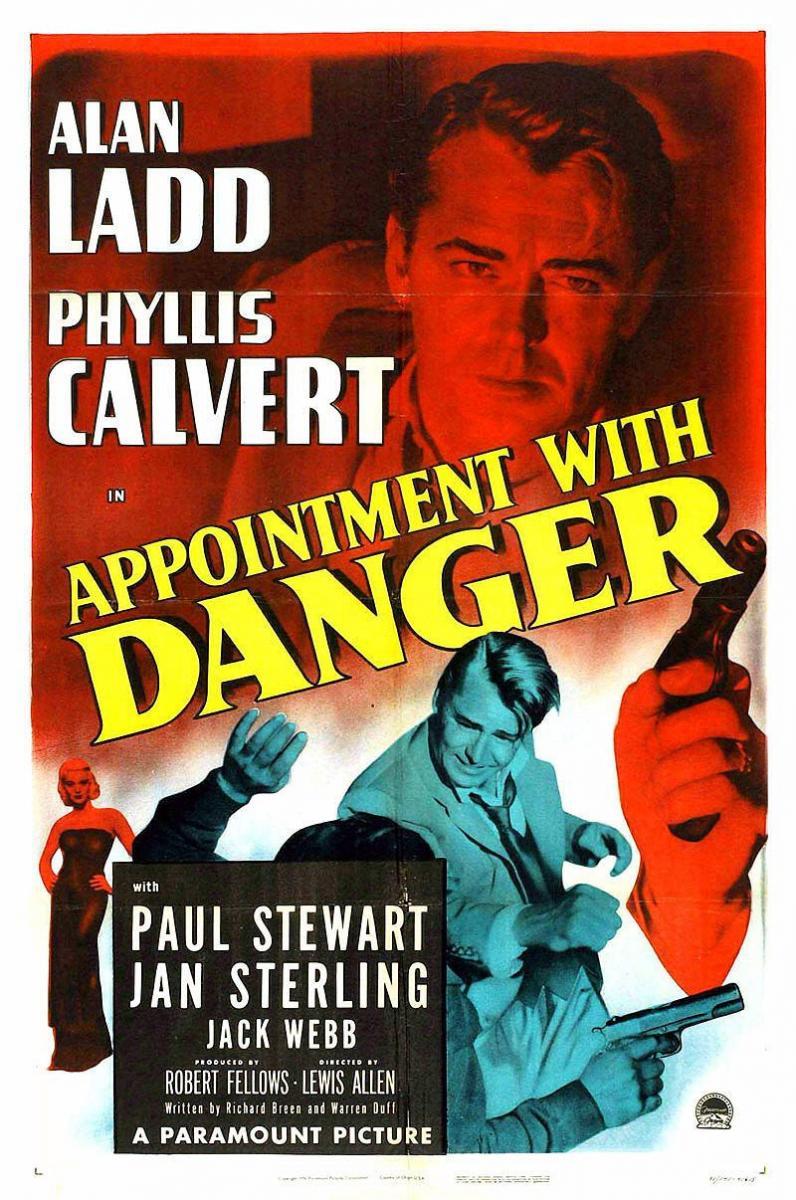
Appointment with Danger (1951)  

 Alan Ladd plays a postal inspector in this entry.  (Who knew post office employees could have such hair-raising adventures?)  A postal inspector has been murdered and the follow up investigation, a postal inspector named Al Goddard (Ladd) tries to figure out why.

On a rainy night in Gary Indiana, two men murder a postal inspector.  The men are played by Harry Morgan (as George Soderquist) and Jack Webb (as Joe Regas).  Yes the two men who are well known as a pair of cops from the black and white TV series Dragnet play a couple of hoodlums.  This is one of the more interesting aspects of the film.  Webb in particular plays a rather sadistic sort, although, in my opinion, Webb played every character pretty much the same way, with his rather serious demeanor and distinct staccato delivery of lines.  Actually, Morgan is pretty much identifiable too, but he has a bigger range of emotions that he can play.

In the alley where they are trying to ditch the body they are spotted by a nun, Sister Augustine (Phyllis Calvert).  While George distracts the nun, Joe tries to manhandle the body and George tells the sister that the friend is drunk.  She goes on her way, but tells a cop about the incident.  Instead of checking it out the cop decides to chase down a speeding car instead.

Goddard is brought in on the case after the body is discovered and the cop has confessed he didn't investigate, but the nun is named as a witness.  Goddard's first job is to track down the nun.  When he finds her he has to remind her that it is her duty to identify the man she saw because she is reluctant to get involved.  Augustine tells the Mother Superior of the nunnery that she is reluctant because she sees that Goddard has "no heart, no charity".

(I should point out at this juncture that I wholeheartedly agree with the sister.  Ladd's character is a bit of a jerk, but you can chalk up some of that as his being dedicated to his job and the enforcement of law and order. Still, all in all, I doubt if I would be willing to knock back a few with Goddard after hours.  But then again, I would be willing to bet that he is a milk drinker and doesn't imbibe anyway...)

 Regas tells his boss, Earl Boettinger (Paul Stewart), that George has become a liability.  Regas wants to kill Soderquist, but Boettinger just wants to have George leave town.  When George refuses, Joe kills him.  Joe is a really sick individual.  He also wants to kill the nun because he thinks she can identify him too.  As such he tries to arrange an accident for her, but the plan falls through and she survives.

Goddard goes undercover as a rogue agent to infiltrate the mob planning their heist.  (They are going to rob a mail truck as it is transferring a load of money from one train to another).  Joe, being the suspicious sort, does not trust Goddard.   (I would bet Joe would look crosswise if someone handed him a diamond ring and told him it was a gift...)  There is some subterfuge going on and the suspense is tight in the movie.  On more than one occasion it looks like Goddard's plans might be revealed.  But Joe, being the weak link in the chain because of his obsessive nature, causes the plans to go awry himself.

If it hadn't been for my affinity to try to make double features out of my posts here, I might never have seen this movie.  I have Hamlette to thank for that, as it is a pretty entertaining flick, although I still don't like Goddard....even if he is the good guy.  Wikipedia notes that this was the last film noir film in Ladd's career, and he goes out with a pretty good bang.


The Blue Dahlia (1946)

Alan Ladd is one of three buddies who have just been released from military service, Johnny Morrison.  He and his palls, Buzz (William Bendix) and George (Hugh Beaumont, the dad on Leave it to Beaver) are recent Navy men.  Buzz suffers from shell shock and George has poor eyesight, but Johnny is released after meritorious service.

The three get off the bus in Hollywood where Johnny is married to a woman, Helen (Doris Dowling).  He goes home where he finds things aren't exactly as he thought they would be.  His wife is carrying on an affair with another man, Eddie Harwood (Howard da Silva).

To make matters worse, Helen has a secret she kept from Johnny.  Instead of dying from leukemia as she had originally told him, Helen and Johnny's son had been killed as a result of her being drunk and wrecking the car she was driving with the son in it.  Johnny is furious and initially pulls his service revolver, with the obvious intent to shoot her.  Instead he throws the gun on a chair and storms out.  (Big mistake there, honcho...)

Johnny wanders out in the rain where he is picked up by a woman (Veronica Lake).  He tells her his name is Jimmy Moore, and it is later revealed that she is the wife of the man with whom Helen had been having an affair.  Sometime after Johnny left Helen, she was shot and killed.  Johnny is prime suspect number one of course since she was shot with his gun.

Johnny makes out that he is in trouble and realizes the only way to clear himself is to find out who really shot his wife.  His first suspect, of course, is Harwood.  The gritty film nor plays all its cards pretty straight, by leading you on through several prime suspects, one of which is Buzz.  See Buzz has a problem with short term memory and the fact that "monkey music" (jazz) makes his head ache due to the plate in his head, the source of the shell shock.

The lives of all people in the movie intertwine rather well.  And believe me, when it is finally revealed who the culprit is, you will be as surprised as I was.   Justice is served in the end, something that was not exactly common in the average film noir.  At least, not the kind of justice that was servered here, anyway.  Ladd is a much more likeable character in this outing.  (And he does drink liquor, so he isn't as much a "stick-in-the-mud" as the character in the previous movie.)

I liked both movies.  Thanks to Hamlette for running this blogathon, (even if I did have to push the car, so to speak, to get it to jump start...:-D)

Quiggy


Friday, March 11, 2016

Love in Old Hollywood


This is my entry to the Marathon Stars Blogathon, sponsored by the blog doyennes of The Wonderful World of Cinema and In The Good Old Days of Classic Hollywood.


The love story of the ages.  Humphrey Bogart met Lauren Bacall on the set of To Have and Have Not.  Although the chemistry was not immediate, it did grab hold and held on for dear life.  Bogie was married at the time to Mayo Methot, but they had a tumultuous marriage, in part due to Mayo's alcoholism.  The two lovebirds carried on their relationship in secret for a while, but it is hard to keep a secret for long, especially in Hollywood.

Not long after filming wrapped on To Have and to Have Not, Bogie moved out of his house and asked Mayo for a divorce, and on May 21, 1945, Bogie maried Bacall in a small ceremony.  It was the "beginning of a beautiful friendship" (to steal a line from a different movie).  The two only made four movies together, but their relationship off screen comes in fairly loudly on the screen.  You can see it chiefly in their eyes when they look at each other.


To Have and To Have Not (1944)

There's a story here.  I'm not quite sure what the story is.  According to a featurette, Howard Hawks bet Ernest Hemingway he could make a film out of even the worst of Hemingway's stories, and this is the one he picked.  It makes for an interesting war time romance, but what was done here was done better with Casablanca.  The most interesting part of this movie is watching the ongoing relationship between Bogie and Bacall blossom from the romance story that develops between "Slim" (Bacall) and "Steve"(Bogart).

In essence, the story is that Harry Morgan (his real name.  Why Marie chooses to call him "Steve" is never really explained) is a fishing guide for hire on the island of Martinique during WWII.  This takes place just after the surrender of France to the Germans and the Vichy government is in charge.  Morgan and his pal Eddie (Walter Brennan) are approached by resistance fighters to ferry cargo (people) but he refuses.  Due to some other intrigue which removes his current cash-on-hand, however, he decides to go ahead and do it, for the money.

The Vichy government, headed by a very smarmy fat Capitain Renaud (Dan Seymour) is suspicious, and thinks that Morgan and his cronies have hidden the resistance fighters (which they have) but the Vichy is kept in the dark through subterfuge.  The movie itself is worth a view, but as you will see, my opinion is it is not one of the better ones, for pure plot.


The Big Sleep (1946)

In the film version of the classic Raymond Chandler Phillip Marlowe novel, Bogie plays Marlowe and Bacall plays one of the two daughters of his client, General Sternwood.  Marlowe is investigating some dirty secrets in which the General's other daughter, Carmen, is involved.  There are so many twists and turns in this movie it's hard to keep track of who killed who and why.  Carmen (played by Martha Vickers) is a vapid, flirty girl who seems to try to come on to every man who enters her range of vision.

Bacall, as Carmen's sister, Vivian is a bit more in tune with the real world, but she is as spoiled as Carmen.  She is, however, a much stronger female character and knows what she wants, and, with the exception of Marlowe, how to get it.  She is initially cold to Marlowe, but warms up to him over the course of the film.

Carmen is mixed up with a pornography racket.  This is only hinted at in the film.  You have to take clues where they come.  But the book went into more detail.  The Hays Code prevented many aspects of the book from being filmed, the most disappointing being the chance to see Martha Vickers in the raw (hey it was right there in the book....)

Everybody but Vivian seems to have had a hand in the murder of one or another of the characters in this movie.  My suggestion is to watch both the original version and then the theatrically released version, both of which were available on the DVD copy I watched.  The chemistry between Bogie and Bacall was emphasized more in the theatrical release at the behest of Jack Warner and Bacall's manager.  So you can expect less of Bacall in the first version, but the story line is a lot clearer in it.


Dark Passage (1947)

This is the strangest of the bunch.  For one thing, the first part of the movie is only shown as if from Bogie's eyes. This first person camera viewpoint had been explored earlier by Robert Montgomery with Lady in the Lake.  It is somewhat jarring if you've never experienced it before, and in this case, the chemistry between Bogie and Bacall is there, but only through his eyes looking at her.

Bogie plays an escaped convict, Vincent, who was convicted of having murdered his wife.  While on the lam, he is conveniently picked up by Irene (Bacall)  who just "happened" to be in the area.  There is some hints that her intuition told her to be in that area at that time, since she could not have known of his escape attempt in advance.  There are many coincidences that crop up in this movie, too many to be taken credibly, if you ask me.

For instance, one of Irene's friends is Madge (Agnes Moorehead) who was instrumental in the trial that sent Vincent to prison in the first place.  Then, later, a guy who picks up Vincent after his prison escape, just happens to be a former convict from the same prison who tries to blackmail Vincent, and in the same boat, Irene, whom he seems to know has come into a lot of money.

This is a serviceable film noir, but of the four would have to rank last on my list of Bogie/Bacall pairings.  It's not quite as good as To Have and to Have Not, and a far cry from either Key Largo or The Big Sleep.


Key Largo (1948) 

Key Largo was adapted from a stage play, and  brought to the screen by John Huston.  This is by far the best of the four Bogie/Bacall films.  In it Bogie is Frank McCloud, a veteran of the war and former combat mate of Nora Temple's (Bacall) husband.  He has stopped off at the hotel owned by the mate's father (played by Lionel Barrymore), to see the land and visit with the family.

Also at the hotel are a bunch of unfriendly guys who, as it turns out, are gang members with Johnny Rocco (Edward G. Robinson) as their leader.  Claire Trevor (who won an Oscar for her performance in this film) is the alcoholic girlfriend of Rocco.  The gang is holed up waiting for the right time to sail to Cuba, planning to take over the rackets in the near future in the U.S.

Plans are thwarted when a hurricane blows in.  Claustrophobic to say the least is this part of the movie where everyone is getting on everyone else's nerves.  Robinson is his usual great self as the gangster headmaster, and the chemistry between Bogie and Bacall virtually sizzles as the movie gets going.  Hang on to the very end to watch how Bogie tries to get the upper hand on Rocco and his four henchmen.


In terms of movie enjoyment the four rate this way:
1. Key Largo
2. The Big Sleep
3. To Have and to Have Not
4. Dark Passage

On the other hand if you just want to see how well Bogie and Bacall work together in the romance dept.  I rank them as follows:

1. To Have and to Have Not
2. Key Largo
3. The Big Sleep
4. Dark Passage

Well that about does it for this time.  Hope you enjoyed the show.
Quiggy


Monday, January 18, 2016

Barbara Stanwyck; Ruthless Woman


My entry for In the Good Old Days of Classic Hollywood's Remembering Barbara Stanwyck Blogathon


Barbara Stanwyck could pretty much do it all. She was a Ziegfield dancer in the early 20's.  She was cast as a romantic lead a number of times.  She was a comedic foil.  She played the tough, no-nonsense matriarch of a ranch in the television series The Big Valley.  But she was by far at her best playing a woman who knew what she wanted and had no qualms about using her wiles to get it.  As Martha Ivers and Phyllis Dietrichson she held men in the palm of her hands and manipulated them like a master puppeteer.

Stanwyck (née Ruby Stevens) was orphaned at an early age and raised in foster homes, from which she constantly running away.  She was a high school dropout, and worked a number of jobs before she was 16.  At that age she auditioned for and won a job in the Ziegfield Follies, and heracting career was off. In a few years she was a star on Broadway and the talk of the town.  Following her first marriage, to fellow actor Frank Fay, she was off to Hollywood, where the rest as they say was history.

Stanwyck was cast as the star of her movies almost from the very start.  She was impressive enough that he likes of Frank Capra and Cecil B. DeMille both loved to use her in their movies.  From 1930 to 1962 she was a prolific actress, starring in over 75 movies, and garnered 4 Academy award nominations, albeit not winning one until an honorary Oscar presented to her in 1982.  Later on in life she was recognized by winning 3 Emmys (one for the aforementioned role on The Big Valley.)


The Strange Love of Martha Ivers (1946)

There are so many things about this movie that are astounding, not the least of which is my copy of the DVD came as one of 9 film noir movies on a collector set, most of which were obviously second rate, and easily forgettable.  How could a movie which not only boasts Stanwyck, but Van Heflin as a co-star, and the first movie by a fellow named Kirk Douglas, as well as directed by the renowned Lewis Milestone and written by Richard Rossen, all familiar names to old time movie buffs, be kitted with such less than memorable movies?

In the fictional town of Iverstown, a little girl, Martha, is trying to run away with her boy friend Sam.  They are hiding out on a train but are discovered by a detective sent to find her by her aunt, Mrs. Ivers (played by Judith Anderson, before she was given the DBE by the Queen and became Dame Judith Anderson).  Little Martha Ivers hates her aunt, which is why she has tried to run away several times before.


She is betrayed by the son of her tutor, Walter O'Neill.  Mr. O'Neill wants badly for a scholarship for his son and kowtows to the harridan aunt.  The aunt at one point starts beating Martha's pet kitten, which causes her to take the cane way from her aunt and kill her.  With only Walter as a witness, she convinces Walter's father an intruder came in and did it.  Mr O'neill obviously doesn't believe the story but tells her to tell the police exactly what she said.  Meanwhile we see the young Sam hide away on a circus train.

Flas forward 17 years. The grown Sam Masterson (Van Heflin)  is driving with a sailor along a road and sees a billboard welcoming people to Iverstown.  He crashes the car while trying to check out the sign.  The car is banged up so he has to stay in town.  He observes signs saying Walter O'Neill (Kirk Douglas) is running for office.   He finds out that this is the same Walter O'Neill from his childhood and also that he, Walter, was married to the former Martha Ivers (Barbara Stanwyck).


Sam calls on his old friends.  It turns out that Walter is an alcoholic and a hen-pecked husband.  Martha has used her wealth and manipulative ways to get him his office.  Sam's sudden appearance does nothing to elate the two.  Both think he has showed up to somehow blackmail them for the murder of the aunt, despite the fact that Walter as a DA had tried and convicted an innocent vagabond for the crime.


Sam, meanwhile has found a woman, Toni Marachek (Lizabeth Scott), who appears to be running away.  The two hit off a romance, but Toni is a convicted felon who has violated her probation.  She is arrested and sent back to prison.


Sam tries to get Walter to use his influence to get her released, but Walter still thinks blackmail is the true goal of Sam.  He hires some thugs to beat him up and deliver him out of town.  This only makes Sam more determined to find out what is going on.  When he finds out the truth, he tries to go along with the blackmail story, but the truth comes out that he was long gone by the time Martha murdered her aunt, and had only just discovered the truth.

The final playing out of this story is one that shows Stanwyck's character  for the manipulative witch she is.  She shows that all she really cares about is herself and what she can get.  Not surprisingly, she gets exactly what's coming to her in the end.


Double Indemnity (1944)  

This is the one that tops some people's lists of the greatest film noir movie of all time.  I have to admit it is up there on my list, definitely in the top 5.  (I include only movies filmed in black & white and filmed in the 40's and 50's on that list, FYI.  Chinatown and the like are more accurately termed neo-noir, not true film noir.)

The movie starts out with Walter Neff (Fred MacMurray) returning to his office significantly injured.  (Side note:  Was anybody else besides me not expecting Fred MacMurray to be a romantic lead role or for that matter, a less than scrupulous guy?  I mean this is Professor Brainerd of Flubber movies and Steve Douglas from My Three Sons.  Yes, he played a few more dramatic roles, but when I first saw this movie, that's all I knew of him.  Back to the review:)


Neff, dictating in his dictaphone informs his boss that the peviously assumed accident that he, Keyes, was suspicious of was indeed murder and that he, Neff, was the one who killed Dietrichson with Dietrichson's wife.  The film then ensues in a flashback.  Neff had gone to discuss insurance options with Mr. Dietrichson, but he was not there.  his wife, Phyllis (Barbara Stanwyck) was.  She appears on screen the first time in a towel, enticing to any red-blooded male, of which we can assume Neff is.


Walter and Phyllis discuss options of insurance, as well as some pretty steamy (for 1944, anyway) flirting.  Phyllis tells him to come back the next evening to talk to her husband.  Later she calls him and changes the appointment.  He goes, her husband is still not there but she wants to talk about insurance options odf her own,  including accident insurance.  Phyllis asks about insuring her husband against an accident and wonders if it's possible to have him insured without his knowledge.  Neff figures out that she has ulterior motives and tries to turn her away from the idea but leaves.


Later that evening Phyllis shows up at Neff's apartment, dressed in a tight knit sweater.  Needless to say, she has showed up with all the right equipment to entice Neff to be complicit in insuring her husband then committing a murder to make it look like an accident, with the "double indemnity" clause in it to pay off double.  Stanwyck at many times during this movie is given a closeup of her face and you can just see the scheming in her eyes.  She is manipulating Walter Neff with every wile she has in stock and he is falling for it hook, line and sinker.


Together that hatch out a plan to first, get the husband to sign up for accident insurance without his knowing about it and second to somehow stage the accident that will be his death warrant.  But planning and executing part are easy.  The hard part is getting away with it. Baton Keyes (Edward G. Robinson), Neff's boss, becomes suspicious of the "accident".  He constantly refers to a "little man" that resides in his gut that tells him when some insurance scam is fishy, and this one is doing it in spades to him.


Neff and Phyllis meet in secrecy to discuss their options.  They have to meet incognito because Neff is sure that Keyes is having Phyllis followed.

Things continue to escalate after Phyllis' stepdaughter Lola (Jean Heather)  intimates to Neff that she suspects foul play from her stepmother, and someone else who helped her, but she is not sure whom.


This is one taut thriller, the more so because despite the dirty deed, you are drawn into the story and somehow rooting for Neff to get away with it, even though at the beginning of the movie you already know he is admitting his guilt to his boss.  Stanwyck pulls off an Academy Award performance for which she was nominated but lost.  MacMurray  and Robinson also pull off great Oscar performances, but neither was nominated.  As a matter of fact, Double Indemnity garnered 7 Oscar noms, but failed to take any of the statuettes home.  When the Best Director award went to Leo McCarey for Going My Way, Bill Wilder tripped him as he was going down the aisle.  Bravo, Billy!

Well, that's it from the back seat this time, kiddies.  Gotta put the old Plymouth in for the night.  Drive safely.

Quiggy