Showing posts with label 1948. Show all posts

Friday, July 31, 2026

Body of Evidence


This is my entry in the Master of Suspense Blogathon hosted by Classic Film and TV Corner


I think there is something wrong with me. But if there is, it's a good bet I'm not alone in the world. 

In that I mean that I absolutely enjoy when a movie takes a despicable act of real life, and turning it into a dynamic tension filled drama on the big screen, without any apparent apologies from the makers for what they are perpetrating on the public. In the case of Rope it was the real story of the murder of a boy by two of his "friends". In 1924 two college students, Nathan Leopold and Richard Loeb, had killed an associate of theirs, Bobby Franks.

For the time (the 1940's), it would seem that the basic background story would have been controversial to put to film. Not the murder itself... Everyone knows that murder was a subject that was always a useful and entertaining subject for film, dating back to the early days of cinema. (The Great Train Robbery from 1903 is sometimes credited as the first film to ever depict someone actually being killed on screen). And murder had happened countless times in films since then. So, by 1948 it wouldn't have been outlandish to see someone killed in a movie.  

The part that was controversial, and the part the makers of Rope had to work around, was the homosexuality of the two main characters. In 1948 it was still taboo to come right out and say anyone was homosexual in a movie. This despite the fact that a character had been established as such elsewhere. (I am always intrigued by the fact that Joel Cairo, one of the villains of Dashiell Hammett's original novel version of The Maltese Falcon, is unabashedly designated as one, but when it came time to film the Humphrey Bogart version of the story the producers had to tread a very thin line when portraying him).

In Rope, the main characters are very much supposed to be lovers, but the Hays Code that was in effect at the time forbade anything that might outright establish this relationship. Again, this despite the fact that the characters they were based on, Leopold and Loeb, were indeed in that kind of relationship. Now, even though Hitchcock couldn't come right out and state that the two were gay, there were several scenes throughout that could hint at this relationship. But under no circumstances was it allowed that the audience could definitively say "yeah, those two are lovers". At least overtly.

There are hints, to be sure. At one point the two murderers are discussing the murder (at least that's what the implication of the scene is supposed to convey):


Phillip: "How did it feel... during it?"

Brandon: "I don't remember feeling very much of anything... until his body went limp and I knew it was over. I felt tremendously exhilarated. How did you feel?"

Hitchcock got away with quite a bit in that respect. 

Arthur Laurentz, the screenplay writer. in an interview of a documentary, The Celluloid Closet, says :

"I don't think the censors at that time realized this was about gay people. They didn't have a clue what was and what wasn't, that's how it got by." 

It is interesting to note that Cary Grant and Montgomery Clift were both considered for parts in the film, but both turned down the roles because they didn't want to play characters that may or may not be homosexuals, even though both had reputations within the Hollywood community as having an affinity for that kind of relationship. (The original character of Cadell had had a relationship with one of the boys prior to the events in the film in the original play, but that relationship was removed when Stewart took over the role). 

There is another subtext that may or may not be all that obvious, at least to modern audiences. The characters of Brandon and Phillip feel that they are above the law because they consider themselves superior to the common man, on an intellectual level. Therefore they consider the act of murder at least condonable because their victim is less than superior. Thus Brandon and Phillip could almost be seen as mirrors of the Nazi ideology of a superior or "master race". I also think that there is some hint at the Russian red communistic ideal that replaced the aristocratic bourgeoisie with the intellectual bourgeoisie to them.

And in fact, during the denouement of the film, Stewart's Cadell attaches much of the Nazi ideology (via Nietzche's Man and Superman philosophy)  to Brandon and Phillip:

"By what right do you dare say that there's a superior few to which you belong? By what right did you dare decide that, that boy in there was inferior and therefore could be killed? Did you think you were God, Brandon? Is that what you thought when you choked the life out of him? Is that what you thought when you served food from his grave? I don't know what you thought or what you are, but I know what you've done. You've murdered!" 


Rope: (1948):

Where is Hitch?: In almost every Hitchcock movie Alfred Hitchcock managed to make an appearance. Since 99% of the film takes place inside Brandon and Phillip's apartment, Hitch's cameo came during the opening credits. You can see him walking on the sidewalk just outside the apartment building.


The movie itself opens with the murder, as Phillip (Farley Granger) does the dirty work of strangling David (Dick Hogan) as Brandon (John Dall) watches with undisguised glee.


The two hide the body, along with the rope in a trunk in the living room, and proceed to prepare for a dinner party they are going to host. Despite Phillip's objection Brandon insists that they convert the trunk into the serving table for the party. Brandon has a macabre sense of humor, to say the least.


In fact, not only are the guests to include David's parents and David's fiancee, Janet (Joan Chandler), but Brandon has also invited Kenneth (Douglas Dick). Kenneth was a former lover of Janet, but the two are no longer an item, since Janet left him for David. This, of course, creates a bit of an uncomfortable situation for Janet and Kenneth. But being the essence of a person who lacks the scruples of polite society, Brandon finds the situation enthusing.


Also invited, unbeknownst to Phillip, is their former schoolteacher, Rupert Cadell (James Stewart). It was because of some very controversial opinions of Cadell that Brandon and Phillip initiated their experiment with murder in the first place.


The situation gradually starts to come apart mainly because Phillip has regained some of his conscience and feels guilt as well as fear of exposure while Brandon continues to hold on to his intellectual superiority. It's not hard to tell which one is going to crack.


The whole coverup really starts to fall apart as Cadell realizes that David's continued absence is not because David, all of a sudden, has developed a change of approach to his usual habits. David would not have, by Cadell's, (as well as his fiancee's and his parents') way of thinking just not show up for a scheduled date. And Cadell realizes that the way to get at the truth is to work on the insecure Phillip.


Eventually the part breaks up, but Cadell, whose suspicions have forced him to reach a conclusion that the pair have committed some unorthodox  actions comes back, under a ruse that he left his cigarette case behind. He confronts the two. The emotionally fragile Phillip eventually breaks, but the solid and "intellectually superior" Brandon holds onto his convictions; that some are just superior to others and have the right to do and act as they please. 


Cadell is not without sin in the matter itself. Earlier in the movie he had carried on a conversation with the guests about the benefits of committing murder. Only Cadell is speaking only intellectually, he is only proposing his ideas for a philosophical discussion. The problem is that by proposing the ideas he has inadvertently given Brandon and Phillip a "justification" for their actions. And words, despite what some people might believe, can be just as damaging as actions.


"Brandon, till this very moment, this world and the people in it have always been dark and incomprehensible to me. I've tried to clear my way with logic and superior intellect. And you've thrown my own words right back in my face, Brandon. You were right, too. If nothing else, a man should stand by his words. But you've given my words a meaning that i never dreamed of! And you've tried to twist them into a cold, logical excuse for your ugly murder! Well, they never were that Brandon, and you cant make them that. There must of been something deep inside you from the very start that let you do this thing, but there's always been something deep inside me, that would never let me do it - and would never let me be a party to it now." 


You know, for the most part I thought, like other reviewers I read, that Stewart was miscast in the role of Cadell. He never really came across as the cynical professor that the part seemed to indicate that he was. It is only in that final confrontation that I think Stewart really shines. Granger and Dahl. on the other hand, really came across as the characters whose roles they inhabited. Especially Dahl. I couldn't help but feel pity for Phillip because he seemed to be ripe for domination from Brandon, but Brandon was basically the essence of Machiavellian, and Dahl probably was the best available actor in Hollywood at the time to pull it off.

Rope was not a huge hit. It was Hitchcock's first film without a studio backing him (he had created Transatlantic Pictures for the sole purpose of producing films his way, and this was his first foray). It barely made back it's cost in terms of box office receipts. What may have had an effect on it's commercial viability may have been that whole "gay subtext", but I also think that what might have affected it's success is there is not much really going on in it. You get the murder in the first 2 minutes and then the rest of the film is just a bunch of people rambling on. It's essentially a stage play. And Hitchcock didn't help matters, in my opinion, by making every effort to hide the fact that it was a movie (making it intentionally look like a stage play, in other words).

Rope is no where near the worst of Hitchcock's output. (That would be Mr. and Mrs. Smith, in my opinion). But on the other hand, it's not one of his best either. The thing that really hampers the film in my opinion is the subpar cast of characters other than Granger and Dahl. Even Stewart really doesn't shine until the final 5 minutes of the film. To be fair the rest of the cast are just there as set decoration for the story, but none of them really make their characters seem like real people.

I think Rope is worth a watch, to be sure. But if I had a choice between it and a half dozen other Hitchcock films, (and you get to pick which ones those other five would be), I would probably choose at least 2 of the others in the choices over Rope

Well folks, time to get this old Plymouth back to the garage. And despite the rumors floating around, there is no dead body in the trunk. Really.

Quiggy


Saturday, July 11, 2026

Hillbilly Hamlet


The following is a guest post by my friend Jim Bob Turner: I made a few editorial notes, but it's mostly his thoughts. For the most part you should be able to figure out to what or whom he is referring without my help. -Quiggy


Hamlet (1948):

OK, so my buddy Quiggy said he was tryin' to "expand my whore risin's". Hey! He said it, not me... and where them "whores" was in this movie, I can't say. I sure didn't see any...

But anyways, I'm good buddies with him, so I sat down an' watched this here movie on his say so. It was about some guy, I think he was called Hambone, or something like that. "Hambone". Sounds like my kind of guy, I'm going in thinking maybe this guy an' me could get together and share some good recipes. He might even have a good recipe for fried possum...


Anyways, the movie starts off with some guy saying that this is the "story of a man who could not make up his own mind...", and right away I'm thinking maybe this guy he's talkin' about tips the jug a little too much.  I get the same way, especially when I've drunk a little too much of cousin Cletus' moonshine. Cletus may not be able to add two and two together and come anywheres close to 5, but he does make a pretty mean batch of mountain dew...

I should point out at the start that this Hambone character comes from some play from about 1000 years ago. I think it was a play that Miz Winfred wanted us to read for English class back in my high school days. It was writtened by some guy named William Shake A Spear. I didn't read it, of course. I got the class nerd to help. It might actually have been my friend, Quiggy (ed. note: it wasn't me... I didn't meet Jim Bob until after high school). He gave me a quick 5 minute sum up. I didn't think I missed much.


So, anyway, the movie starts out with some guys who are guards on a balcony and they are talking about one of them claiming that he seen this ghost of the old king, who later turns out to have been Hambone's daddy. See, some time before this point, Hambone's daddy had died. His uncle, Claude, ended up marryin' Hambone's mother and now his uncle is his stepdaddy. Sounds like normal to me... what's the big deal...?


I guess Hambone didn't take to kindly to his uncle Claude becomin' his new daddy. He seems to think there's sumpin' fishy going on in Denmark, which is home country. Hey, "sumpin's fishy in Denmark"! I think I came up with a new phrase! I like that better'n the line in the movie... (ed. note: Jim Bob is referring to the line in the play/movie "something is rotten in Denmark." I have to admit I like Jim Bob's line better myself. too.) 

Hambone seems to be so glum about the whole situation that I think he's even thinking about suicide. I think that's the whole point behind that earlier dig at him, when the guy says the movie is about a guy who can't "make up his mind.." At one point Hambone even has an argument with hisself, tryin' to decide whether or not to drink the kool-aid. (ed. note: Jim Bob is referring to that famous piece known as "Hamlet's Soliloquy".)

So the guards decide they gotta tell Hambone what they seen. An' Hambone, thinkin' he's just gotta see for hisself, goes with them to the next guard watch. Hey, gotta give ol' Hambone some credit for having guts. You wouldn'a got me up on that balcony... There he meets up with ghost daddy and his daddy tells him the truth of what happened. Hambone's daddy, the former king, had no name in this picture, or I guess in the Shake A Spear play either. Leading me to ask that one question... hey, Hambone...who's your daddy?


Hambone learns of the truth behind daddy's death from the ghost. It turns out that Claude dumped some poison into Hambone's daddy's ear and killed him. Hambone decides that the best thing for him to do is to somehow prove that Claude is a bad guy. He decides he is gonna try to act like he's gone crazy. Hambone missed his calling. He shoulda been a stage actor, because he manages to pull off this play acting. 


At least he does as far as his mommy, Gertie, and his girlfriend, Filly, is concerned. 


But Claude suspects that Hambone may not be as crazy as he's puttin' on to be. Watch out, Hambone. Any guy that would kill his own brother is not a guy you wanna even play lawn darts with, much less try to trick. 


Claude gets his advisor, Possum to spy on Hambone. Possum thinks Hambone may not be faking it however. But he thinks the madness might have something to do with Filly, who as it turns out, is Possum's daughter. Hambone continues to play the part even when he thinks no one else is watchin', so he convinces Filly that he's done lost it, too.


But wily old Hambone, he ain't done yet. He gets a band of wandering actors to put on a play for Claude, but he gets them to change part of the usual play by puttin' in a scene that includes the same evil deed that Claude pulled on his daddy, hoping that Claude's guilty conscience will get the better of him. But when it comes down to it, Claude starts to pray for forgiveness and Hambone, who was gonna kill him, decides that he can't go through with it. Not because he himself has some kind of change of heart; he's just worried that Claude will be forgiven and let into Heaven, and Hambone wants him to go the other direction. (You gotta appreciate such focus on gettin' revenge).

The story gets a little more twisted as it goes on. Claude sends Hambone to Limey country (ed. note: He means England.) The plan is that some friends that Claude has will kill Hambone while he's there and keep Hambone outta his hair. But Hambone and his ship get attacked by pirates. I just thought of a movie I watched years ago where this kid says "Gettin' killed by pirates is good..." But Hambone don't get killed by them pirates. He gets returned to Denmark. And I guess Claude is startin' think what's a guy gotta do to get rid of his enemies... 

I forgot to point out that at one point Hambone accidentally killed Possum. Torn up by the death of her father, and the fact that Hambone seems to have lost his hold on being sane, Filly killed herself by jumping in a pond and drowning. Filly had a brother, Larry, who had shown up after his daddy's death and wants revenge. So Claude and Larry arrange a good ol' fashioned duel. My buddies over in Kentucky, the McCoys, woulda been proud. Them lowdown Hatfields would have deserved the same kind of showdown.

There's some sneaky little goings on involving fixin' up a sword with poison so that when Larry nicks Hambone he is gonna die toot sweet. All'n' of the bad guys gets their come uppance in the end. Too bad Hambone is one of them. I kinda liked him. Now I'll never get his recipe for pork chitlins...


Quiggy: Well, thanks Jim Bob. 

Hope you folks enjoyed Jim Bob's foray (actually mine, just in case you are slow on the updraw...) into the artistic world.

And, BTW, if you'd like another angle on Hamlet, check out Renaissance Man. As with my review of that movie, this one is dedicated to Rachel of Hamlette's Soliloquy, who I hope likes this take on her favorite Shakespeare play.

Drive safely, folks.


Wednesday, July 3, 2019

Pit of Despair


This is my entry in the OLivia deHaviland Blogathon hosted by In the Good Old Days of Clasic Hollywood


I will preface this review with this comment:  I did NOT like this movie.  And that has absolutely nothing to do with the acting of Ms. de Haviland or any of the other stars in the movie.  As a matter of fact, I wholly concur with the Academy that Olivia should have been given a nomination for Best Actress (and maybe even should have won. Having yet to see Johnny Belinda, I won't comment on whether it was better than the winner, just that I was impressed.)

No, what I didn't like about the movie was how real it seemed.  Which is a bonus for how well Anatole Litvak, de Haviland et. al. did in presenting the movie, to be sure.  But it made me feel claustrophobic in it's presentation.  Maybe its because the character of Virginia reminded me of a woman in my past.  There is something a little disturbing about Virginia, and even after the issues she has are resolved,   I still felt vaguely unsettled by the character.

That and the film is listed as film noir and my definition of film noir is rather more limited.  I guess I went into it expecting some rather shady dealings to have been the cause of Virginia's committal to the insane asylum (I watched this for the first time just for this blogathon and only chose it because it had been listed as film noir).  I learned one thing after watching, however;  I need to be more open-minded about how I define movies.

One of the things that really made the movie so disturbing was a fact that I hadn't clued in on until it was pointed out by a fellow blogger.  There is no glamor in this film.  None of the women are wearing makeup and apparently no form-fitting undergarments either.  de Haviland and her fellow inmates look rather stark, something not very common in films, where even Ma Jarrett in White Heat is not all that disheveled, even after she has gone to prison.

The movie exposed a rather jaundiced eye on the situation in mental institutions of the time, according to the experts.  And it experienced a bit of controversy as a result.  Especially in England, where censors demanded a point to be made that all of the people in the movie were actors and that the situations portrayed therein were not indicative of the British mental institution system.

Several familiar faces appear in the film, including Natalie Schaefer (Mrs. Howell on Gilligan's Island) as Virginia's mother,  Betsy Blair (Marty's love in the film of the same name) as one of the inmates, Lee Patrick (Sam Spade's secretary in The Maltese Falcon), and Glenn Langan (who was the titular The Amazing Colossal Man) as one of the doctors.  As well, Ms. deHaviland's main co-stars included Mark Stevens and Leo Genn as the two men in her life, her husband and her doctor respectively.


The Snake Pit (1948):


The movie was based on a book, written as a semi-autobiography by Mary Jane Ward which, I think, is sort of a composite of her own experiences in a mental institution as well as incorporated experiences of fellow inmates.

Virginia is a patient in the ward, a mental institution that only caters to women.  Virginia herself is a bit schizophrenic.  She hears voices and wonders exactly where she is.  She has no concept of being in a mental institution and early on thinks she might actually be in a prison.

Over the course of the movie Virginia alternates from being lucid to being entirely in the depths of some fantasy world.  She calls herself alternately Virginia Cunningham and Virginia Stuart (the first being her married name and the second being her maiden name).  At times she admits to being married and at other times she insists that she is NOT married.  This despite the fact that her husband, Robert (Mark Stevens) shows up to visit her.

Her main doctor at the facility (Dr. Van Kensdelaerik (Leo Genn) who, fortunately for us as well as his patients.and colleagues, answers to the name Dr. Kik), is convinced he can help her and tries various methods, including some of the then acceptable treatments like electroshock therapy.

Over the course of the film we find out that Virginia has had some issues with men and that she blames herself for the death of two men in her life, her father and the fiancee she had before she eventually married Robert.  It's a long road to recovery.  She first has to face the hidden psychological tremors of her past, and then has to accept them.

In the process she goes from the lucid part to the almost total insanity.  At one point she is straitjacketed and sent to the ward for the worst of the patients (mentally).  Every scene in this movie has some of the most believable characters.  It's hard to believe that Litvak didn't incorporate a few actual patients in his film.

de Haviland made this movie work.  It's hard to think of anyone else who could have pulled  it off so convincingly, but I noted that Gene Tierney had originally been cast but had to be replaced because she got pregnant before production started.  Kudos to every one of the women who played patients in this film.  Although most of them are unknown to us these days, they all stepped out of the comfort zone, in my opinion, and played parts that had no glamor or prestige.  Still, as I stated before, even though I applaud the performances, it still made me feel extremely uncomfortable.

Well, folks, time to head home.  Drive safely, folks.  Please.

Quiggy


Saturday, October 27, 2018

Skid Row Monsters

Frankenstein was the first in line
And the Wolfman came up next.
Dracula was a-doing his stuff,
Breathing down my neck.
Jump back, make tracks, here comes the Hunchback
Better get outta his way.
Fee fee fi fi fo fo fum
It was a Monster's Holiday!

Buck Owens Monster's Holiday"


In the 30's, even at the height of the Depression, monsters like Dracula and Frankenstein and the Wolf Man could find work.  Sometimes they even got to team together to scare the living daylights out of the theater crowd.  The 30's through the mid-40's were halcyon days for the fright masters.

But then came the late 40's.  By this time the fickle horror fans had moved on and the classic monsters were passe, out of work.  It must have been devastating to see the Wolf Man on the unemployment line, Frankenstein picking up day labor work as a gofer on a construction site, and Dracula sitting under a bridge with a cardboard placard that read "Will work for blood."

Then came the most embarrassing moments of their lives.  Their agents called and said they had work for them.  But it turned out that work was as comic foils in a series of movies with a comedy duo, Bud Abbott and Lou Costello.  It was work, they were going to be headliners again, but not in the classic scare movies they had made their bread and butter in the years previous.  This time they would only be scaring Abbott and Costello, while their audiences would be howling with laughter.


The preface above is written tongue-in cheek, of course.  I thoroughly enjoy the twist on the old Universal Monsters being paired up with Abbott and Costello.  The run of the Abbott and Costello versus classic horror monsters numbered 5 theatrical releases (Abbot and Costello Meet Frankenstein, Abbot and Costello Meet the Killer, Boris Karloff, Abbott and Costello Meet the Invisible Man, Abbott and Costello Meet Dr. Jekyll and Mr. Hyde and Abbott and Costello Meet the Mummy.)  There was also a meeting of the Creature from the Black Lagoon on their syndicated TV show.

Universal Studios went full bull goose loony with the first outing however, pitting the comedy duo not only against the titular Frankenstein monster, but also had the addition of Dracula and the Wolf Man (and a brief cameo by another Universal monster headliner, the Invisible Man).  Abbott and Costello Meet Frankenstein is considered by many to be one of the top comedy horror films of all time.


Abbott and Costello Meet Frankenstein (1948):

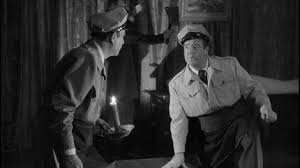
The film opens with a worried Lawrence Talbot (Lon Chaney, Jr.) trying to get a phone call through from London to Florida.  He is desperate to deliver a message to the customs office there that under no circumstances should a couple of crates bound for McDougal's House of Horrors be delivered.


Unfortunately, not only is Talbot under duress because he is about to be turned into his arch-nemesis/alter ego, the Wolf Man, the customs office is being run by a couple of dimwits; Chick (Bud Abbott) and Wilbur (Lou Costello).


Wilbur tries to carry on a conversation with Talbot, but unfortunately Talbot is a dollar short and a full moon late.  He turns into the Wolf Man during the telephone conversation and Wilbur dismisses him as a kook.  Meanwhile, Mr. McDougal (Frank Ferguson) shows up, a blustery windbag, demanding that the two customs agents deliver his packages personally.


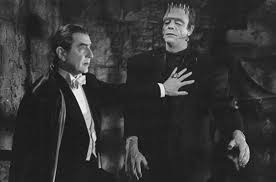
While delivering the packages, the two dolts manage to exasperate McDougal in many ways, not the least of which is mishandling his prized packages.  It turns out that the two packages contain the coffin of the legendary Count Dracula (Bela Lugosi) and the Frankenstein monster (Glenn Strange), which Mc Dougal plans to make showcases in his wax museum.


Wilbur has attracted the attention of Dr. Sandra Mornay (Lenore Aubert).  She coos and frets over Wilbur, which only serves to make Chick jealous.  Chick being the ladies man of the pair.


And when MacDougal has the pair arrested for damaging his packages, they are bailed out by a woman, but it turns out that it is not Wilbur's admirer.  It is Joan (Jane Randolph).  And she too coos over Wilbur to the consternation of Chick.


It turns out that both of the women have ulterior motives for flirting with Wilbur, however.  Joan is really a private investigator for the insurance company that insured McDougal's packages and thinks she can get the information on what happened by getting in with Wilbur.  And Sandra?  Well she is working in cahoots with Dracula.  She and Dracula want Wilbur's brain to transplant into the Frankenstein monster.  (Not that much of an improvement...)  And Talbot (remember Larry Talbot?) knows of the nefarious plans.  So he tries to work in conjunction with Chick and Wilbur to thwart them.  But then he has a hairy problem that makes that a tough go.


If you are familiar with any of the horror/comedy output of Abbott and Costello you can probably guess all of the vaudeville acts that are incorporated into the film.  And of course Wilbur is usually the only one who encounters all the monsters (at first), while Chick berates him for being idiotic for even thinking the monsters are real.


This one has one of the classic funny lines that most people will have heard, even if they never saw the movie:

Talbot (Wolf Man): "I know you'll think I'm crazy, but in a half an hour the moon will rise, and I'll turn into a wolf."

Wilbur: "Yeah, you and about 20 million other guys."


Believe it or not, this was only the second time that Lugosi ever played Dracula.  Yes he had been vampires in other movies, but none of them had been the original horror master himself.  And of course there had always been only one Wolf Man, Lon Chaney Jr.  As to why Boris Karloff did not appear as the monster, well there are several stories behind it.  But the most believable one, to me, is that Karloff objected to his iconic role being played for laughs.  But apparently money talks, because he not only appeared in the next A &C output, Abbott and Costello Meet Boris Karloff, The Killer, but he was also the titular character in Abbott and Costello Meet Dr. Jekyll and Mr. Hyde.


Well folks, time to fire up the old Plymouth and head home.  Drive safely.

Quiggy


Friday, March 11, 2016

Love in Old Hollywood


This is my entry to the Marathon Stars Blogathon, sponsored by the blog doyennes of The Wonderful World of Cinema and In The Good Old Days of Classic Hollywood.


The love story of the ages.  Humphrey Bogart met Lauren Bacall on the set of To Have and Have Not.  Although the chemistry was not immediate, it did grab hold and held on for dear life.  Bogie was married at the time to Mayo Methot, but they had a tumultuous marriage, in part due to Mayo's alcoholism.  The two lovebirds carried on their relationship in secret for a while, but it is hard to keep a secret for long, especially in Hollywood.

Not long after filming wrapped on To Have and to Have Not, Bogie moved out of his house and asked Mayo for a divorce, and on May 21, 1945, Bogie maried Bacall in a small ceremony.  It was the "beginning of a beautiful friendship" (to steal a line from a different movie).  The two only made four movies together, but their relationship off screen comes in fairly loudly on the screen.  You can see it chiefly in their eyes when they look at each other.


To Have and To Have Not (1944)

There's a story here.  I'm not quite sure what the story is.  According to a featurette, Howard Hawks bet Ernest Hemingway he could make a film out of even the worst of Hemingway's stories, and this is the one he picked.  It makes for an interesting war time romance, but what was done here was done better with Casablanca.  The most interesting part of this movie is watching the ongoing relationship between Bogie and Bacall blossom from the romance story that develops between "Slim" (Bacall) and "Steve"(Bogart).

In essence, the story is that Harry Morgan (his real name.  Why Marie chooses to call him "Steve" is never really explained) is a fishing guide for hire on the island of Martinique during WWII.  This takes place just after the surrender of France to the Germans and the Vichy government is in charge.  Morgan and his pal Eddie (Walter Brennan) are approached by resistance fighters to ferry cargo (people) but he refuses.  Due to some other intrigue which removes his current cash-on-hand, however, he decides to go ahead and do it, for the money.

The Vichy government, headed by a very smarmy fat Capitain Renaud (Dan Seymour) is suspicious, and thinks that Morgan and his cronies have hidden the resistance fighters (which they have) but the Vichy is kept in the dark through subterfuge.  The movie itself is worth a view, but as you will see, my opinion is it is not one of the better ones, for pure plot.


The Big Sleep (1946)

In the film version of the classic Raymond Chandler Phillip Marlowe novel, Bogie plays Marlowe and Bacall plays one of the two daughters of his client, General Sternwood.  Marlowe is investigating some dirty secrets in which the General's other daughter, Carmen, is involved.  There are so many twists and turns in this movie it's hard to keep track of who killed who and why.  Carmen (played by Martha Vickers) is a vapid, flirty girl who seems to try to come on to every man who enters her range of vision.

Bacall, as Carmen's sister, Vivian is a bit more in tune with the real world, but she is as spoiled as Carmen.  She is, however, a much stronger female character and knows what she wants, and, with the exception of Marlowe, how to get it.  She is initially cold to Marlowe, but warms up to him over the course of the film.

Carmen is mixed up with a pornography racket.  This is only hinted at in the film.  You have to take clues where they come.  But the book went into more detail.  The Hays Code prevented many aspects of the book from being filmed, the most disappointing being the chance to see Martha Vickers in the raw (hey it was right there in the book....)

Everybody but Vivian seems to have had a hand in the murder of one or another of the characters in this movie.  My suggestion is to watch both the original version and then the theatrically released version, both of which were available on the DVD copy I watched.  The chemistry between Bogie and Bacall was emphasized more in the theatrical release at the behest of Jack Warner and Bacall's manager.  So you can expect less of Bacall in the first version, but the story line is a lot clearer in it.


Dark Passage (1947)

This is the strangest of the bunch.  For one thing, the first part of the movie is only shown as if from Bogie's eyes. This first person camera viewpoint had been explored earlier by Robert Montgomery with Lady in the Lake.  It is somewhat jarring if you've never experienced it before, and in this case, the chemistry between Bogie and Bacall is there, but only through his eyes looking at her.

Bogie plays an escaped convict, Vincent, who was convicted of having murdered his wife.  While on the lam, he is conveniently picked up by Irene (Bacall)  who just "happened" to be in the area.  There is some hints that her intuition told her to be in that area at that time, since she could not have known of his escape attempt in advance.  There are many coincidences that crop up in this movie, too many to be taken credibly, if you ask me.

For instance, one of Irene's friends is Madge (Agnes Moorehead) who was instrumental in the trial that sent Vincent to prison in the first place.  Then, later, a guy who picks up Vincent after his prison escape, just happens to be a former convict from the same prison who tries to blackmail Vincent, and in the same boat, Irene, whom he seems to know has come into a lot of money.

This is a serviceable film noir, but of the four would have to rank last on my list of Bogie/Bacall pairings.  It's not quite as good as To Have and to Have Not, and a far cry from either Key Largo or The Big Sleep.


Key Largo (1948) 

Key Largo was adapted from a stage play, and  brought to the screen by John Huston.  This is by far the best of the four Bogie/Bacall films.  In it Bogie is Frank McCloud, a veteran of the war and former combat mate of Nora Temple's (Bacall) husband.  He has stopped off at the hotel owned by the mate's father (played by Lionel Barrymore), to see the land and visit with the family.

Also at the hotel are a bunch of unfriendly guys who, as it turns out, are gang members with Johnny Rocco (Edward G. Robinson) as their leader.  Claire Trevor (who won an Oscar for her performance in this film) is the alcoholic girlfriend of Rocco.  The gang is holed up waiting for the right time to sail to Cuba, planning to take over the rackets in the near future in the U.S.

Plans are thwarted when a hurricane blows in.  Claustrophobic to say the least is this part of the movie where everyone is getting on everyone else's nerves.  Robinson is his usual great self as the gangster headmaster, and the chemistry between Bogie and Bacall virtually sizzles as the movie gets going.  Hang on to the very end to watch how Bogie tries to get the upper hand on Rocco and his four henchmen.


In terms of movie enjoyment the four rate this way:
1. Key Largo
2. The Big Sleep
3. To Have and to Have Not
4. Dark Passage

On the other hand if you just want to see how well Bogie and Bacall work together in the romance dept.  I rank them as follows:

1. To Have and to Have Not
2. Key Largo
3. The Big Sleep
4. Dark Passage

Well that about does it for this time.  Hope you enjoyed the show.
Quiggy