Monday, May 4, 2020
The Promise of The Chosen One
The mantle of "hero" is never an easy one to bear. People look to you to rescue them from every plight that befalls them. Not an easy job. Even if you are faster than a speeding bullet, or have every gadget known to man in the pockets of your tool belt, or even if you can manipulate time and space to make the bad guys just disappear into another dimension.
But what if, just what if, you are just an ordinary guy who has less power and intelligence in your entire body than Superman or Batman or Dr. Strange has in their pinky finger? What if you are just some shmo who everyone thinks in the promised savior but you know yourself to be just some guy who happened to be in the wrong place at the wrong time?
That's exactly what happened to Ty Farrell. He's just a struggling actor trying to make a paycheck on a cheesy 50's sci-fi superhero series as "Captain Zoom". But far far away in another galaxy, the planet of Pangea is on it's last legs fighting off the evil overlord Lord Vox. And the little electronics wizard brother of the leader of the resistance is searching for a champion to help them in their endeavor.
And he thinks he's found it when he stumbles across a broadcast of "The Adventures of Captain Zoom", a kiddie sci-fi show originating on Earth.
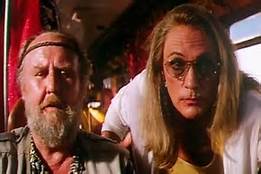
The Adventures of Captain Zoom in Outer Space (1995):
In a galaxy far, far away, the residents of the planet Pangea are in a desperate struggle to avoid the taking over of their planet by Lord Vox of Vestron (Ron Perlman)
In the struggle a young warrior, Tyra (Liz Vassey) leads the people to thwart the evil machinations of Vox. But in a raid on the base of operations Tyra is captured.
Back at home base, things are looking bleak, despite the promise of their spiritual leader, Sagan (Nichelle Nichols) that "it is written" that a promised one will appear.
Most of the people accept her predictions, but young Baley (Gregory Smith), the young brother of Tyra has become exasperated with Sagan's platitudes. Instead, being the electronics genius of the clan, he uses his knowledge and equipment to search for a hero on his own.
And he thinks he finds it in the person of Ty Farrell ( Daniel Riordan).
Farrell is the star of a TV show on a planet far away, "Captain Zoom". But young Baley thinks his exploits are real and thinks that Captain Zoom is just the hero the people need to defeat Lord Vox. So he uses his equipment to bring Zoom to the planet of Pangea.
Of course, you and I know Farrell is just an actor, although no one on Pangea knows what that is...
Farrell: I'm not a hero. I'm just an actor.
Simulus: What's an 'actor'?
Farrel: I pretend I'm somebody else, for money.
Simulus: Oh, a spy... kill him.
Vox has plans to subjugate Pangea and discover the ancient wisdom hidden somewhere on the planet. He also wants Tyra to marry him and become his queen (because he is, after all, just a horny man who has needs other than the desire to become king of the known universe...)
Meanwhile, back at home base, Farrell is having trouble coping with his new situation. For one thing, everyone thinks he really is Captain Zoom, despite his efforts to dissuade them. And they think he is the chosen one come to deliver them just as Sagan's prophecies have foretold.
Of course, due to his ineptitude, while actually trying to rescue Tyra, he too is captured, mainly because Vesper (Gia Carides) i, Vox's high priestess, has clairvoyant psychic powers. But she only has these powers as long as she remains a virgin. (Don't get ahead of me here...)
Vesper has the hots for Zoom, and she tries to work her powers on him. But Tyra and the captain escape from Vox's fortress spaceship. Unfortunately for Vox, this is a surprise because Vesper failed to foretell of the escape. (OK, now you can catch up...)
Eventually Farrell is informed of the sad fact that Baley used all of his available isotopes in brining Zoom to Pangea and the bad news is it will take thousands of years before more can be made. But Tyra tells him that the quest for ancient wisdom in the hidden cavern that both she and Vox are searching for may also contain information that could restore him back on Earth. So he reluctantly joins the quest.
Farrell is essentially the essence of The Peter Principle (a theory that eventually a person rises to a position of which he is too incompetent to perform the duties to which he is assigned... sound familiar?) Farrell is far from the hero that the people of Pangea think he is, but he has an ego to match just about anyone in Hollywood so he thinks he can be whatever they want (as long as it isn't too strenuous...)
The Adventures of Captain Zoom in Outer Space is a real hoot. Unfortunately I don't think it's ever been released on DVD. However, there is a poor quality recording of it on you tube (in three parts, but not to worry it's only about an hour and a half long in toto). I had the fortune of seeing this when it was first broadcast on Starz back in 1995. It's a made for TV film, and the special effects are negligible, but don't go into it expecting a Star Wars knockoff. Go into it for the comic performance of Zoom and his would-be worshipers.
Quiggy
Sunday, January 27, 2019
Cybernetic Future Shock
This is my second entry in the Robots in Film Blogathon hosted by Hamlette's Soliloquy and ME.
Anime and manga are a form of entertainment that originated in Japan. Manga is adult comic book format, while anime is the adult cartoon form, often derived from manga versions of the same. Go to any comic-con or sci-fi convention and you will encounter devotees of both. You will even see people dressed up as their favorite manga and anime heroes (just like you would fans of American films and TV shows).
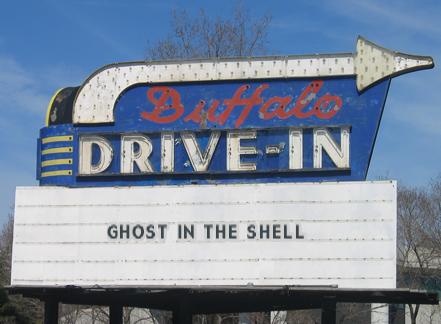
Ghost in the Shell (1995):
In the future of 2029, almost everyone has some cybernetic adaptations. The common man, it seems, has their brain hard-wired into a system. The internal, still existing human is referred to as the "ghost". Some are even more cybernetically enhanced. and some, such as our hero of the piece, Major Kusanagi (voiced by Mimi Woods in the American dubbed version) are basically living organisms with robotic bodies. The cybernetic brain allows some to be able to access the equivalent of the internet through their own brains. (The future as depicted in Ghost in the Shell has some stuff that predicts the future of sorts, because anyone can access the internet, even without cybernetic enhancements, through small hand-held computers... cell phones, anyone?)
In this future world, nations are still committing intrigue and deception. And even internally there are subterfuges going on. Kusanagi works with section 6 of an unnamed country (but which I identify as Japan for convenience). Section 6 is the police force of the nation, and finds itself at odds with section 9 (which is something like our American C.I.A.) Kusanagi works as a secret agent of section 6, trying to prevent the defection of a high-level computer programmer to a foreign country, and assassinates a rogue embassy official from said country.
In the process, she and her partner Batou (voiced by Richard George [Epcar]) discover that the real culprit behind the scenes is a mysterious figure known as "The Puppet Master", a hacker who can access the cybernetic brains of individuals and reprogram them to do his will. During their investigation they uncover a plot by section 9 in which the Puppet Master has been lured into another body, with the intent to control it.
But an attempt to transport the body to another site goes haywire. It seems the Puppet master is a bit more powerful than anyone expected. Kusanagi and Batou work together to try to recapture the Puppet Master.
That's about all I can tell you with out revealing too much about the movie that will intrigue you if you discover it for yourself. This movie is quite a bit more complicated than your average Disney cartoon. You will need to bring your entire brain to the game. It does contain some that sounds rather existentialistic to my mind, and it is a bit more violent than any Disney film. Despite the fact that it is a cartoon, in other words, you probably don't want to watch it with the kids.
Drive home safely, folks Time for me to shut down for maintenance.
Quiggy
Tuesday, August 7, 2018
Closet Cases
Angelman (Chris) of Angelman's Place and I are doing a blogathon The Gender-Bending the Rules Blogathon in September. The impetus of the blogathon stems from having just recently reviewed the 1982 film Victor/Victoria, and being inspired to look into the history of how gays and lesbians have been presented in film over the years. (I was a history major in college, so any history intrigues me, but especially cultural history).
I read (and recently reviewed for this blog) the rather intriguing book The Lavender Screen, which delves into the story of homosexuals in film. After finishing it, I donated it to my local library and mentioned to the director that I'd be interested in seeing The Celluloid Closet. Apparently it had once been a part of the library shelves but had since gone missing and had not been replaced. The director told me he would get it replaced forthwith, and sure enough it only took about a week or so.
First; a personal history: I was born in 1961, and raised in rural Texas, which means I was privy to some of the racism that inhibited the South, if not in my hometown (which never had a black family living there until after I left town to go to college), at least on TV. But I was raised to treat all people the same, regardless of race or color. Which I still retain the effects of that upbringing today. But since my parents were fundamentalist Christians (Southern Baptists to be exact), I doubt they would approve of my extending that respect to members of the LGBT community. But I do. No one deserves to be second-class citizens in my America. Which is why I call myself a Libertarian politically. And it is also why I don't care whether my choices of movies garner approval from my family or my friends. I watch anything that might have some appeal or at least something that would satisfy my curiosity in cultures that are otherwise alien to me.
The Celluloid Closet (1995):
From the very beginning of film there have been homosexuals. How they were portrayed depended on the times. This film includes a lot of clips that, apparently, had been part of the archives of Vito Russo, a man who made part of his living by touring the country delivering lectures on the history of how homosexuals were presented in the movies. One of the earliest clips is from the files of Thomas Edison who basically invented the motion picture. It is one of two men dancing. (Note: I'm not entirely sure that the two men are supposed to be gay. Personally, I just think they were brought together to make the film. Even though the title of the piece is supposed to be "The Gay Brothers"...)
But in it's earliest forms, the movies presented gay men as "sissies". In silent films, this meant they used exaggerated pantomime to prance around, an admittedly prejudiced example of the homosexual as perceived by the straight audience. Interviews with various celebrities include both playwright Arthur Laurents who compares the sissy to the stereotype of the black characters in old movies who were portrayed as Stepin Fetchit types. On the other hand, Harvey Fierstein claims he likes the sissy character, mainly because at least gays were on screen, even if they were rude stereotypes.
As we progress through the film, we become attuned to the goals of the Hays Code and its allies who sought to remove objectionable material from the movies. As a result the homosexual went "underground", so to speak. There were still gays in the movies, only no one admitted that the character was gay, only subtle and not so subtle hints even gave any indication of it. Two films which I have previously reviewed, Dracula's Daughter, in which the main character is presented as (possibly) a lesbian as well as her position as a vampire, as well as The Maltese Falcon, in which Peter Lorre's Joel Cairo is probably gay. The character, as written in the original Dashiell Hammett novel is definitely a "fairy", but the movie had to make it something of a secret.
As the Code relaxed it's rules, there were many movies that had some gay characters, but because of the still in place restrictions, the characters often had to come to drastic ends (such as suicide or other forms of death). Only after the Stonewall riot in 1969 did gays start getting more sympathetic treatment. The film spends a portion of the movie discussing The Boys in the Band, which is noted in the film as the first movie in which none of the gay characters came to an untimely end.
No documentary of gays in film would be complete without addressing the issue of AIDS. Fortunately this film appeared shortly after the movie Philadelphia, so it includes a discussion of that film as well as the lesser-well-known film Longtime Companion, a movie which addressed how a band of gay friends dealt with the AIDS crisis from it's first discovery to the untimely end of some of the characters over a period of a few years.
The sometimes not so subtle hints an inside jokes that were a part of the movies are covered in the documentary too. One focus was on Rock Hudson, an actor who was known to be gay in Hollywood but was only "outed" after his death. In Pillow Talk, Hudson plays a straight man who is acting gay to get inside Doris Day's panties. It is commented on how Hudson must have felt in the role, himself being a gay man who tried to keep up a straight front on screen. Another clip, from the movie Red River, features Montgomery Clift and John Ireland discussing pistols. Montgomery Clift was well known as a gay man in Hollywood so the following quote has some subtle humor to it, even though the character he played was not necessarily gay:
"There are only two things more beautiful than a good gun...a Swiss watch, or a woman from anywhere...you ever had a Swiss watch?"
The film itself, unfortunately, came out after the death of the author, Vito Russo, on whose book it was based. It would have been nice to have some commentary on it by him, but my copy does have a recording of one of his lectures. Lily Tomlin narrates the film, and it is filled with interviews with various Hollywood people, including the aforementioned Fierstein and Laurents, but also Armistead Maupin, Tony Curtis, Gore Vidal, Whoopi Goldberg, and Tom Hanks.
As a history lesson, I found the film to be extremely entertaining. After 20 years or so since the film first came out, the depiction of gays in films has progressed, although not always in a positive manner, at least it has been an improvement from what the studios did in the first 50 to 60 years.
Quiggy
Sunday, April 1, 2018
Shadows of the Future
This is my second entry in the End of the World Blogathon hosted by yours truly and Movie Movie Blog Blog.
Terry Gilliam is one of my favorite directors. He has an odd sense of the world and his movies tend to be outre. His works include Time Bandits, Brazil, The Adventures of Baron Munchausen, and The Zero Theorem, all of which stretch the boundaries of reality. I love a film that, initially, makes you leave the theater wondering just what the hell happened. And Gilliam's movies tend to do that to me. Which makes them get on my list of favorite movies, as bizarre as that sounds.
I also love the concept of time travel. Sometimes the mechanisms for initiating time travel are central to the story (as in The Time Machine) and at other times you are just expected to take it for granted that time travel is possible, but aren't given any details about the operation of whatever machinery accomplishes the process (as in The Terminator)
12 Monkeys falls into the second category, but there is an added twist to it. We as the viewers are hip to the idea that Bruce Willis' character is from the future, because we see the future world and see him given his mission. But is that really the case? For one thing, as would be expected, James Cole (his character), as would be expected, is thought to be insane by the modern world, because who in his right mind would claim to be from the future? And the audience is left in suspense throughout the movie as the idea that maybe he really is insane and it's all in his mind is hinted at during the course of the film.
12 Monkeys (1995):
The future is bleak. The world lives underground, since at some point in the past a manufactured virus wiped out most of the population. Criminals are given the task of going above ground to collect samples to see how the virus is progressing in hopes of it's dissipation, so that life could be resumed above ground. James Cole (Bruce Willis) is one of these criminals. After a mission to topside Cole is brought before a group of scientists and given a new mission.
His goal is to go back to 1996 and discover the origins of the virus. The future scientists believe that the originators of the virus were "The Army of the Twelve Monkeys", mainly because the world topside is covered with graffiti that has an emblem, representing the 12 Monkeys and the word "We did it!"
But the scientists aim is off. Cole ends up in 1990, 6 years before the virus outbreak. He is arrested and sent to an insane asylum, because after all, he must be crazy. He thinks he's from the future! Dr. Kathryn Railly (Madeline Stowe) and her superiors put him in an insane asylum.
The asylum is where he meets Jeffrey Goines (Brad Pitt). Jeffrey is the son of a rich industrialist, but he's not all there. (Pitt was nominated for an Oscar for this role, but lost to Spacey for his role in The Usual Suspects, a slight for which I have never forgiven the Academy. You have to see the portrayal to get my position.)
The scientists in the future are keeping an eye on Cole, and zap him out of there toot sweet. But like most people in charge, they blame Cole for screwing up the mission, even though they were the ones at fault for sending him to the wrong time. He is asked if he wants to try again, and Cole agrees. But they send him to a battle in the middle of World War I in France. Screwed up again....Bureaucrats!
Finally they get it right and send him to 1996. He kidnaps Railly and forces her to help him. Initially she does so just to keep her life safe, but gradually she comes to realize that Cole must have something on the ball, and even more gradually comes to realize that Cole must be telling the truth about his coming from the future.
Complicating matters is the fact that Cole is falling in love with Railly and begins to try to convince himself that all this future crap is really just in his mind. The Gilliam touch of trying to decide just what is reality comes to play in spades. I liken Gilliam movies to what one of my favorite sci-fi authors, Philip K. Dick (author of such works that inspired Blade Runner, Total Recall, and Minority Report). The question remains throughout whether this is all just in Cole's head, or if he really is from a plague devastated future. Further complicating his mission is the fact that in the 1996 version of the past (which is actually the present for the movie goer), Jeffrey is now out of the mental hospital and working with his father and the scientists. But he is still bat-shit crazy.
He is involved with an animal activist paramilitary group called the Army of the 12 Monkeys, who have a plan to create havoc on the world. Spoiler Alert! however, it's not to release the plague that devastates the future.
12 Monkeys was inspired by a short French film, called La Jetee and if you find this movie interesting, checking out that movie ought to be next on your list. The similarities are there in black and white, and it serves as a pretty good accompanying piece to the film.
!2 Monkeys has really lost none of it's impact in the past 20 years, although it is somewhat hampered by the fact that Gilliam chose to use a "quote" from a scientific journal at the preface of the movie stating that a man who claimed to be from the future predicted that the world would be devastated by a plague in 1996. In 1995 it may have been a bit Twilight Zone-ish, but now it just hangs there as part of a film, not as an ooo-weee-ooo type thing. Of course, Y2K and 2012 turned out to be duds, too, but the initial effect was a bit more dramatic at the time.
So ends this excursion into the weird world of Armageddon. Drive home safely, folks. And if you should pick up a hitchhiker on the way home claiming to be from 2112, give his story at least some thought.
Quiggy
Thursday, September 7, 2017
The Bond Age (Part IX)
2017 marks 55 years of James Bond on the movie screen.
To celebrate this momentous year, I am undertaking to review the entire
oeuvre of Bond films, all 24 of them (at this juncture in history), two
at a time. These will appear on the 7th day of each month (Bond's
agent number being "007"). At the beginning of each entry I will give
my personal ranking of each movie and of each movie's theme song.
(These are subjective rankings and do not necessarily agree with the
view of the average Bond fan, so take it as you will). I hope you enjoy
them, nay, even look forward to the next installment. As an added
note, I am deeply indebted to Tom DeMichael, and his book James Bond FAQ,
for tidbits of information with which I am peppering these entries.
-Quiggy
Timothy Dalton was a success in two outings as Bond. A third Dalton Bond film was in the works when disaster struck the series. A lawsuit had been filed between the producers and MGM/UA, the distributors, of the series. It seems that there was some problems with how the company and the producers viewed licensing agreements which had been signed way back in 1962. This caused a lengthy delay in the production of the next movie in the Bond series, during which time Dalton's contract expired.
Whether the producers chose to go a different direction or Dalton just simply declined to renew his contract is a matter for the history books. But the Bond role was open again. Brosnan was he obvious choice, although serious consideration was given to Ralph Fiennes and, believe it or not, Mel Gibson(...?!). Brosnan had been passed over, if you remember, because of his work on the American TV series Remington Steele.
A new Miss Moneypenny was cast for the new Bond, an actress named Samantha Bond. (Is that kismet, or what?) Also the new Bond would have a new M. Not only that, but a woman boss. Judi Dench was pegged to play Bond's superior, and thus the only actor left to reprise his role in the series was Desmond Llewelyn as "Q".
GoldenEye (1995)
Quiggy's Personal Ranking of the Movie: # 6
Quiggy's Personal Ranking of the Theme Song: # 18
Best Bond Quote: (The lead in to this one has Bond and his psychologist barrelling down a winding road when Xenia appears in her Ferrari. The psychologist says "I like a spirited drive just as much as the next girl.." and then spots Xenia. "Who's that?" she asks) Bond: "The next girl."
Best Bond Villain Quote: Janus: "Kill him!... The man just won't take a hint."
(A very close second is Boris's oft repeated "I am invincible!" (Which you find out at the end is not necessarily so...)
Best Weapon: Love the pen that is really a disguised grenade.
In a scene that it turns out takes place prior to the fall of the Berlin wall and the dissolution of the Communist Soviet regime, the film opens with Bond (Brosnan) working in conjunction with another agent, Alex Trevelyan, 006 (Sean Bean), in an infiltration of a Soviet military chemical weapons facility. Colonel Ourumov (Gottfried John) captures 006 and tries to lure Bond out of his hiding place. The colonel kills 006, but Bond manages to escape in a rather exciting chase sequence.
In the opening credits, the song "GoldenEye" is sung by Tina Turner and it was written by Bono & The Edge of U2. With that combination of talent, you would THINK that the output would be nothing less than spectacular. However, in my opinion the song is a bit cold and static. The Billboard charts for the Hot 100 would seem to bear that out. It did not crack the top 100 (although it did make the Billboard Dance Hits chart, so some people must have thought it was dance-able...but not me). In its defense, neither of the Dalton Bond themes cracked the top 100 either, but this one just doesn't pop for me.
One of the first things that will catch your eye in the opening credits is that Sean Bean's name appears right after the title. Now unless Sean Bean has an ego the size of Marlon Brando, and managed to get top billing for a measly five minutes of screen time, that should be a clue that 006 may not really dead, so Spoiler Alert (for the slow on the uptake)!.... he's not.
Nine years later: On a winding road Bond is driving with an MI6 psychologist (Serena Gordon). Bond is pretty much scaring her already with his driving when a mysterious woman in a Ferrari shows up, and Bond's ego refuses to let him lose the race. Narrowly avoiding a couple of accidents, Bond eventually lets the woman win to avoid wrecking into a bicycle entourage.
Later Bond meets the woman at a baccarat table where he manages to introduce himself and find out her name, Xenia Onotopp (Famke Janssen). His charm is pretty much wasted on her because she is only concerned with her goals. Which is later revealed to be a hijacking of a new Russian helicopter. It turns out she is in cahoots with now-General Ourumov to hijack a former Soviet defense system called "GoldenEye".
What GoldenEye is is a system whereby a satellite in space can fire electromagnetic that can isolate an area and cause an area to lose its power to operate all electronic systems within the area. The pair enter the Russian facility where the operation systems of Golden Eye is housed and Xenia kills all of the personnel inside. Well, all but Boris Grishenko (Alan Cumming) who had "conveniently" stepped out for a smoke, and Natalya Simonova (Izabella Scorupco) who had, fortunately, gone to the kitchen for some coffee.
Onotopp an Ourumov activate GoldenEye and cause the facility and surrounding area to be laid waste and put in the dark. At MI6 HQ, this event is viewed by Bond and the rest of those present. Bond is taked with finding Golden Eye and whoever stole it. He goes to St. Petersburg (the cold one in Russia, not the warm one in Florida...) where he meets CIA agent Jack Wade (Joe Don Baker), who apparently is now Bond's contact after Felix Leiter's disablement in The Living Daylights.
Baker's Wade is a bit of a smart ass, but I always have liked Baker's acting. He tells Bond how much he hates the secrecy, passwords and codes of the "stiff-assed Brits", but helps Bond get to a former enemy, an ex-KGB agent now nightclub owner named Valentin Zukovsky (Robbie Coltrane). Through a bit of negotiation, Bond gets Zukovsky help him to meet up with the leader of Russian crime syndicate, known only by the name "Janus".
When Bond finally meets up with "Janus", guess who he really is.... well, if you read the half-assed attempt at a spoiler alert above, you've already guessed. It turns out that it's our beloved co-agent 006, who apparently DIDN'T die at the hands of Ourumov. Trevelyan was really a descendant of Russian Cossacks, whom history details as having allied with Nazi Germany against Russia. After the war, they surrendered to the British and requested asylum, but the Brits turned them over to the Soviets and they were later executed by Stalin . It turns out that Alex has been planning this whole revenge scheme for years, to pay back both Russia and England for betrayal.
The last part of the movie involves some pretty exciting battles between Bond and Alex, with the goal being to try to prevent Alex from doing the same thing to London that he had done to the Russian facility earlier in the movie. With the help of Boris, who is in cahoots with Janus, the suspense mounts as to whether the enemies just might succeed this time.
Brosnan's first outing as Bond is top notch. There was an attempt to return to the nonchalant quips that had been sorely missing from the Dalton movies, and many of these were a bit flat, but still, it was nice to get to see Bond's humorous side come back to the films.
Tomorrow Never Dies (1997)
Quiggy's Personal Ranking of the Movie: #23
Quiggy's Personal Ranking of the Theme Song: #23
Best Bond Quote: (I'm not passing this one up. Moneypenny is talking to Bond requiring him to report to MI6. He is in a romantic tryst with his Danish teacher. He tells her Goodbye in Danish.) Moneypenny: "You always were a cunning linguist, James."
Best Bond Villain Quote:(I'm giving this one to Carver's henchman. Read the review below for more explanation): Stamper: "I owe you an unpleasant death, Mr. Bond."
Best Weapon: That cell phone is a monster. I want one with all tose apps and gizmos.
In one of the best opening sequences ever, Bond is surreptitiously filming a conclave of terrorists. Back at MI6, the Admiralty overrides M's wishes and orders a missile strike on the terrorist conclave. Too late they find out that there is a plane with nuclear warheads on it. More than just a terrorist enclave will suffer. But Bond to the rescue, he does some Bond magic and flies the plane out...
You know what? I can't do it. I can't even BEGIN to give this movie any respect. Aside from that dynamic opening, the movie just goes down hill from there. Oh, the very beginning shows a bit of promise. A British ship is warned it is in Chinese waters, even though the British GPS systems on board say they are not. And a fancy torpedo controlled by some bad guys (not the Chinese) does some fancy maneuvering and completely destroys the ship.
But from there it goes headlong into one of the most ridiculous scenarios ever. Our bad guy this time? Elliot Carver (Jonathan Pryce), a media mogul who is trying to start World War III. Why? For ratings, of course. He wants to be top dog in the news industry and nothing is above the line in order to get that position. Something similar happened 100 or so years ago when William Randolph Hearst tried to manipulate political forces to get his newspaper headline stories.
The movie even references this history when Carver compares himself to Hearst. But I don't think Hearst was the person the producers wanted the film-going public to think of when they saw this movie. Probably less than half of the people who went to the theater to see it even recognized Hearst's name when Elliot Carver mentioned him. Personally I think the producers wanted people to think of Rupert Murdoch, Fox News Media mogul. Hell, Pryce even resembles Murdoch in the film.
And a villian trying to start WWIII just for ratings? Please! Even Blofeld's plan in On Her Majesty's Secret Service seems intelligent by comparison. And how about that song? Yes, decent orchestration, but Sheryl Crow was probably the worst choice they could have found to sing it. What? couldn't they entice Shirley Bassey to give it another go? I'm sure it would it would have been thousands of times better.
Sorry to end on a down note, but you could always go back up and read the "GoldenEye" review before you leave the theater... drive safe, folks
Quiggy
Friday, June 24, 2016
Road Trips Can Be Such a Drag
In the course of film history, most gay men have been either the villain (Peter Lorre's Joel Cairo in The Maltese Falcon or John Dall and Farley Granger in Rope) or the subject of ridicule (many examples in comedies of the era, but the best example is John Ritter's Jack Tripper on the TV show Three's Company. Tripper isn't actually gay, but the fact that he is pretending to be gay and how his "gayness" is treated by society is a good illustration).
Society itself could be blamed, but a major factor was the Hays Code which ruled with an iron truncheon over what could and could not be presented on film. Because homosexuality was considered a disease by the prevailing authorities, even so far as to being a cause to be arrested for being a homosexual in the real world of the time, the Hays Code established that a gay person on film had to be presented in a negative light.
This gradually began to change in the 1970's. According to my research for this post, the turning point was considered to be the Stonewall riots, an event that occurred in 1969 in New York City in response to police raids on a gay bar, the Stonewall Inn, in Greenwich Village. The resulting exposure and outcry of the LGBT community caused the rest of the world to begin change in its view of the homosexual. This also made its way to Hollywood, where always with its eye on the bottom line, the studios began to see possibilities of the LGBT dollar in the theater.
Before this gets to be a tedious history lesson (or is it already too late?) I will end this ramble, but the fact is that homosexuality is not viewed in such a negative light these days. In the mid 1990's alone, there were two movies that presented an entertaining look at the world as viewed by "drag queens". A drag queen, to quote Wesley Snipes' character in To Wong Foo, is "a gay man [who] has way too much fashion sense for one gender".


The Adventures of Priscilla, Queen of the Desert (1994)
The ostensible star of this movie (aside from the titular bus, anyway...) is Hugo Weaving, an Australian actor who came to prominence in the United States from such high exposure roles as Elrond in the Lord of the Rings trilogy, or if you like your films dense and confusing, as Agent Smith in The Matrix movies. Weaving plays Tick, a gay man who performs a drag queen show under the name "Mitzi".
The true star, in my opinion, however, is the legendary Terence Stamp, who won the Golden Globes for Best New Actor in his very first role as the titular character in Billy Budd (1962), and has been dozens of movies since, including a few of my favorites (Superman II, Wall Street, Alien Nation, The Limey). Stamp plays a transgender woman, Bernadette, who has recently lost a lover.
Rounding out the cast is Guy Pearce. Pearce is also a native Australian, who came to attention outside Australia when he appeared in L. A. Confidential. I did not see that one until much later. My personal introduction to Pearce was as the scientist who invented The Time Machine in the early 2000's remake of the classic film of the same name, and the following year in with Jim Caviezel in The Count of Monte Cristo. Pearce plays a rather flamboyant and exuberant gay man named Adam, who does his drag queen show under the name of "Felicia".
![]() |
| Bernadette, Felicia and Mitzi |
In the beginning of the movie, Tick gets a call and is invited to come to Alice Springs to perform his cabaret. The cabaret, it turns out, is that he and his entourage dress up in drag and perform by lip-synching to various "hit" songs. Tick calls up his friend Bernadette, who has recently lost her lover, and invites her to come with him, conveniently neglecting to tell her that Adam will also be accompanying them until it's too late for her to back out. Neither knows, as yet, that Tick is going because the person that requested his performing troupe is his wife.
Adam, for his part, manages to acquire a run-down tour bus for the trip, which he promptly dubs "Priscilla" (the titular "Queen of the Desert"). The three take off for their trip from Sydney to Alice Springs. They stop over on their first night, but are not received very well with the populace of the town. This is repeated several times during the course of the movie, in which due to the prevailing fears, prejudices, or just seething hatred for their homosexual-ness, are alternately threatened or abused. After awakening from their overnight stay the first night they find their bus vandalized with the words "Aids F***ers Go Home".
![]() |
| Unfortunately this is the best picture I can find of the bus without the offending graffitti. Take my word for it, however, it is impressively dilapidated. |
At one point, probably due to the hostility they are experiencing on the main road, the three decide to take off across the Outback via a dusty secondary road. Due to the less than reliable transport, they break down in the middle of the desert. That night an Aboriginal Australian takes them back to his encampment where the trio perform their act for them.
Bernadette goes off hiking looking for help. Meanwhile, Adam decides to redo the bus in a bright lavender paint job.
Eventually Bernadette returns with Bob, a local mechanic who tows the lame bus back to his shop. Bob is married to a mail-order bride, a very brash and brassy Filipino woman, who before the movie is over tells Bob to shove it where the sun don't shine and takes off. This leaves Bob free, and he follows along with the trio on their trip. He also gradually falls in love with Bernadette. (Bernadette, you will remember, is a transgender woman.)
The bus arrives in Alice Springs where, surprise surprise, Tick also has a son he hasn't told the group about.
This movie, as with all road trip movies eventually, is all about transitions. Each character learns something about his or herself. Tick ends up taking his son (who has no problem with his father's sexual identity, as Tick feared he would) back with him to Sydney while Bernadette stays with Bob in Alice Springs. (Apparently she is starting to have feelings for Bob in return.)
Australian movies had been getting attention in the states before now (Crocodile Dundee, Mad Max, The Man from Snowy River just to name a few). This movie helped to spur the ongoing craze for the quirky tpe of movies for which the movies from Oz became known. At some point in the future I intend to do my own Oz-fest posting, as there are about 4 or 6 on my future post schedule from Down Under.
To Wong Foo, Thanks for Everything! Julie Newmar (1995)
If you haven't seen this movie, you are indeed missing out. Two he-man studs of the action-adventure genre, Patrick Swayze and Wesley Snipes, stepped out of their cushy comfort zones to take on the roles of drag queens. Accompanied by John Leguizamo as a third drag queen, this movie is the second road trip movie, somewhat inspired by the previous movie, although, as we will see, entirely different in how it plays out.
Swayze is Vida Bohemme, and Snipes is Noxeema Jackson. The two are co-winners of a New York City drag queen contest and given two air fare tickets to Los Angeles to compete in the national Drag Queen pageant. (I should note, in my opinion, that Swayze looks pretty decent, and convincing, as a woman in this flick but I thought Snipes looked exactly like what he was in real life {as opposed to his character}, a man dressed up as a woman.)
Leguizamo plays Chi Chi Rodriguez, a runner-up who is devastated by not winning the contest. (Here, again, I interject my opinion. I kept having to remind myself that "Chi Chi" was indeed a man in drag. He, of the three, pulled off the role of a drag queen the best.) Vida convinces Noxeema to trade in their air tickets to buy a car and take Chi Chi with them on their trip. To achieve this they go to a restaurant run by a friend, John Jacob Jingleheimer Schmidt (really!) , played by Robin Williams. With Williams help they are given access to a car dealer who lets them have a land yacht of a Cadillac convertible.
![]() |
| Noxeema, Chi Chi and Vida |
Somewhere in the midwest (it's never actually said which state they are in, but a lot of the outdoors portion of the movie was shot in Nebraska) they are pulled over by a sexist, racist and homophobic Sheriff Dollard (Chris Penn). Initially Dollard thinks they are really all women and tries to molest Vida who knocks him out. They think, however, he is dead, and race for their lives to get away from the scene.
The rickety old Cadillac breaks down however, and the three find themselves at the mercies of the elements. Fortunately they are rescued by Bobby Ray (Jason London) who takes them into his hometown of Snydersville. Their car is towed in by Virgil (Arliss Howard), and they are given a room in the town's hotel, also owned by Virgil and his wife, Carol Ann (Stockard Channing).
Almost everyone in the town is totally oblivious to the fact that the three are not what they seem to be (although it is revealed later in the movie that Carol Ann was clued in from the very start.) The three have an incredible influence on this small town America, each in their own various ways. Vida tries to be the typical busybody, although in her defense, Virgil is a scumbag wife-beater, and her interventions is well needed.
Noxeema meets an older woman who was once the proprietor of the town's movie house, whom she gets to come out of her shell.
Chi Chi has a crush on their rescuer, who has a crush himself, although he does not know Chi Chi's true nature.
Vida and Noxeema chide Chi Chi for leading on poor Bobby Ray, especially because Chi Chi is a man, but also because Bobby Ray has a lovelorn admirer there in Snydersville himself, Bobbie Lee (Jennifer Millmoe). All's well that ends well, in this story though because Chi Chi relents and lets Bobby Lee have her beau. When Sherriff Dollard, who was only unconscious and not dead, shows up, all hell breaks loose, comedically. The homophobic sheriff calls out for the drag queens to show themselves, and everyone in town identifies themselves as the drag queens for which he is looking.
Folks, this entry is one for the books. If you have been a frequent reader of this blog, you will realize these were not the typical "man cave" movies I am wont to usually reviewing. But let it not be said I can't come out from under a rock and watch a couple of good movies that would not usually fit that niche. Hope you enjoyed this entry.
Quiggy