Saturday, September 2, 2017

A Ladd and His Gun: The Sequel


This is my entry in the Alan Ladd Blogathon hosted by Hamlette's Soliloquy


Alan Ladd has never really been on my radar as a film actor.  As a matter of fact, up until I started reading Hamlette's blog, the only movie in which I had ever seen him was Shane.  I have since gotten interested in watching him, especially his film noir outings.  I also discovered a radio series, Box 13, which is a mystery series from the bygone years.  I still don't have the fascination with him that she does. (I have stated elsewhere that the only actor with whom I have ever had a fascination is John Wayne, and I will watch ANY movie featuring him.)

But Ladd is still an interesting actor.  I haven't seen enough of him to get a line on his personality, but he seems to be a pretty good actor.  Some time down the line I think I might get to a double feature of his westerns (of which he made a few), but in the meantime, being the film noir aficionado that I am, I present this pairing for the blogathon.

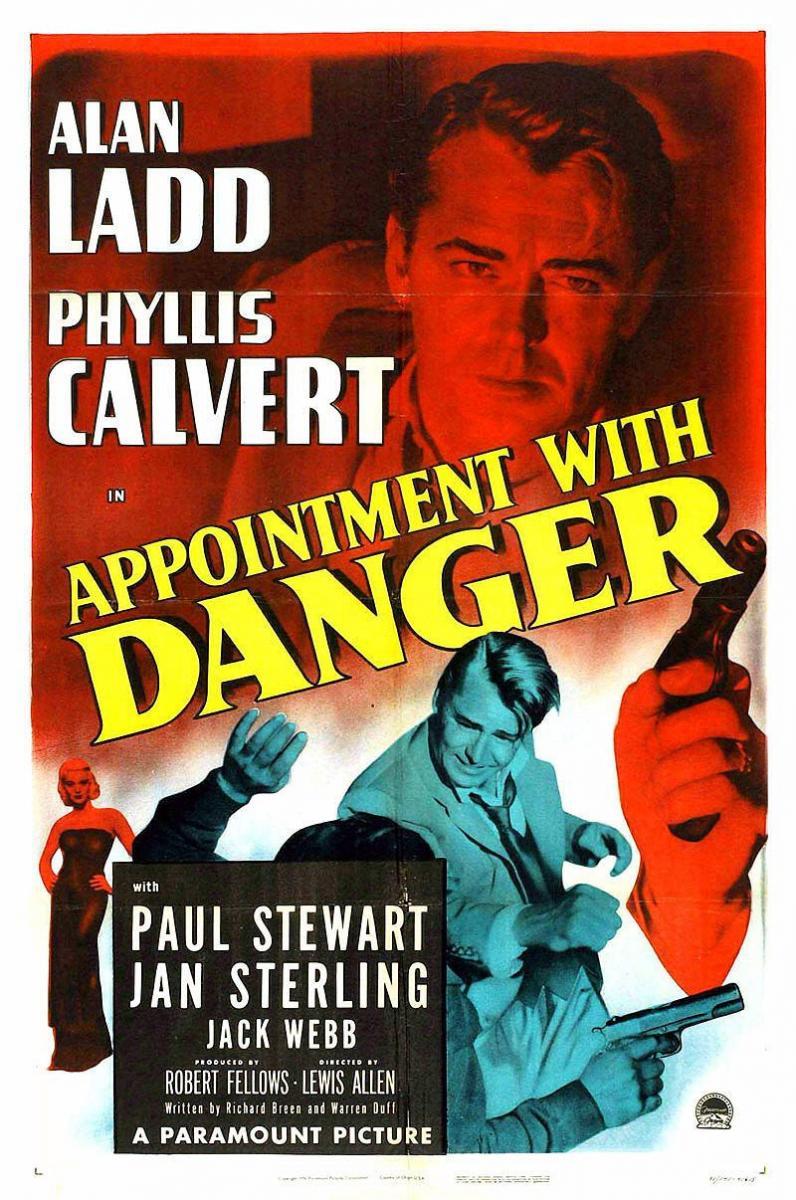


Appointment with Danger (1951)  

 Alan Ladd plays a postal inspector in this entry.  (Who knew post office employees could have such hair-raising adventures?)  A postal inspector has been murdered and the follow up investigation, a postal inspector named Al Goddard (Ladd) tries to figure out why.

On a rainy night in Gary Indiana, two men murder a postal inspector.  The men are played by Harry Morgan (as George Soderquist) and Jack Webb (as Joe Regas).  Yes the two men who are well known as a pair of cops from the black and white TV series Dragnet play a couple of hoodlums.  This is one of the more interesting aspects of the film.  Webb in particular plays a rather sadistic sort, although, in my opinion, Webb played every character pretty much the same way, with his rather serious demeanor and distinct staccato delivery of lines.  Actually, Morgan is pretty much identifiable too, but he has a bigger range of emotions that he can play.

In the alley where they are trying to ditch the body they are spotted by a nun, Sister Augustine (Phyllis Calvert).  While George distracts the nun, Joe tries to manhandle the body and George tells the sister that the friend is drunk.  She goes on her way, but tells a cop about the incident.  Instead of checking it out the cop decides to chase down a speeding car instead.

Goddard is brought in on the case after the body is discovered and the cop has confessed he didn't investigate, but the nun is named as a witness.  Goddard's first job is to track down the nun.  When he finds her he has to remind her that it is her duty to identify the man she saw because she is reluctant to get involved.  Augustine tells the Mother Superior of the nunnery that she is reluctant because she sees that Goddard has "no heart, no charity".

(I should point out at this juncture that I wholeheartedly agree with the sister.  Ladd's character is a bit of a jerk, but you can chalk up some of that as his being dedicated to his job and the enforcement of law and order. Still, all in all, I doubt if I would be willing to knock back a few with Goddard after hours.  But then again, I would be willing to bet that he is a milk drinker and doesn't imbibe anyway...)

 Regas tells his boss, Earl Boettinger (Paul Stewart), that George has become a liability.  Regas wants to kill Soderquist, but Boettinger just wants to have George leave town.  When George refuses, Joe kills him.  Joe is a really sick individual.  He also wants to kill the nun because he thinks she can identify him too.  As such he tries to arrange an accident for her, but the plan falls through and she survives.

Goddard goes undercover as a rogue agent to infiltrate the mob planning their heist.  (They are going to rob a mail truck as it is transferring a load of money from one train to another).  Joe, being the suspicious sort, does not trust Goddard.   (I would bet Joe would look crosswise if someone handed him a diamond ring and told him it was a gift...)  There is some subterfuge going on and the suspense is tight in the movie.  On more than one occasion it looks like Goddard's plans might be revealed.  But Joe, being the weak link in the chain because of his obsessive nature, causes the plans to go awry himself.

If it hadn't been for my affinity to try to make double features out of my posts here, I might never have seen this movie.  I have Hamlette to thank for that, as it is a pretty entertaining flick, although I still don't like Goddard....even if he is the good guy.  Wikipedia notes that this was the last film noir film in Ladd's career, and he goes out with a pretty good bang.


The Blue Dahlia (1946)

Alan Ladd is one of three buddies who have just been released from military service, Johnny Morrison.  He and his palls, Buzz (William Bendix) and George (Hugh Beaumont, the dad on Leave it to Beaver) are recent Navy men.  Buzz suffers from shell shock and George has poor eyesight, but Johnny is released after meritorious service.

The three get off the bus in Hollywood where Johnny is married to a woman, Helen (Doris Dowling).  He goes home where he finds things aren't exactly as he thought they would be.  His wife is carrying on an affair with another man, Eddie Harwood (Howard da Silva).

To make matters worse, Helen has a secret she kept from Johnny.  Instead of dying from leukemia as she had originally told him, Helen and Johnny's son had been killed as a result of her being drunk and wrecking the car she was driving with the son in it.  Johnny is furious and initially pulls his service revolver, with the obvious intent to shoot her.  Instead he throws the gun on a chair and storms out.  (Big mistake there, honcho...)

Johnny wanders out in the rain where he is picked up by a woman (Veronica Lake).  He tells her his name is Jimmy Moore, and it is later revealed that she is the wife of the man with whom Helen had been having an affair.  Sometime after Johnny left Helen, she was shot and killed.  Johnny is prime suspect number one of course since she was shot with his gun.

Johnny makes out that he is in trouble and realizes the only way to clear himself is to find out who really shot his wife.  His first suspect, of course, is Harwood.  The gritty film nor plays all its cards pretty straight, by leading you on through several prime suspects, one of which is Buzz.  See Buzz has a problem with short term memory and the fact that "monkey music" (jazz) makes his head ache due to the plate in his head, the source of the shell shock.

The lives of all people in the movie intertwine rather well.  And believe me, when it is finally revealed who the culprit is, you will be as surprised as I was.   Justice is served in the end, something that was not exactly common in the average film noir.  At least, not the kind of justice that was servered here, anyway.  Ladd is a much more likeable character in this outing.  (And he does drink liquor, so he isn't as much a "stick-in-the-mud" as the character in the previous movie.)

I liked both movies.  Thanks to Hamlette for running this blogathon, (even if I did have to push the car, so to speak, to get it to jump start...:-D)

Quiggy


Friday, September 1, 2017

The World According to Spınal Tap


This is my entry in the Movie Parody Blogathon hoste by MovieMovieBlogBlog


Author's note:  This is Spinal Tap is a pretty raunchy movie.  If you are the least bit prudish, I suggest you avoid this movie.  In fact, it might be prudent to skip reading this review, as I will be quoting several lines that might offend some sensibilities, but are necessary to convey why I think this movie is so funny.   Be forewarned.

This movie is set up as a documentary (or as director Marti DeBergi (Rob Reiner) puts it, a "rock"umentary.  What it really is is a "mock"umentary.  There is no real band called "Spinal Tap" (or at least there wasn't in 1984).  All of the characters in the documentary are actors playing parts in what is posed as a documentary on the 1983 musical tour of "The Loudest Band Ever", Spinal Tap.  Reiner, as DeBergi, follows with a film crew documenting the tour, as well as carrying on some intimate conversations with the main core of Spinal Tap;  David St. Hubbins (Michael McKean), Nigel Tufnel (Christopher Guest) and Derek Smalls (Harry Shearer).  It should be noted that all three actors were musically inclined, and they have since actually toured and produced a couple of albums under the name Spinal Tap.

If you are blessed with a copy of the DVD, a special feature has commentary from the three main core actors, McKean, Guest and Shearer).  But instead of commenting as actors, they make the commentary in character as St. Hubbins, Tufnel and Smalls.  This in effect gives you two movies in one, as, in the chronology of the film, the members of Spinal Tap supposedly were disenchanted with what DeBergi had done and make snide comments along with the commentary.


This is Spınal Tap (1984)

Debergi (film director Rob Reiner) introduces the theme of the movie by telling the audience that he began with a plan to capture "the sights, the sounds, the smells" of a rock band on tour.  Ostensibly,  the Tap (as I will refer to them for brevity) were going on tour to promote their 15th album Smell the Glove.


This movie would be hard to encapsulate as I am usually wont to do.  Instead, I have decided to highlight some of the funnier bits.  According to my information, the movie never really had a script as such.  There was a  plan, of course, but most of the film was done impromptu, as such, with only a basic premise for each scene.

In one of the best (and more memorable scenes) Nigel (Guest) is showing DeBergi (Reiner) his collection of guitars, and his improvised amplifier.  The amp has been modified to go to "11".

Nigel: "The numbers all go to eleven.  Look, right across the board, eleven, eleven, eleven..."
DeBergi: "Oh, I see.  And most amps go up to ten?
Nigel; "Exactly."
DeBergi: "Does that mean it's any louder?"
Nigel: "Well it's one louder, isn't it It's not ten."[...]
DeBergi: "Why not just make ten louder and make ten be the top number?"
Nigel: (after a brief pause)  "These go to eleven."


(A brief side note: I enjoy being funny, even when the rest of the room might not understand it.  I was in a hotel last year that had 11 floors.  I got on the elevator with a young couple and the woman said to her male companion: "We're on 10."  And I waited a second, then said "These go to eleven."  I got a quizzical look from the woman, but the guy smiled.  I said to him "I don't think she got it...but you did, didn't you...?")

One of the running gags throughout the movie is the rather bizarre accidents that happen to the drummers in Spinal Tap.  This is a parody of the actual phenomena of the life expectancy of drummers in rock bands, and this may be one of the  sensitive points to some of you.  But the Tap has had some really strange deaths of drummers.  One "died in a bizarre gardening accident".  Another choked on vomit, "someone else's vomit".  Another drummer exploded on stage.  (OK, I will admit it's rather sick, but in the context it's funny.)


At one point, Debergi talks with the band about the reviews of their previous albums.  Intravenous de Milo was reviewed as "The tasteless cover is a good indication of the lack of musical talent within. The musical growth of this band cannot be charted.  They are treading water in a sea of retarded sexuality and bad poetry".  (to which Nigel responds "Well, that's just nitpicking, isn't it"?)  The Gospel According to Spinal Tap (which actually shows the album as being titled "Rock and Roll Creation") had a review that said "The pretentious ponderous collection of religious rock psalms is enough to prompt the question 'What day did the Lord create Spinal Tap, and couldn't He have rested on that day, too?'"   Shark Sandwich got only a two word review, "Shit Sandwich".

The band has a continuing decline in attendance and many cancelled shows over the course of the film.  This leads to the decision to a revival of performing a rock opera, "Stonehenge".  Nigel draws a diagram detailing a mock-up for the concert, which is supposed to be a replica of a portion of Stonehenge for the concert.  But on the drawing  he inadvertently writes the dimensions as 18" instead of 18'.  Of course, the replica is built to specifications, but the band doesn't know about it until they are performing on stage.  The replica comes down, accompanied by a couple of dwarves dressed as druids dancing around it.


One of the running gags throughout the film is the delay in the release of the album.  The executives are having fits and some markets are refusing to carry the album because they find the cover offensive.  And believe me, as they describe it (which you never actually see), it is pretty racy and sexist.  The executives decide to release the album as completely black.  (Note: this was years before Metallica released their black album).  The consternation of the band over the cover is a pretty funny scene.


Eventually all the mishaps with the band and their manager, Ian Faith (Tony Hendra), leads to the dismissal of their manager.  St. Hubbin's girlfriend, Jeanine (June Chadwick), takes over as manager.  Jeanine represents the interference usually associated with the breakup of the Beatles, due to Lennon's woman, Yoko Ono, (although Jeanine is not Asian).  None of the other band members really like her, especially Nigel.  A very funny scene happens towards the end of the movie where Jeanine has substituted a show that was cancelled by booking them to play a dance on an Army base.  In the midst of interference from loudspeakers at the base, Nigel leaves, disgusted and quits the band.


The movie is absolutely hilarious, especially when you realize that none of the actors playing three main band members (McKean, Guest and Shearer) were actually English, but they manage to pull it off exquisitely.  There are lots of recognizable faces in the movie as other characters, some of which you may know by name and some which may be familiar to you by face even if you don't know their names.  These include Ed Begley, Jr, Fred Willard, Paul Schaeffer, Howard Hesseman, Paul Benedict, Bruno Kirby, Fran Drescher,  Patrick Macnee, Dana Carvey, and Billy Crystal.

I encourage you to give this movie a shot, but as I stated in the preface, if you are the least bit prudish, I will understand if you choose to avoid it.  It's not as offensive as a few of the other movies I've reviewed over the years, but it does tip the scales in some places.

Drive home safely, folks.

Quiggy


Sunday, August 27, 2017

Madness Comes from Above


This is my entry in the Ingrid Bergman Blogathon hosted by The Wonderful World of Cinema


The scene is Grauman's Chinese Theater.  It is the 1945 Academy Awards presentation.  Leo McCarey, et. al. are running away with the statuettes, nearly sweeping every category for which the film was nominated.  (Much to the dismay of Billy Wilder, whose Double Indemnity was an "also-ran" in many of the same categories).

Fortunately for Ingrid Bergman and her fellow candidates for Best Actress, there was no competition the running from that mega-winner.  The competition was still fierce, however.  Included in the running, besides Bergman for her role in Gaslight,  were Barbara Stanwyck, whose virtuoso performance of Phyllis Dietrichson in the aforementioned Double Indemnity virtually defined the film noir  role of  femme  fatale.  Others included Claudette Colbert, Greer Garson and Bette Davis.

Bergman had been nominated once before, at that point, for her role in For Whom the Bell Tolls, but lost out to Jennifer Jones. When the dust cleared in 1945, it was Bergman who came out on top. It was Jones who presented Bergman with her Oscar. The remarkable thing is, although she had many roles under her belt in her native Sweden, she only had about ½ dozen or so English speaking roles by this time, one of which was her famous role in Casablanca.

In fact, after she made her first English language film, Intermezzo, she fully expected to return home, because she could not speak English, and thought she would not be accepted by the American people.  Not only was she accepted, she eventually took her place in the rankings of most popular actresses of the day.  And she is still popular even today.  A list by filmsite.org lists her only behind Bette Davis and Barbara Streisand as the most popular actress of all time.  .


Gaslight (1944)

It is the late 19th century.  A woman, Alice Alquist, has been murdered.  She was a famous stage actress, and efforts to find her killer, or for that matter, the reason for the murder, have been largely fruitless.  Alice has only one heir, a niece, Paula (played by Terry Moore in the opening segment).  Paula is sent to Italy where it is hoped that a tutelage with a music teacher, and time away from the scene of the tragedy will help Paula get over the event.


Several years later, Paula (now played by Ingrid Bergman) is studying to be a singer.  But her teacher, Maestro Guardi (Emil Rameau), sees that her mind is not on her studies.  He drags the truth out of her, she is in love, and it is distracting her from her studies.  He encourages her to go be with her man, asking her to bring him round to meet her teacher someday.  Paula meets Gregory Anton (Charles Boyer), the man she loves, and a whirlwind romance begins.  It comes to its fruition when the two are married.


Paula and Gregory return to Paula's home in London which she inherited from her aunt, but has been vacant these past few years.  Life begins idyllically at the onset, with Gregory hiring a couple of house servants, Elizabeth (Barbara Everest) and Nancy (Angela Lansbury)


Side note:  Believe it or not this was Lansbury's first role and OMG, she almost steals the scenes in which she appears.  She was nominated for an Oscar for Best Supporting Actress for her efforts.  And after having watched this, as well as The Manchurian Candidate and the previously reviewed Please Murder Me, I think she must be one of the most underrated actresses of all time, since she played good-natured and pleasant women so well, too... (see Bedknobs and Broomsticks or the TV series Murder, She Wrote)


At any rate, Gregory begins a systematic and evil campaign to convince his wife she is losing her mind.  He accuses her of losing, misplacing or outright stealing many items in the house.  And he also feigns innocence when she mentions the lights dimming in the house.  (It being before electricity, all lights were gas operated, and we are led to believe (although I can't vouch for its truth) that when a light is lit in some other room in the house, the flow of gas is diminished to all, so the lights in her room dim as a result.  The reason why the lights dim is because Gregory is upstairs in the supposedly sealed off attic.


What Gregory is doing is he is trying to get her out of the way so he can look for the jewels her aunt had hidden, unimpeded.  See, it was really him who had murdered her aunt, but he was  interrupted before he could retrieve the jewels for which he had killed her.  I should note here that it seems to me that Boyer is playing against type in this role.  I admit to have never seen Boyer in any film, but I listen to a lot of old radio shows, and he was always projected as a dashing romantic lead who makes  women swoon.  Rather like when Brad Pitt played Jeffrey Goines in 12 Monkeys, it was not a character for which it was expected of the charismatic actor.  And yes, Boyer was nominated for an Oscar for this portrayal, but was a victim of the Going My Way curse mentioned above.  (Do you get the idea I'm not a big fan of the Bing Crosby flick?)


Joseph Cotten appears in this movie as Brian Cameron,  a police official who was an admirer of Paula's aunt, and even initially thinks Paula is Alice.  It is he who is suspicious enough of the situation that he begins to investigate the long-since closed case of the murder and discovers what Gregory is really doing.


Despite Gregory's attempts to shield his wife from the outside world,  he gets in touch with Paula and uncovers the truth, both as to what Gregory's plans are as well as who he really is.  Stay tuned until the end to see how Paula reacts to the truth and the denouement when she confronts Gregory.  It is this scene that makes her Oscar so right.


Well folks, time to dim the lights and close the drive-in.  Drive home safely.

Quiggy


Saturday, August 26, 2017

Learning to Command


This is my second entry in the Van Johnson Blogathon hosted by Love Letters to Old Hollywood


On December 7, 1941, the Japanese navy, under orders from the Japanese government, bombed the American naval base in Hawaii, commonly referred to as Pearl Harbor.  As a result of fears of Japanese-Americans who might be sympathetic to the Japanese side, many Japanese-American were interned in what were essentially POW camps. (Side note: When I visited Washington DC in 1988, the Smithsonian had a fascinating display where you could see what life was like for these internees.)

The order to intern these people, signed by President Franklin Delano Roosevelt, stipulated that military commanders could exclude access to areas that were deemed of national security.  Only those citizens on the American mainland were interned.  In Hawaii, it was deemed logistically impossible due to the large numbers of those of Japanese descent, and the devastating effect it would have on the work force in Hawaii if such restrictions were implemented.  Instead, martial law was established.

But one of the after effects of the order was that many soldiers already serving in the military who were of Japanese descent were discharged.  Many of these Japanese-Americans were, as opposed to the government's suspicions, loyal to their adopted homeland.  And many young men wanted to be considered as potential soldiers to fight for the American side.  Initially they were only allowed to serve as a sort of "home guard".  Eventually, however, the 442nd Regiment was formed to allow these soldiers to be included in the fighting front of the war effort.

The 442nd fought in the European theater.  They were forbidden to fight in the Pacific Theater.  There was still some remaining fears among the brass and the government of their loyalty, I guess.  On the other side of the coin, no such restrictions were made on those of German and Italian descent to fight in Europe.  The unit saw its first action in the war in 1944, and the legend began.  By the way, the title of this movie comes from the motto of the 442nd, which was "Go for broke!"


Go for Broke! (1951)

Van Johnson plays Lt. Michael Grayson, who appears newly commissioned to his post at () to receive his first assignment.  He is extremely disappointed by the sight of Asian-America soldiers training on the barracks, but his disappointment is increased ten-fold when he discovers that his assignment is to train a squadron of Asian-American enlistees for service in the war effort.


Grayson is from Texas and a newly decorated lieutenant, and quite expected that he would be returned to his old regiment from Texas after finishing officer's school, so his disappointment is magnified.  He exhibits some prejudice towards his new regiment, but I think it's more a product of the time rather than a hatred of race.  After all, just a couple of years earlier the Japanese had bombed Pearl Harbor, and he, like most of his fellow Americans, still had some stinging memories of that betrayal.

In retrospect, we can see from a idealistic liberal standpoint how it is wrong to lump all Asians into a pile and treat them as the enemy, much in the same way that Americans did to Muslims in the weeks and months after some radical members of a Muslim based faith hijacked a few planes and did monstrous damage on US soil in 2001.

But at the time, it was not uncommon for such racial lumping of those of ethnic descent.  Grayson does not  particularly like his new circumstances, and he is rather hard on his new wards, but he treats them more or less fairly, if a bit harshly.


He is what is referred to as a "90-day wonder", a term used to describe new graduates of the officer training camp, a not always conciliatory pejorative.  That's because a great majority of newly commissioned officers had yet to get their feet wet, so to speak, and ended up initially alienating a lot of the non-commissioned officers and soldiers under them.


This is the case with Grayson.  He his hard on his new soldiers, taking a lot of his frustrations at his assignment on them.  The first 30 minutes of the movie deal with the soldiers and Grayson trying to adapt to each other, while Grayson continues to find a way to be transferred from this position to a more appealing one

.

But once the regiment ends up on European soil, and begins to engage in battle both sides develop some respect for each other, although Grayson's course seems to flow a bit faster in that regard.  In one pivotal scene in a bar off the front, Grayson meets up with a former comrade from his Texas unit.  The comrade comments how Grayson got stuck with a bunch of "Japs", a racial epithet used frequently during the war, referring to the enemy.  Grayson insists they are not "Japs", but that they are  "Japanese-Americans, or Nissei, or, as they like to call themselves, 'Buddha-heads'".  Grayson gets in a fistfight with the former comrade-in-arms over the racial epithet.  He has grown to respect his unit and their bravado.


There are lots of great battle scenes here if you like war movies, and yes, unfortunately some of the beloved members of the regiment do die.  It is war, after all.  But the transformation of the characters from mistrust to respect make this a great drama piece as well.


Thus brings an end to this double duty feature weekend tribute to Van Johnson.  Drive home safely, kiddies.

Quiggy


Friday, August 25, 2017

Sing a Song of Villainy


This is my first entry in the Van Johnson Blogathon hosted by Love Letters to Old Hollywood


Everybody, and I mean everybody, wants to jump on the bandwagon when its on its way up the hill.  And Batman was not an exception.  The show was hot in it's first season, and even through most of it's second season.  As such, with its potential for "guest villains", many of Hollywood's elite sought to be one of the premiere guest villains on the show.  Besides the recurrent quartet of The Joker (Caesar Romero), The Riddler (Frank Gorshin), The Penguin (Burgess Meredith) and Catwoman (variously played by Julie Newmar, Lee Meriweather and Eartha Kitt), there were occasions when other Hollywood stars were able to play their own versions of Batman's storehouse of nemeses.

Among these were Vincent Price (as Egghead),  Maurice Evans (as The Puzzler), Michael Rennie (as The Sandman) and Joan Collins (as The Siren).  Van Johnson, a prolific actor from about 1940 until cancer laid him low in the early 90's, was a guest villain early in the second season, playing The Minstrel, a charismatic and virtuoso singing talent who used his electronic genius to play havoc with the Dynamic Duo.  Johnson died just a few years ago, but he left behind a legacy of his own.  I am particularly fond of his appearances in some of my favorite WWII movies such as Thirty Seconds over Tokyo and Battleground.


Batman:  Episodes "The Minstrel's Shakedown" and "Barbecued Batman?"

There is something fishy going on at the Gotham Stock Exchange.  Some members are flat busted while others become multi-zillionaires due to the freaky way the stocks are being sold.  But wait, is it really stocks being bought and sold at unprecidented levels?  No, actually it is super-villain-of-the-week, The Minstrel (Van Johnson), a musical genius and an electronics wizard, who has manipulated the stock quotes.  And he has plans to make the most out of it.


Batman and Robin are called in to investigate, and they find that The Minstrel has been planting microchips in the computer system that allows him to manipulate the system.  Of course, Batman being the resourceful character that he is, he plans to catch The Minstrel retrieving his chip.  But he is thwarted, first by a washer woman (Phyllis Diller), who may  or may not be in The Minstrel's employ. (Note:  I don't know for sure whether she is or not, but its highly suspicious that she is whistling the minstrel's tune...)


Then The Minstrel himself shows up and through electronic wizardry stuns Batman and Robin and makes his escape.


The Dynamic Duo manage to create a Bat Drone that will locate from where The Minstrel's television signal is coming.  And, as usual they end up at a warehouse, and as usual they decide to use the Batarang and Bat rope to climb up the side of the building , and, as usual (again), they are captured and put to an elaborate death sequence, this time roasting over an electronic radar grill.


Side note:  Just out of curiosity why don't these lame-brained villains do what I would do first if I captured Batman and Robin?  That is, unmask them to reveal who they really are...  Anyway we tune in "tomorrow" same Bat-time same Bat-channel as our narrator exhorts, to find that our heroes find a way to escape, as they always do.

The Minstrel and his henchman manage to make their escape, but leave behind The Mimstrel's main squeeze, Amanda (Leslie Perkins) to delay them.  She expects to be arrested, however,  Batman lets her go, but unbeknownst to her, has planted a bug in her purse.


When The Minstrel finds the bug, he informs Batman that he plans to use his electronic genius to bring the stock exchange bulding down via vibrations attuned to the frequency of the stones in the building, much akin to the way a singer can hit a high note and shatter glass.  Bat man and Robin go to the building, and the building does indeed shake, despite and attempt by the duo to shut off the power in the building that The Minstrel needs to accomplish his task.  The climatic battle at the end results in, as expected, The Minstrel's capture, but The Minstrel delivers a warning as he is taken away that a jailbreak is imminent and he will return to do in the Dynamic Duo.  (Which may have happened, eventually, but the character never returned during the series' run.)


The Minstrel is a bit of a dilettante.  He remains on the sidelines and watches his cohorts try to take out Batman because he "abhors violence".  Personally, I think it's just because he is a wimp.  Hey, even Catwoman gets her knocks in once in a while.  Is The Minstrel the most ridiculous concept of a villain ever to face the Dynamic Duo in the series?  I wouldn't go so far as to say that.  (I think that honor would probably go to "Shame", a parody of western outlaws, played by Cliff Robertson. )

Van Johnson is charismatic as usual in this episode.  And he can sing pretty good.  The Minstrel was a villain created specifically for the TV series and was not in the original Batman comics.

Well, folks, that wraps up today's entry.  Tune in tomorrow, same Van Johnson time, same Van Johnson channel for a review of one of his dramatic roles in Go For Broke!.

Quiggy

Friday, August 18, 2017

A Week in Hell...Err, School


This is my entry in the Workplace in Film blogathon hosted by Moon in Gemini.


I graduated high school in 1980.  I didn't know what I wanted to do with my life, but I knew I wasn't ready to go off into the sunset and find a real job.  So I caromed around the local junior college, taking courses that interested me.  Still no real plan, my choices of subjects were pretty haphazard.

Then in 1984 I went to see a movie called Teachers.  Although the comedy/drama did not always present teachers and their job in an enticing light, it still inspired me to buckle down and I proceeded to start taking courses to achieve a degree that would let me teach.  (My focus was on history, which is why you see a few historical films reviewed on my blog.  I love history.)

The ensemble cast of  teachers and students in Teachers makes for a very entertaining movie, but one that is hardly conducive to the kind of review I usually do.  I have chosen, therefore, instead to do a quick overview of the most predominant individual characters in the movie.  The running plot, besides a daily week in the life of an urban school, is that the school is being sued by a former student who graduated from the school but can't read or write.


Teachers (1984)

In no certain order, just as I decided to cover them, here are some of the major characters in the movie):


Alex Jurel (Nick Nolte):


Jurel is an idealist, and a left over from the 60's.  He believes in the kids and wants to make sure they get prepared for the real world.  He is also a threat to the system because the powers that be fear he will testify in the deposition on the court case telling the truth and exposing the system for being as faulty as it really is.  Most of his students look up to him and really respect him.  One in particular, Diane (see below), comes to him specifically in time of dire need.

Roger Rubell (Judd Hirsch):


Along with Jurel, Rubell was an idealistic teacher.  But somewhere along the line he became a realist, siding with the system, more or less to keep his status within it secure.  He is the "voice of reason", trying to convince Jurel to play ball and not buck the system.  All Rubell really wants is things to go back to normal (i.e. the dismissal of the court case; the teachers to keep doing whatever it takes to keep the status quo; etc.)

JoBeth Williams (Lisa Hammond):


Hammond was a former student at JFK, and is now an attorney on the court case representing the plaintiff.  She admits she had a "crush" on Jurel when she went there, but she is also an idealist in her own right, wanting what's the right thing to be done (changing the status quo and the system at the school).  As such, the romantic aspect of the movie becomes a bit tight as she thinks that Jurel ewill ultimately side with the system and try to prevent the case from succeeding.

Ralph Macchio (Eddie Pilikian) & Crispin Glover (Danny Reese):


Eddie and Danny are buddies, malcontents and just plain troublemakers, although Eddie, for his part has a good heart.  Danny, on the other hand, is a bit disturbed (something Glover has played well over the years).  Both Danny and Eddie create trouble within the school, but Eddie is viewed, by Jurel at least, to be salvageable, and gets transferred to Jurel's class to try to get him to be all that he really can be.  Danny's case doesn't work out so well.  He is intimidated by almost everything, and ultimately pays the toll in a very heart-wrenching scene.

Laura Dern (Diane Warren):


Warren is a student in Jurel's class.  More or less she is just there, but her case becomes significant in Jurel's life when it is revealed hat she is pregnant, having had a liaison with Mr. Troy (Art Metrano), a gym teacher.  Jurel helps her out by taking her to get an abortion at her insistence, and that later plays into Jurel's position in the system.

Allen Garfield  (Carl Rosenberg):


Rosenberg is a tormented soul.  He doesn't get the respect he thinks he deserves from his students, nor does he really want to play ball with the system.  He has some of the same idealistic tendencies as Jurel, but these are mostly for self-preservation rather than a real idealistic goal of changing the status quo.

Royal Dano  (Kenneth "Ditto" Stiles):


"Ditto", as he is known, is called "Ditto" because he hogs the copy machine (called a ditto machine, if you remember those things).  He has won awards for the most complacent class, which you have to see to really get the joke.  "Ditto" gives out tests in class and dozes behind a newspaper while the class does the tests.  He really annoys fellow teachers and the school psychologist when he does this.

Richard Mulligan  (Herbert Gower):


This is the character that really inspired me, which becomes funny when you know who he really is.  Gower is an outpatient from a mental institution who is inadvertently hired because the school thinks he is someone else, a Stuart Van Ark, a substitute teacher for a history class.  The reason why he inspired me is because he dresses up as Abraham Lincoln and General George Custer, and seems to be really inspiring to his students to being interested in history.


The school bell has sounded so that's the end of today's lesson.  Be sure to do your homework and come back to school Monday, because there will be a quiz.

Quiggy