Showing posts with label 1991. Show all posts

Sunday, September 24, 2023

Another Dynamic Duo

 First you had Batman and Robin.They opened the door to history of dynamic crime-fighting duos throughout the next 50+ years. (OK, so The Lone Ranger predated Batman by a few years, but it really took off in 1966, by my standards). But while such shows as The Green Hornet were rarities, with their superheroes and the secret identities, there were also the typical cop shows, which paired two somewhat dissimilar buddies fighting crime as authorized agents of the law enforcement.

Starsky and Hutch, C.H.I.P.s, Miami Vice. These are the ones that made buddy cops a regular go to on TV. But the heads of NBC, CBS and ABC weren't always on top of their game.  (If they were, we would be watching season 35 of the same shows that got started in the 90's...) So you know that some ideas get off to a good start, but some of them fizzle at the starting gate.

Remember a scene (if you saw the movie in the first place) in Pulp Fiction in which Mia Wallace (Uma Thurman) mentions having been in a pilot episode for a TV show that didn't get picked up by the networks? There are several of these every season. And when you feel like saying "WTF is this crap?" when watching a TV show, just remember that it probably beat out something that was probably WAY worse of an idea.  (Of course, there IS a possibility that what was left behind could have been a WAY better idea, who knows?) There is a whole wikipedia page that lists TV pilots  like this, and you can jump to any of the ideas to see if they made a mistake by not picking that one over whatever they picked.  And even that page is not inclusive because it only lists shows that have their own wikipedia entry.

One of the ones not listed there is Tag Team.  I saw the entry for this in an Uncle John's Bathroom Reader entry titled "Lost TV Pilots".  The concept sounded interesting enough for me to look and see if I could find the pilot on YouTube, and (luckily?) I did.  

Tag Team (1991)

 Trying to cash in on the popularity of  professional wrestling, this pilot starred 1980's WWF stars "Rowdy" Roddy Piper and Jesse "The Body" Ventura as the Lizard Brothers, professional wrestlers who quit the ring to become undercover cops.

from Uncle John's Bathroom Reader: Wonderful World of Odd

OK, so two pro wrestlers (who are obviously at least somewhat well-known faces, as "undercover" cops?  Just that part seems to have a flaw.  But even getting over that, how far could you go with the main attraction being these two guys who are, obviously, going to do most of their crime fighting by performing wrestling moves on the bad guys? It seems like an idea doomed to fail at the outset to me.  But since Piper, who passed away a few years ago, and Ventura had been making some headway into the acting field at the time, I for one was willing to give them a chance. (Not sure I would have bothered in 1991 but I've mellowed with age).


Tag Team (TV series pilot)): 1991


The Lizard Brothers, "Tricky" Rick McDonald ("Rowdy" Roddy Piper) and Bobby "The Body" Youngblood (Jesse "The Body" Ventura {Yeah, right, I see it too}) are about to go into the ring against another tag team called the Samurai Brothers, Tojo (Pat Tanaka) and Saji (Akio Sato).  They are in the process of getting a name for themselves, and even the head of the Wrestling group (a stand in for Vince McMahon, I would guess) wishes them luck.

But the Wicked Witch of the West (I mean "Wrest") played by Shannon Tweed comes back to tell them if they don't take a dive in this match, they are going to be finished in the wrestling world. She tells them if they actually try and win she will tell her husband that they have been trying to put the moves on her.  She used the same tactic on another wrestler and he is no longer allowed in the ring.

Obviously that doesn't sit well with our heroes, but the fact of the matter is Witchiepoo does have the clout to keep the doors shut if they don't play along.  So initially they think it might be a good idea.  But they do come around to saying screw it and winning the match anyway.  But, the Witch follows through with her threat, so now they are out of the pool as far as wrestling goes.


So what do two former body builders/wrestlers do to pay the rent?  Well they try a couple of various gigs, including an hilarious attempt to manhandle a piano up a flight of stairs.  But the piano gets away, rolls down the flight of stairs, and manages to crash through the flimsiest brick wall this side of a Korean King Kong knockoff movie. And demolishes the delivery truck which just happens to be underneath.
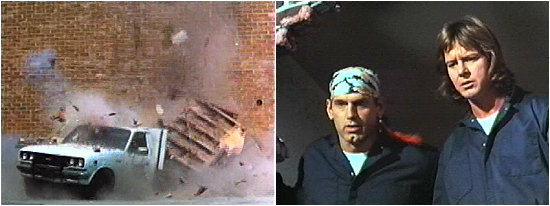


"Rick? I think we body-slammed the truck."


Things do get better, though.  As a result of foiling an armed robbery at a local grocery store (which oddly becomes a wrestling match, go figure.) the two decide to try their hand at becoming policemen.  And despite the best efforts of some people to get them run out of the academy, they do make it as officers. If that female police instructor looks familiar, just imagine her with pointed ears.  That's Robin Curtis who took over the Saavik role after Kirstie Alley refused to continue it on the Star Trek movies.

After graduation, the guys get assigned to their police duties and one of the first duties is to help guard an eyewitness to a mob hit on a couple of undercover cops.  (And, BTW, does that eyewitness looks familiar?  She was the college student that Bill Murray's Ray Venkman was hitting on in an an early scene in Ghostbusters.) 

 The guys are now "undercover cops" themselves.  But in the next scene Jesse is decked out in is usual wrestling attire, so maybe they are undercover as their former wrestling personas (which would seem to limit the possibilities of undercover work if you ask me.)


The safe house is invaded by none other than the two mob guys who committed the murder of the cops.  (Don't ask me to explain how they aren't under arrest, since the eyewitness is due to be in the courtroom the next day. Who is she going to finger anyway?)  Of couse, the whole point of the encounter is to allow the execution of another series of wrestling encounters, so why bother with plot points.  But after throwing them out the window, where they manage to escape, the eyewitness turns out to have booked too.

So they go looking for her and find her at the local animal shelter.  She had just told them how much she loved dogs, so where else would she be?  They grab her and take off for the courtroom where she is just shy of missing her opportunity to be the star eyewitness, but then the two mob guys show up again, and guess what, we get another wrestling show.

So what went wrong with this series pilot? Why didn't such a dynamic plot make it to at least one season of show status?  Well, according to some, it was because there was an internal battle between Disney, one of the backing companies, and another company that tied up a lot of legal mumbo-jumbo.  I actually read a couple of reviews that touted the show as being a victim that WOULD have been a great show.  But, seriously, can you watch the pilot and think the world missed out on a NCIS dynasty?

I'll let you decide for yourself.  Below is the pilot taken from a YouTube page. Watch it if you dare.


Thanks, and enjoy your day.

Quiggy


Friday, September 20, 2019

Make Room for Hannibal


This is my entry in the Siskel and Ebert Blogathon hosted by 18 Cinema Lane


The Gene Siskel and Roger Ebert phenomenon was at the very least a compelling tête-à-tête that appeared weekly on TV.  As early as the 1970's in various formats, the two would come on and discuss the current batch of releases in the theater, famously giving either a "thumbs up" or "thumbs down" rating for each movie.  Sometimes both would agree on the rating, but then at other times they would disagree.

In particular, as to the disagreement theme, was their view of The Silence of the Lambs.  While Siskel berated the movie for lack of compelling characters and the subject matter being a little too sensitive, Ebert actually liked the movie.


I wholeheartedly agree with Ebert's take.  Yes the movie does dip a little at the end, what with the "who's behind the next door" typical horror film trope, I feel, however, that both Jodie Foster and Anthony Hopkins deserved their gold statuettes from the Oscars.  Hopkins in particular is extremely memorable.  You'll probably never hear the word "liver" in the same way after viewing Hopkins tell of his encounter with a census taker.  (and BTW, just in case you didn't know, that "thhpthhpthhp" he utters at the end was improvised.  It wasn't in the script.  And yet his little slurping noise is probable the one most recognizable part of the entire film..)


Both Gene Siskel and Roger Ebert have gone on to do their reviews from "the other side" now.  Siskel passed away in 1999 and Ebert left us in 2013.


Silence of the Lambs (1991):

A serial killer is on the loose.  Known by the FBI as "Buffalo Bill", he has the habit of kidnapping young girls and cutting them up, removing certain body parts, primarily skin, before disposing of the bodies.

Clarice Starling (Jodie Foster), a young recruit, is given the task of interviewing Hannibal Lecter (Anthony Hopkins), a former psychiatrist who has been imprisoned because of his taste for human flesh and his propensity for killing his prey to quench his tastes.


The task is given to her by her superior and mentor Jack Crawford (Scott Glenn).  John Kenneth Muir, in his book Horror Films FAQ, suggests that Crawford is in essence a surrogate father to Clarice, since she lost her father at an early age.  He also suggests that on some level that Lecter is also somewhat of a surrogate father (sick as that may seem).


Clarice interviews Lecter, but Lecter gains the upper hand immediately, by demanding a tit for tat.  He will only talk about "Buffalo Bill" if Clarice reveals some intimate details of her own life.  The most intriguing part of this movie is that tête-à-tête, as Clarice delves into her own past and psyche in order to appease Lecter and get him to open up about his insight into the current case.

Lecter also manages to convince Clarice that a "reward" is appropriate for his insight; that is he will tell her things to help her if she can manage to get him a better arrangement within the prison.  Of course Clarice doesn't have that kind of pull, but her boss does.  But the  deal is hampered by Lecter's nemesis within the prison, the doctor/warden.  Dr. Chilton (Anthony Heald) is reluctant to give any concessions to his prisoner.  Chilton is a smarmy self-satisfied jackass, and despite the presence of Lecter and "Buffalo Bill" is probably the least appealing character in the movie.  (it's almost gratifying when his imminent end is hinted at in the ending of the film).


Through Lecter's help and some luck, eventually Clarice is able to track down "Buffalo Bill", although her luck may just run out, as the film descends into the "who's behind the next door" sequence hinted at above.

One must approach Silence of the Lambs with a bit of an open mind.  The fact is that Lecter is alternately disturbing and, at some times, even appealing as a villain.  One cannot watch this movie and expect that all will be right in the end, even if one is an optimistic idealist.  If you like your movies to be on the dark side, however, it can be a good experience.  But don't fool yourself into believing that it will be uplifting.

Well folks, time to head home.  Drive safely.

Quiggy


Friday, August 30, 2019

Strange Days in PA


This is my entry in the Alan Smithee Blogathon hosted by MovieMovieBlogBlogII


"Bloodsucking Pharaohs in Pittsburgh???!!  Are you serious, Quiggy?"

If you don't know me by now, that's what you're probably asking yourself.  Hell, even if you do know me, you may be asking that....

I thought it was high time to get back to the original intent of this blog, though.  That of highlighting the obscure, quirky or sometimes even downright insane movies that were the meat and potatoes of the drive-in movie theater in it's heyday.  Of course, this movie was made long after most drive-ins had been paved over to make way for condominiums, but it still has the essence of the themes intact.

Spoiler alert! of sorts.

There are no bloodsuckers in Bloodsucking Pharaohs in Pittsburgh.  There are no pharaohs in Bloodsucking Pharaohs in Pittsburgh.  It doesn't even take place in Pittsburgh... OK, so that part is not true.... it actually IS set in Pittsburgh...

This movie is one that requires more than just an "acquired taste".  (and if you know me, you know how much I dislike that phrase).  It requires a pretty jaded sense of movie style.  It was directed by Dean Tschetter who, after the snippers got through with the original cut, decided to use the Alan Smithee clause to credit the movie.

Alan Smithee, for those of you who don't know, is a legal loophole for directors.  It is used when the finished product is so far gone from the original, due to outside influences, that the director feels he has the right to remove his name from the credits.  After finishing watching the Smithee version, you may wonder just why it was deemed so far from the original.  It's pretty gory and bloody.  Well, apparently, Tschetter's version had way more blood and gore.

While not nearly as sick as, say, The Texas Chainsaw Massacre, or Saw, or The Evil Dead, it is pretty bloody.  It has the added effect that humor is used throughout, although you may be so disgusted by the gore you may miss some of the funnier parts.  (Just for example:  During one scene where the cops are investigating a murder the background music becomes very intense and loud, until one of the cops yells "Turn that stuff down!" at which point one of the cops turns off the radio in his cruiser [the source of the background music] . At least it was funny to me...)

A short background.  I think this movie was "straight to video".  I know I never saw an ad for it and I avidly read the counterculture magazine "The Austin Chronicle" which usually had ads for any movie that is currently showing (even if they don't review it).  I originally rented it on VHS from Hastings when they acquired a copy.  I don't think its even available on DVD.  But you can watch it on YouTube if this review piques your interest...

Most of the actors you probably will have never heard of.  With the exception of Veronica Hart (credited as Jane Esther Hamilton here), who was a fairly prolific porn star, most of them only had a handful of credits outside this movie.  The only name that is likely to trigger a memory is Tom Savini, a makeup artist who has his name in the credits of such movies as Creepshow.


Bloodsucking Pharaohs in Pittsburgh (1991):


(Note:  I'll spare you any graphic pictures from the film.  You'll thank me later.)

Detectives Sweeney Birdwell (Jake Dengel) and Joe Blocker (Joe Sharkey) are called to the scene of a bizarre murder.

Sweeney and the rest of the the police ridicule Joe because he has a weak stomach and has to step aside and puke every time he sees one of the victims (part of the aforementioned humor).  The murders have a bizarre twist as each one involves removing certain body parts (brains, intestines, etc.)

Part of the background is that Joe was a former detective in Las Vegas where a similar series of bizarre murders occurred.  And we learn that Joe knew each one of the victims there.  Apparently he is also familiar with the victims in the current series occurring in Pittsburgh.

The Las Vegas murders ended when Joe's partner shot the culprit (multiple times, another sick, but funny scene).  The victims in Las Vegas and the ones in Pittsburgh are all hookers, which says something about Joe, who comes off as rather misogynistic, due to the fact that his wife left him for another man back in Vegas.

Clues abound in the fact that the serial killer keeps leaving messages in Egyptian hieroglyphics on the bodies of the victims.  So Joe and Sweeney end up going to investigate in "Egypt town" (is there really an "Egypt town" in Pittsburgh?  Your guess is as good as mine.  But it may be another factor in the humor aspect of the film.)

The daughter of Joe's former partner, Deedee (Susann Fletcher) shows up trying to discover what has happened to her disappearing father as well as to help the two bumbling detectives solve the current series of murders.  Although she is treated as an inferior (mainly because she is a woman, and a meter maid, at that...) it turns out she knows a hell of a lot about what happened in Las Vegas and sees the parallels in the events in Pittsburgh.

A side attraction (and one of the best humor points) is Sweeney's wife, Irma (Beverley Penberthy) as she tries to quit smoking.  She goes to an aversion therapy session where she views videos of people smoking in a building, which is subsequently demolished, and a plane, which subsequently crashes.  This is followed by a alternately a bunch of guys in gorilla costumes bursting in to the room and soaking her with hoses or a group of guys with shock rods shocking the crap out of her.

Eventually we get down to the meat (no pun intended) of the matter; who is actually responsible for the killings.  (It won't be who you think...)

I don't recommend this movie to anyone who may be a little skittish to the scenes of blood and gore.  And it's not really all that great a movie even if you like this sort of stuff.  But it is a diversion from the typical fare I have been reviewing of late, and I certainly want to thank Steve for being so accommodating as to let me include it in his blogathon.

Drive safely, folks.

Quiggy 


Saturday, November 4, 2017

Food for Thought


This is my entry in the Food in Film Blogathon hosted by Speakeasy and Silver Screenings.


I often wonder what people think of me and how stable my mind must be... not that it would change anything if I did know... I just wonder...

I told Kristina and Ruth that I wanted to go a different and quirkier route with this topic, as is my wont on occasion.  Think of all the movies that have mouth-watering meals, excellent haute cuisine cooking and wonderful cooks standing over beaming patrons.  Is there anything more comforting than a well cooked and well served meal? Well... maybe if it's not too outré...


"Outré" is putting it mildly for the two movies discussed today.  You might want to think twice when you try that new restaurant down the street after hearing about these joints.  If you think twice about the turnover rate of stray cats near the Chinese place down the street, prepare to get really wary about the neighborhood mom and pop place next door.


I really enjoy black comedy.  Note:  if by "black" comedy your first thought is Richard Pryor and Eddie Murphy, you are in the wrong universe.  Black comedy, also dark comedy,  is a term used to describe a medium (films, but also plays and the like) that take very serious subjects and turn them into a darkly humorous form.  Also called "gallows humor", it was first coined in the 30's by a French writer to describe some of Johnathan Swift's writings.  Swift once wrote that poor Irish people ought to sell their children to the rich to be used as food.   But the term has also been applied to writings even as early as ancient Greek writer Aristophanes.


Eating Raoul (1982):

Paul (Paul Bartel) and Mary Bland (Mary Woronov) are a straight-laced couple living in abject denial of the sexual mores of their apartment.  The two are married, but other than a little hugging and kissing, they are not really sexually active.  (They sleep in separate beds...just like the old 50's sitcom married couples did).


Their neighbors , in fact seemingly the whole apartment building however, are really into the swinger scene, with all the different sexual styles and appetites that entails.  Paul works in a liquor store, but is the ultimate wine snob, and gets fired because he refuses to sell some cheap wine that the owner has in stock and also because he bought a case of $400 a bottle wine, but the clientele who frequent the shop haven't got that kind of spendable income.


Meanwhile on the home front, Paul and Mary want to buy a house in the country and open up their own home-style kitchen, but they haven't got the money that the realtor is asking, and to make matters worse, someone else keeps offering more money, causing them to have to keep upping their own offer for the place.

Paul comes home one day to find Mary being molested by a swinger who strayed from the party being held in their building and kills him with a frying pan.  Finding him with a large sum of money, they decide to ditch the body in the trash compactor and pocket the money.  After killing a second straying swinger, the two decide there is some decent money to be had doing this.


They decide to advertise in a swinger's magazine, with the help of Doris (Susan Saiger), a stay-at-home mom who makes money on the side as a dominatrix.


While out one day, Paul finds an ad for a locksmith who does cheap work.  Because wine snob Paul has a pretty decent collection of vintage wines they call Raoul Mendoza (Robert Beltran).  Raoul, it turns out, has ulterior motives for installing burglar systems...he also robs his clientele after installing their security systems.


As such, he happens to break into the Bland's place after they have just killed another swinger but have not yet disposed of the body.  The three come up with a plan that benefits all three.  The Blands will keep the money and Raoul takes the bodies away, where he sells them to a dog food company and shares the profits with the Blands.


All seemingly goes well until one day Paul is out when a "client" shows up, and tries to rape Mary.  Raoul happens to come in and strangles the would-be rapist.  He then proceeds to woo Mary who is charmed by his demeanor (and his Thai Stick cigarette...).  Although Paul does not know what went on, he begins to suspect, and with Doris, tries to scare Raoul into leaving the country.  None of these ruses works, and Raoul makes plans to get rid of Paul instead and take Mary for his wife.


Be sure to stay for the finale of this movie.  You'll get to see why it was titled "Eating Raoul"...


Delicatessen (1991):

It never really is clear what happened to society in this movie, but from the appearance of the landscape, there must have been a nuclear war.  In this post apocalyptic world in France, food is in short supply.  They use bags of lentils and corn in lieu of money.  In one apartment building, Clapet (Jean-Claude Dreyfus), a butcher, runs a shop on the bottom floor to cater to his clientele.  He sells them meat which, it becomes clear, is not your typical meat.


Clapet runs ads in the newspaper advertising for a handyman.  Once the unaware handymen have been fattened up, Clapet kills them and sells their "meat" as meat.  It seems most of the residents are in on the ruse.  For sure, his daughter, Julie (Marie-Laure Dougnac) knows.  She falls in love with the new hire, Louison (Dominique Pinon) and alternately tries to help him escape or convince her father to let him go.


The apartment building is filled with other equally bizarre characters.  The best is Aurore (Silvie Laguna), a woman who is haunted by voices she thinks are in her head and tries various Rube Goldbergesque ways of committing suicide.


Also funny are a guerilla group of outcasts who live below the city in the sewers and whom Julie entreats to help her get Louison out of her father's hands.  Of course, they botch the job and kidnap the wrong person.


A warning to the potential viewer, both of these movies are obviously not family friendly (unless you are very liberal about what you let your kids watch...)  Also the second film is entirely in French, so unless you are fluent in French, you'll have to deal with subtitles (always a potential problem with some viewers.)


Whew.  I'm getting hungry now.  There's a new place that just opened up across town that advertises the "best baby back ribs"... (or maybe it says "baby ribs"...I'm not sure.


Quiggy


Thursday, June 8, 2017

Cold (Space) Warrior


This is my entry for the Christopher Plummer Blogathon hosted by SeanMunger.com


It had to happen sooner or later.  In 1989, the big news was the fall of the Berlin Wall and the complete and utter chaos that followed after the Communist Russian government collapsed.  The Klingons of the Star Trek Universe had, for most of their first twenty years of existence, been a stand-in for the Russians.  Thus when the Communist Russian government fell, the Klingon government had to follow suit.

Several parallels to the current events at the time can be seen.  In 1986 a nuclear accident happened at the Chernobyl Nuclear Power Plant.  A similar disaster happens on the Klingon moon Praxis.  The Klingons in particular have to stand down from their aggressive military stance because their planet is dying as a result of their disaster.  Soviet Russia, too, had difficulties which made their own lifestyle as a nation collapse.

As I stated previously in my review of StarTrek II: The Wrath of Khan, my favorite Star Trek villain is Ricardo Montalban's portrayal of Khan Noonien Singh, but a close second is Christopher Plummer's portrayal of the renegade Klingon General Chang.  The fact that both of these movies were directed by Nicholas Meyer has a lot to do with it.  I personally feel that Meyer was able to draw out the story line much better than any of the other directors who attempted it.


Star Trek VI: The Undiscovered Country (1991)

At the beginning, Hikaru Sulu (George Takei), a former helmsman for the USS Enterprise and now the commander of his own vessel, the USS Excelsior, is on manuevers when they are hit by unexpected shock waves.  The shock waves resulted from an explosion on the Klingon moon, Praxis, the site of a key energy production facility for the Klingons.

The Klingons initiate a procedure to bring peace between the Federation and the Klingon Empire (because the Klingons can no longer apply the aggressive pressure they had previously exhibited... sounds familiar, doesn't it?)  The Klingons send an ambassador to Earth for negotiations, Gorkon (David Warner).  He is to be escorted by the Enterprise, which Kirk resents because as he says he has never forgiven them for the death of his son.

A note from your blogger:  In Star Trek III: The Search for Spock, a crew of Klingons led by the villainous Kruge (Christopher Lloyd) had engineered an attack on the Enterprise and its crew.  I won't go into more detail; that's for another post, but it must be pointed out that Kirk is not the ideal liberal paragon of virtue that Roddenberry envisioned in this movie.  And I totally agree with this idea. After all, Kirk exhibits a xeno-racism by blaming all Klingons for the actions of one, or a group if you accept that all of Kruge's crew were complicit in his actions.  Roddenberry himself made himself a PITA about the fact that his liberal idealistic future had been compromised by some of the xeno-racist things some of the characters say in this film.  In fact he had made a petition to the powers that be to stop the release of the movie, but died a few days later, so his petitions were not followed.

Gorkon and a few guests, including Gorkon's military guard, Chang (Christopher Plummer) come aboard the Enterprise for a dinner, after which the crew of the Enterprise express some remarks about the way the Klingons composed themselves at the dinner.  So obviously Kirk is not alone in his feelings towards the Klingons.

That night (there is night in space?), the Klingon ship is fired upon, ostensibly by the Enterprise, and the ship is damaged and many Klingons either hurt or killed.  The Enterprise crew is flabbergasted because they did not fire upon the Klingon ship.  Kirk and McCoy beam aboard to render what help they can, but McCoy, being unacquainted with Klingon biology, is unable to help and Gorkon dies.

Kirk and McCoy are arrested for the crime of murder by Chang and taken to the Klingon homeworld to stand trial.  They are defended eloquently by an unnamed Klingon defense attorney (played by Michael Dorn, and a theory runs through the Star Trek fanbase that he may have been Worf's grandfather, although he is not identified by name in the movie).  But the two are convicted and sent to the Klingon equivalent of Siberia.

Meanwhile, on the enterprise, Spock and crew try to find out what really happened in the attack on the Klingon ship.  To help aid in this they have to ignore or pretend to have communications problems when Starfleet tries to order them back to Starbase.  It takes a while but it is soon revealed that there  is at least a couple of traitors on board the Enterprise.  And they were working in conjunction with Chang, who as it turns out, is the ultimate cold warrior, kind of like General Jack D. Ripper in Dr. Strangelove.  Chang just could not face a future with no enemies (in this case Starfleet), and engineered the assassination of his own Klingon ambassador so as to restart the conflict.

While Plummer does not evince the mania or pure menace of Khan from the earlier Star Trek movie, he still manages to leave a mark on the viewing audience. And I absolutely love every time a Shakespearean, or other literary quote is used in the movie (of which there are several.  See how many you can identify).  One of the best lines in the movie is when one of the Klingons says you can't appreciate Shakespeare "until you've read him in the original Klingon"...:-D

Plummer has the neatest look of any Klingon ecer portrayed on film, too.  That's him in the banner at the head of this entry.  Who wouldn't want to go hang out at the bar with a cat who looks that menacing?  You could keep all the riff-raff away with just his look.

I haven't seen a whole hell of a lot of Plummer movies, mostly as the star or one of the stars of a few war movies.  (The Night of the Generals, Battle of Britain, Aces High, Waterloo).  I always enjoy him when he makes an appearance on screen though.  He is one of those few men that I think I could fall for if I had been born a woman, even in his older age.

Hope you enjoyed the tribute this time, kiddies.  Time to fire up the nacelles and head home.

Quiggy


Tuesday, January 17, 2017

Dumb and Dumber? Meet Stupid and Stupider


Before the meteoric rise of one of the most recognizable actors of the 90's and beyond, a virtually unknown actor was cast as a dimwitted high school metal head, teaming up with another virtually unknown actor in a buddy movie franchise that has spawned one sequel, and continuous rumors of another sequel in the works. That actor was...Alex Winter (who???)... I mean Keanu Reeves.

Both actors had been on the scene for a few years, but both were still fledgling artists in 1989.  Winter, for his part, was most prominently known as one of Keifer Sutherland's cohorts in The Lost Boys, and Reeves had a role in the teen drama River's Edge. This would prove to be the launching pad for Reeves as a box-office draw.  Unfortunately, Winter did not see the same success, at least not in the theater, but his career took a different tack, working mostly behind and in front of the TV camera.

The first Bill and Ted movie arrived in theaters in early 1989.  Pitted against such blockbusters of the year as Tim Burton's first Batman, Ghostbusters II, and Indiana Jones and the Last Crusade, the movie still managed to find an audience and made enough of a profit that a follow-up was green-lighted.  That movie too managed to garner a profit.  Over 20 years later, in 2011, a rumor began circulating, one which Reeves and Winter both acknowledged, that a third movie was in the works, to catch the two as they approached their 50's, but this has yet to come to fruition.

The Bill & Ted franchise concept was the brainchild of  Ed Solomon and Chris Matheson, and, as near as I can tell, with the exception of a couple of the later series episodes of Laverne and Shirley, neither had any writing credits to their name.  They seem to have hit at just the right time with this, however.  That happens in Hollywood, sometimes.  One or a group of people just hit on something that connects with people on a certain level.  I must admit, however, that the crowd that this one hit with was a good 10-15 years younger than I was at the time, but yet I still got a kick out of it, especially the first one.  And every time Poison's "Every Rose Has It's Thorn" comes on the radio, I find myself imitating the two vocalizing the lyrics as if they were profound quotes from a philosophical guru.


Bill & Ted's Excellent Adventure (1989)

In the future, 500 years from now, the world is a liberal's wet dream.  People live in peace and harmony.  And it's all because of two teenagers from 1988 who are the saviors of the planet through their music.  But it wouldn't be that way without the intervention of a future mentor, Rufus (George Carlin), who goes back in time in a time machine in the form of a telephone booth.  (Shades of Doctor Who!)

I should warn you at the beginning, if you approach this movie with any hope of having it adhere to the concept of time travel and its inherent potential for paradoxes, you are doomed to disappointment.  The film plays fast and loose with the scientic part of the theories.  (And there are some legitimate theories out there, even if the possibility has yet to be proven concretely).

In the present of 1988, Bill S. Preston, Esquire (Alex Winter) and Ted Theodore Logan (Keanu Reeves) are two brain dead slackers who are on the verge of failing history.  Their teacher, Mr. Ryan (Bernie Casey), tells them in no uncertain terms that they must get an A+ on their final exam, an oral presentation, if they are to have any hope of passing his course.

The two are approached by Rufus, who has come from the future to give them use of his time machine to help them pass history and thus save history as he knows it; a future in which the music of Wyld Stallions, their wannabe band, is actually a profound influence.  The two go back to France in the 1800's where they encounter Napoleon, and through an accident bring the French icon into the present.  Leaving Napoleon in the care of Ted's little brother and venture into the past where they abduct Billy the Kid and Socrates.  They also end up in medieval England where they fall in love with two princesses, the daughters of the king.

Seeking "extra credit", they venture back and get several more historical figures; Joan of Arc, Sigmund Freud, Ghengis Khan, Ludwig van Beethoven and Abraham Lincoln.  Bringing them to the present, they unleash them on the local mall, and try to track down Napoleon, whom Ted's brother ditched because he was too annoying.  The historical figure wreak havoc on the mall, and Napoleon, who has found his way to a water park called Waterloo is doing the same thing.

Finally gathering them all together, the two slackers manage to do a presentation at their history exam, which wows the assemblage.  Rufus congratulates them and presents them with the princess from the past as a present.  But they are still incompetent musicians.  One can only hope that they "do get better"  as Rufus promises to the audience, "breaking down the fourth wall", as it is known in the argot of film.


Bill & Ted's Bogus Journey (1991)

It is a couple of years later.  The boys and their girlfriends (the princess from medieval England) have formed a band.  But the boys are still losers and haven't got a clue, how to play their guitars or anything else for that matter.  Meanwhile, a renegade from the future, De Nomolos (Joss Ackland) has engineered a plan to change the future by killing Bill and Ted before they can be the influence they eventually become.  He commandeers his own time machine and sends two Bill and Ted look-alike robots to do the job.


The two robots (which Bill and Ted call the "evil robot usses"), kill Bill and Ted.  The two seek out a way to return to the real life.  Along the way they manage to garner the help of the Grim Reaper, who is obliged to help them because they manage to defeat him in a game (or games, since the Grim Reaper is a sore loser...)

On their "bogus" journey they end up in Hell, where they find that Hell is rather personal, each of them forced to endure their own personal nightmare.  Bill has a granny, (played by Alex Winter with tons of makeup), ugly as sin, that wants a kiss and Ted has to escape a military school leader who wants him to drop and give him infinity in pushups).  They eventually escape Hell and get to Heaven, where the big guy in charge gives them the services of the best scientists in the universe (a couple of aliens) to help them defeat the evil robot usses.

In a showdown at the "Battle of the Bands" (in which Wyld Stallions were to perform, don't ask how they managed that...), Bill and Ted and their creations,  the good robot usses, battle the evil robot usses to try and save the day.  Of course, if they defeat the evil robot usses they will still have to deal with De Nomolos who is flat out determined to change the future, at whatever cost.

One can only wonder what happens in the future that causes these two to become the prophets of peace and harmony, when it's obvious they probably couldn't even SPELL "peace and harmony" without a spell check.  But since this is just goofy Hollywood time-wasting, its probably better not to dwell on it.

Well, folks, the screen has just darkened and a phone booth has materialized in the parking lot, so your humble reviewer may be off on an adventure for himself.  Have a safe drive home.

Quiggy